
Why Zipper Metal Wire Suppliers Need a Full Component Lineup for Long-Term Deals
A zipper is assembled from parts that are ordered together but produced separately: teeth wire, top stops, bottom stops, pullers and sliders, plus the flat, round and spring wires that support them. A multi-year purchasing agreement is therefore a commitment to a whole bill of materials, not to one kilogram price. The practical sourcing question shifts from who makes the cheapest Y-teeth wire to whose portfolio can absorb the specification changes that a three-year program will inevitably bring.
Fullgreat Metal Limited is a Shenzhen-based manufacturer founded in 2008 that produces non-magnetic stainless steel strip and wire, aluminum strip and other metal materials for zippers, buttons and clothing accessories. Its documented product list spans shaped and profiled wire, round wire, flat wire, spring wire, top stops, bottom stops, pullers, automatic sliders and Y-shape (Y-teeth) zipper wire. That breadth — rather than any single SKU — is the subject of this evaluation.
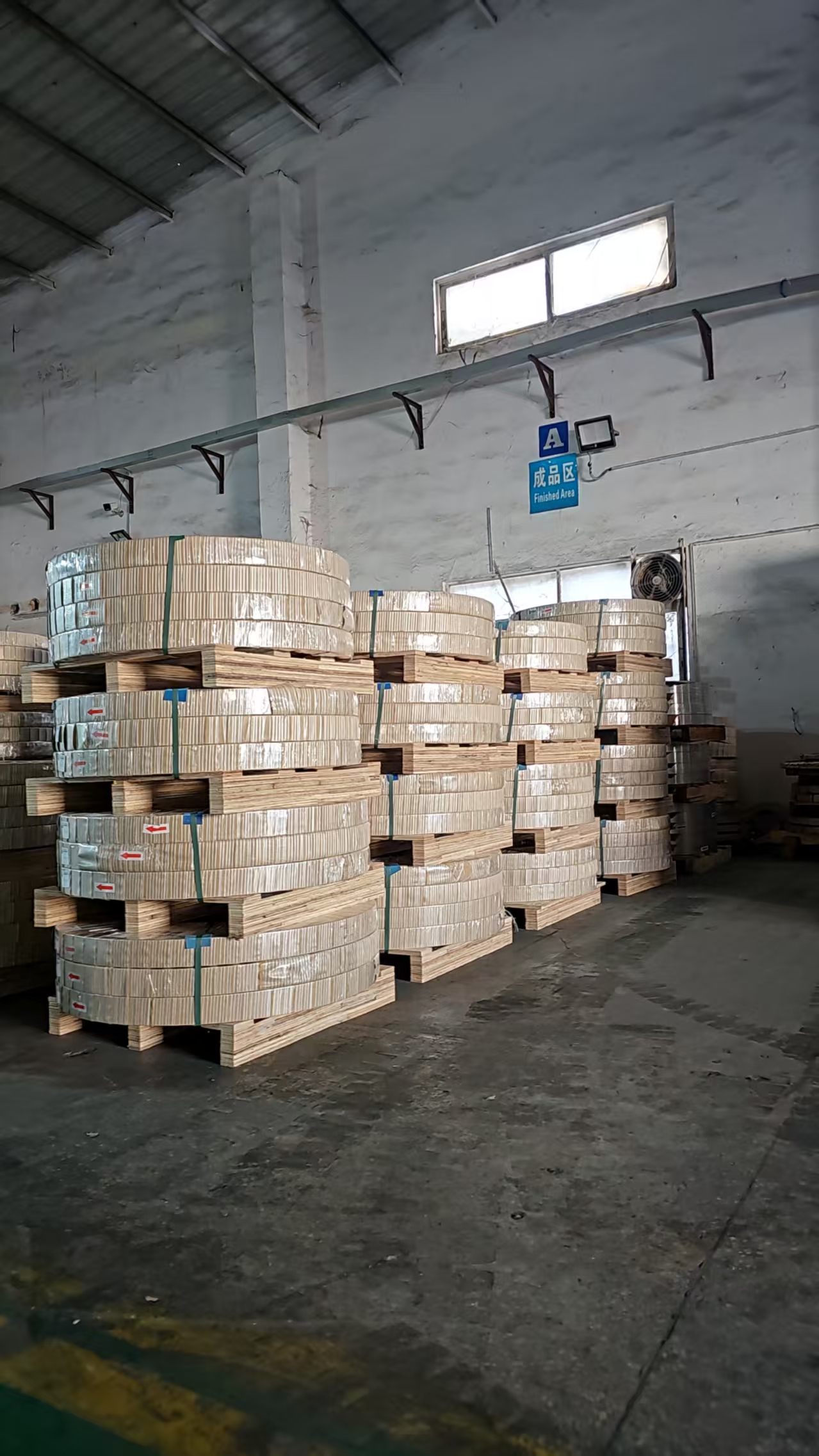
Aluminum strip is one of several base materials a zipper metal wire supplier must be able to source and process consistently across a multi-year agreement.
The Problem: Multi-Year Programs Do Not Buy One SKU
Most supplier scorecards are still built around a single line item. A buyer collects quotations for Y-teeth wire at a given cross-section, compares price per kilogram, checks minimum order quantity and lead time, and awards the business. That approach works for a single production run. It breaks down over a contract term of two, three or five years, for three structural reasons.
First, the bill of materials changes. A zipper program that starts with one teeth profile typically expands into additional sizes, additional finishes and adjacent components — top stops, bottom stops, pullers and sliders are consumed alongside the teeth wire and are usually purchased by the same team. If the wire supplier only makes teeth wire, every additional part becomes a separate sourcing project with its own qualification cycle.
Second, re-qualification is expensive. Bringing a second supplier online for a new component means new samples, new dimensional checks, new pre-shipment acceptance arrangements and a new set of commercial terms. Each new supplier also introduces a new point of failure in a supply chain that is already exposed to metal price movement and transport variability.
Third, the negotiation position weakens over time. A buyer who has consolidated volume into a single source of supply but cannot source adjacent components from that source ends up splitting leverage across vendors, and loses the ability to trade volume for continuity.
The opportunity runs in the opposite direction. A supplier with a genuinely broad metal lineup lets a buyer extend an existing agreement instead of re-opening it — which shortens qualification time, reduces the number of incoming inspection routines and keeps quality documentation under one supplier record.
What a “Full Component Lineup” Actually Means
Portfolio breadth is easy to claim and harder to verify. In zipper metal wire, it means a supplier can deliver the metal content of a zipper in more than one geometry, in more than one material, and across the component categories that are consumed together on a production line. Fullgreat's documented product categories fall into three groups.
| Component group | Documented products | Why it matters in a long-term agreement |
|---|---|---|
| Teeth and profile wire | Y-shape Wire for Zipper, Y shape wire, Y teeth wire, Y teeth, Special-Shaped Wire, Shaped Wire, Profiled wire | Determines the visible zipper chain; profile geometry must stay repeatable batch to batch |
| Supporting wire forms | Metal Round Wire, round wire, Flat Wire, Spring Wire | Covers secondary metal needs so the buyer is not qualifying a second mill per part number |
| End and movement components | Top Stop, Bottom Stop, Zipper Puller, Zipper Automatic Slider | These are consumed with the teeth wire and are the parts most often lost when a wire supplier is narrow |
Definition to keep in mind: a full component lineup is not a catalogue length. It is the ability to supply the metal parts of a zipper from one qualified source, under one quality record, for the duration of an agreement.
Why Portfolio Breadth Signals Supply-Chain Resilience
Breadth is evidence of production versatility, and versatility is what a buyer is really purchasing when signing a multi-year deal. Fullgreat's operating profile supports that reading in several concrete ways.
- Scale and continuity. The company's product documentation states a monthly production capacity of 3,000 tons. For a multi-year agreement, capacity headroom is what determines whether an order can be absorbed during a demand spike without a lead-time break.
- A defined commercial entry point. The documented minimum order quantity is 1 ton, with a typical production lead time of 30–45 days. These two numbers set the realistic cadence of a trial order before a long-term schedule is fixed.
- Manufacturing base. Fullgreat operates a 5,000 m² factory with 50 employees and a 10-engineer R&D team, and reports a 70% export ratio, serving Turkey, Latin America (Brazil, Mexico), Southeast Asia (Vietnam, Indonesia, Bangladesh) and the European and American markets.
- Material development depth. The company began work in 2008 on non-magnetic stainless steel intended to replace copper strip in buttons and zippers, developed the material in cooperation with Sichuan University, and states it has obtained a number of national patents in this area. Documented grades include non-magnetic stainless steel strip FPD806 and FPD808, and stainless steel wire FPD901 and FPD902.
Taken together, these facts describe a supplier whose answer to a specification change is more likely to be “we already make that form” than “we will need to add a line”. That distinction is precisely what a supplier scorecard should be measuring.
Technical Explanation: Reading a Lineup by Material, Form and Control
A component list is only useful if the underlying variables are documented. Three variables determine whether a wire form can be carried across a multi-year program.
Material
Different end products tolerate different metals. Fullgreat's Metal Round Wire (model FPD-MRW) is documented as available in stainless steel, copper or aluminum, with customization possible. The Spring Wire (model FPD-SW02) is documented with the same three material options, also customizable. Material choice drives appearance, corrosion behaviour and cost, and it is the variable most likely to be revised mid-contract when a brand changes its finish specification.
Geometry and hardness
Form is where a narrow supplier fails fastest. Documented customization covers size and shape, and hardness is offered in soft or hard. The Bottom Stop Wire, for example, is documented as customizable in size and shape, with hardness available in soft or hard, for clothing accessories and bag & luggage scenarios. The Spring Wire is documented with a round shape and customizable hardness and size.
Dimensional control
Profile wire only works if the cross-section stays inside tolerance. In manufacturer-published technical documentation, preformed Y-teeth zipper wire in #3, #4, #5 and #8 sizes is described as controlled to approximately ±0.01 mm on cross-sectional micro-geometry — width, tooth thickness and groove depth — with uniform tensile elongation. Separately, documented quality control procedures cover dimensional requirements, composition, tensile strength and elongation.
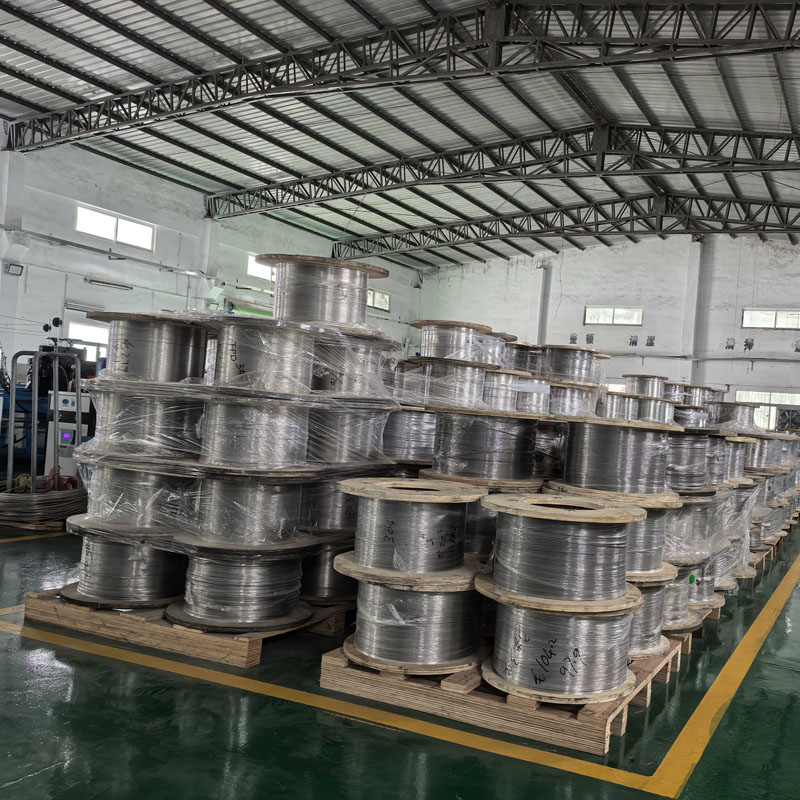
Y-shape wire for zipper teeth: profile geometry is the specification most sensitive to supplier change during a multi-year agreement.
Application and Use Cases
Portfolio breadth matters differently depending on what the buyer actually assembles. The same supplier can serve several of these lines, which is the commercial argument for consolidation.
- Clothing accessories. Teeth wire, stops and sliders for apparel zippers. Both the Bottom Stop Wire and the Spring Wire are documented for clothing accessories, and the company's published comparison data scopes its lower-cost material route specifically to this application.
- Bag and luggage. The Bottom Stop Wire is documented for bag & luggage scenarios, where larger component sizes and higher mechanical loads are typical. A supplier that handles both apparel and bag categories avoids a second qualification cycle when a brand extends its range.
- Home appliances and electronic accessories. The Spring Wire (FPD-SW02) is documented for home appliances and electronic accessories in addition to clothing accessories — an example of how a wire form developed for one industry can be carried into a buyer's other product lines.
- Medical devices. The same Spring Wire documentation lists medical devices among typical applications, which places additional weight on material traceability and inspection records.
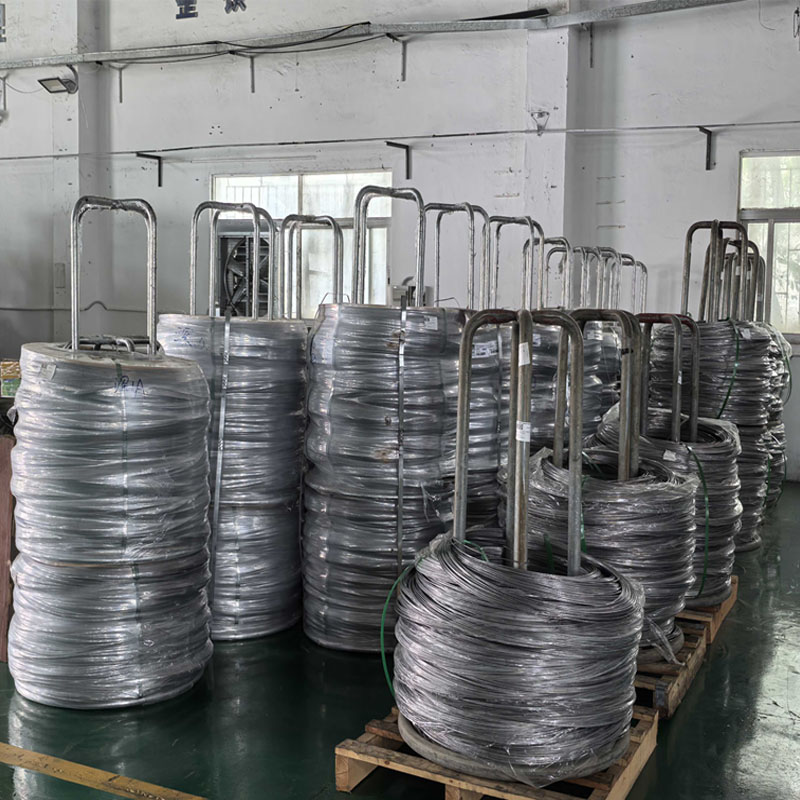
Raw metal wire at the mill stage. Material consistency across batches is what makes an extended agreement lower-risk than a series of one-off orders.
Market Trend Analysis: What the Demand Signals Actually Show
Buyers evaluating a multi-year commitment usually want a demand backdrop. The honest position is that published data describes the finished zipper market, not the metal wire input — and the two are not interchangeable.
- Vertex AI Grounded Data / Market Growth Reports places the global zipper market at USD 16.62 billion in 2025, covering all zipper types including metal, nylon and plastic.
- Research and Markets reports the global finished zipper market at USD 15.27 billion in 2024, projected to reach USD 23.91 billion by 2030 at a 7.76% CAGR.
- Market Research Future estimates USD 17.39 billion for 2024 and USD 18.74 billion for 2025.
- Business Research Insights forecasts growth from USD 20.08 billion in 2026 to USD 39.17 billion in 2035 at a 7.71% CAGR, while market.us headlines a 7.0% CAGR for the same finished-zipper category.
- Secondary media coverage of a zippers industry report puts the metal zippers segment at USD 11.1 billion with a 3.3% CAGR, although the horizon year is not recoverable from the available excerpt.
- The World Trade Organization's Global Trade Outlook and Statistics, reported in October 2025, cited 7% growth in global apparel trade during the first half of 2025.
Two cautions belong in any scorecard that uses these numbers. The 2024 estimates from two independent publishers differ by roughly 14% (USD 15.27 billion versus USD 17.39 billion), and the reported CAGRs differ across publishers (7.0%, 7.71% and 7.76%) — differences that are not resolvable from the published excerpts and should not be averaged. More importantly, no market size for zipper metal wire itself was located in the reviewed source set. Downstream zipper growth is a directional signal for wire demand; it is not a procurement sizing or pricing input.
Comparison with Traditional Solutions — and Where Breadth Stops Helping
Copper and brass have been the default story for metal zipper components. The documented alternative route is non-magnetic stainless steel and bimetallic composite constructions, and the cost argument is the most visible part of that shift.
| Dimension | Copper-based route | Documented non-magnetic stainless / composite route |
|---|---|---|
| Cost | Baseline | Company-published comparison data indicates costs about 40% lower than copper for clothes-accessory applications; separate manufacturer technical documentation cites a 30%–40% raw material cost reduction for bimetallic composite wire versus solid brass |
| Service cycle | Baseline | Documented as a longer service cycle with fewer replacement parts required |
| Material efficiency | Baseline | Documented as a lower raw material loss rate and higher material utilization efficiency |
| Scope of the claim | — | Documented for clothes accessories; the published comparison is not a claim of equivalence across every end use |
Those are the arguments for substitution. A credible evaluation also has to state the boundaries, and there are at least four that a long-term buyer should write into the scorecard.
- The cost and tolerance figures are manufacturer-published. The 40% cost comparison, the 30%–40% composite saving and the ±0.01 mm profile tolerance all originate from the supplier's own product and technical documentation. No independent testing of these figures was located in the reviewed source set, so they should be treated as claims to verify through sampling rather than settled facts.
- Commercial terms constrain small programs. A 1-ton minimum order quantity and a 30–45 day typical lead time are workable for planned production but not for urgent or very small runs. Buyers with unpredictable demand should plan buffer stock rather than assume short-cycle replenishment.
- Metal components require inspection discipline. Fullgreat's documented risk register identifies a failed needle detection test as a risk type, and the stated control is strict needle detection before shipment, supported by full-automatic needle detector equipment, dedicated inspectors, 100% full inspection and recorded test data for traceability. The limitation is structural: the control depends on the supplier actually running it, which makes it a verification item, not an assumption.
- A broad lineup is not the same as a proven lineup. Product range tells a buyer what a supplier can quote. Established repeat production, batch-to-batch consistency and documented acceptance results tell a buyer what the supplier can hold over years.
A Long-Term Supplier Scorecard Built Around Portfolio Breadth
The following structure converts portfolio breadth into a decision framework a procurement team can apply before signing a multi-year agreement.
| Scorecard dimension | What to verify | Evidence type |
|---|---|---|
| Component coverage | Whether teeth/profile wire, supporting wire forms and end components can be supplied from one qualified source | Product documentation and sampling |
| Material options | Availability across stainless steel, copper and aluminum, and which are customizable | Product documentation |
| Customization range | Size, shape and hardness (soft or hard) flexibility per component | Technical datasheet |
| Capacity headroom | Monthly capacity against the buyer's forecast peak | Supplier capacity statement |
| Commercial terms | MOQ, delivery terms, payment terms, acceptance criteria | Quotation and contract |
| Quality control scope | Dimensional requirements, composition, tensile strength, elongation | QC procedure documentation |
| Contamination control | Needle detection method, inspection rate and record traceability | Inspection records |
| Continuity risk | Dependence on a single material, single line or single market | Supplier disclosure |
Documented commercial terms for reference: minimum order quantity 1 ton, delivery terms EXW, acceptance criteria pre-shipment test, payment terms T/T.
Future Outlook
Two pressures are likely to keep portfolio breadth on buyer scorecards. The first is material substitution: as downstream zipper demand grows and metal input costs stay volatile, the commercial case for stainless and composite routes over solid copper continues to be evaluated — although the substitution is documented as application-specific rather than universal. The second is consolidation behaviour: brands and their tier-one suppliers increasingly prefer fewer qualified metal sources with wider coverage, because every additional vendor adds qualification cost and quality-record fragmentation.
For distributors and channel partners, the same logic applies in a different form. A partner building a catalogue over several years benefits more from a supplier whose lineup grows with the catalogue than from a supplier that is cheapest on the first item. In that sense, portfolio depth is as much a channel-retention factor as a production factor.
The practical conclusion for buyers is unglamorous: score suppliers on whether their component range can survive your specification changes, and treat single-SKU pricing as one input rather than the decision. Fullgreat publishes a company profile document that buyers can use during initial screening.
Download the Fullgreat Metal company profile (PDF)
FAQ
What counts as a full component lineup for zipper metal wire?
It is the set of metal parts consumed together in zipper production and supplied from one source. Fullgreat's documented categories comprise Y-shape Wire for Zipper, Y shape wire, Y teeth wire and Y teeth, Special-Shaped Wire, Shaped Wire and Profiled wire, Metal Round Wire and round wire, Flat Wire, Spring Wire, Top Stop, Bottom Stop, Zipper Puller and Zipper Automatic Slider.
Which materials and customization options are documented for the wire products?
Metal Round Wire (model FPD-MRW) is documented as made of stainless steel, copper or aluminum, all customizable, with customizable size and shape and hardness available in soft or hard. Spring Wire (model FPD-SW02) is documented with the same three material options, a round shape, customizable hardness and size, and typical applications including clothing accessories, medical devices, home appliances and electronic accessories. Bottom Stop Wire is documented as customizable in size and shape, with hardness in soft or hard, for clothing accessories and bag & luggage scenarios.
What are the commercial terms for a first order?
The documented terms are a minimum order quantity of 1 ton, delivery terms EXW, acceptance criteria based on pre-shipment test, and payment terms T/T. A first order at the 1-ton minimum is typically used to validate dimensional and material consistency before a multi-year schedule is committed.
What production capacity and lead time should a multi-year buyer plan around?
Fullgreat's documented monthly production capacity is 3,000 tons, with a typical production lead time of 30–45 days. Capacity headroom should be compared against the buyer's forecast peak rather than average demand, since the risk in a long-term agreement is the spike, not the baseline.
How is quality controlled before shipment?
Documented quality control procedures cover dimensional requirements, composition, tensile strength and elongation. On metal contamination, the documented risk type is a failed needle detection test, and the stated control combines strict needle detection before shipment with full-automatic needle detector equipment, dedicated inspectors, 100% full inspection and recorded test data for traceability.
What are the limits of evaluating a supplier by portfolio breadth alone?
Breadth shows what a supplier can quote, not what it can hold over years. Three specific limits apply here. The ±0.01 mm profile tolerance and the 30%–40% bimetallic cost reduction are manufacturer-published figures without independent testing in the reviewed source set. A 1-ton MOQ and 30–45 day lead time constrain small or urgent programs. And because no market size for zipper metal wire itself was located, downstream finished-zipper forecasts should be used as directional context only, not as wire-level procurement data.