
Will Your China–India Air Freight Supplier Last Three Years?
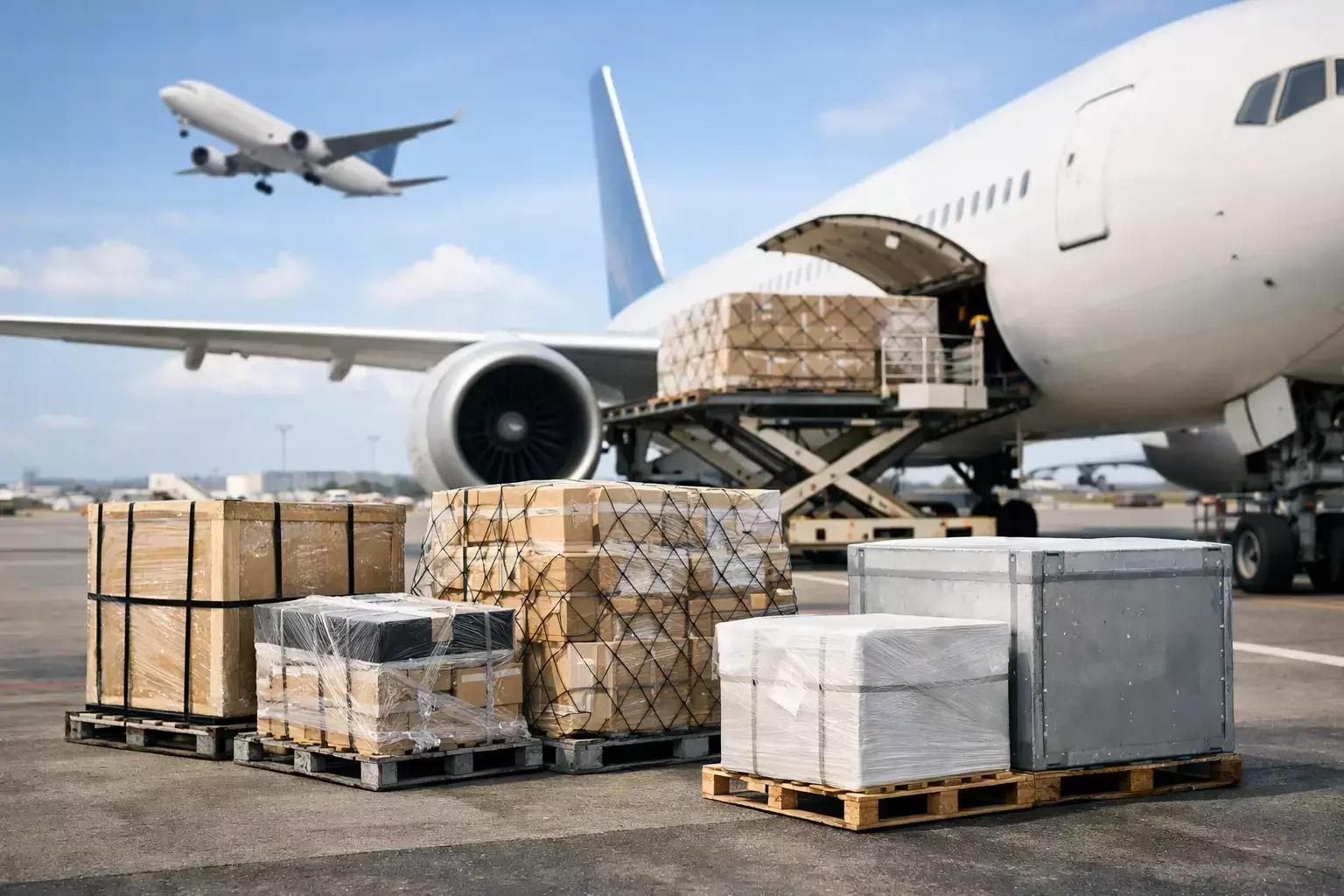
Airport-to-airport air freight is easy to buy once. Holding the same service level across several contract years depends on capacity, process and compliance continuity.
Airport-to-airport air freight between China and India is easy to buy once and much harder to buy repeatedly. A single booking can be sourced from almost any forwarder with a rate desk. Holding the same service level across twelve or twenty-four months — through peak-season space shortages, airline schedule changes and shifting Indian customs practice — depends on a narrower set of supplier attributes: controlled consolidation capacity, documented process discipline, verifiable compliance paperwork, and a reporting rhythm the buyer can audit.
This article sets out a long-term supplier sustainability evaluation framework for that second question. It treats sustainability as an operational property that can be inspected rather than as a promotional claim, and it uses the published operating data of one China-side provider — JTUO Logistics Co., Ltd. — as a worked example of the kind of evidence a buyer should be able to obtain before signing a twelve-month arrangement.
Scope first: what airport-to-airport actually covers
On the China–India lane, airport-to-airport air freight assigns the supplier responsibility for the China-side leg only. In a typical arrangement that means space allocation and booking, warehouse receiving and consolidation, cargo preparation and palletizing, export declaration, air waybill (AWB) issuance and airport handover. Responsibility transfers at the destination airport.
This boundary matters for evaluation because it determines which risks the supplier is actually accountable for. India-side import clearance and last-mile delivery sit outside airport-to-airport scope; importers and their customs brokers handle them. JTUO Logistics states the boundary explicitly — its service scope excludes customs clearance within India and last-mile delivery to warehouse or door. A supplier that does not define this line clearly is hard to hold to service levels later, because every delay becomes arguable.
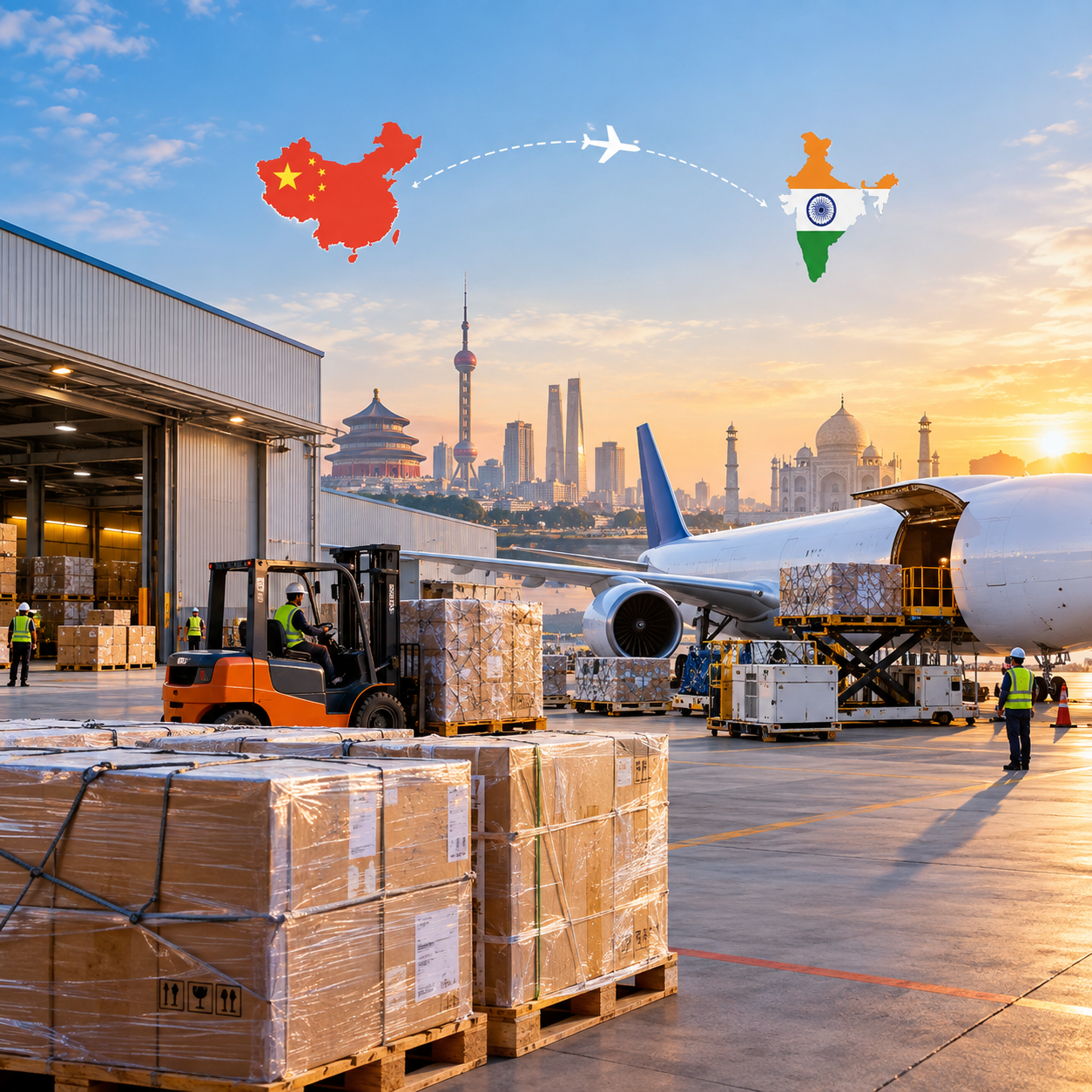
The China–India air freight corridor: consolidated cargo moves from China-side warehouses to Indian gateway airports, where airport-to-airport scope ends.
The durability problem behind the rate sheet
Three structural features of the China–India air cargo market make long-term evaluation more important than short-term price comparison.
Volume is growing, but it is concentrated. India's air cargo market reached 3.6 million tons in 2025 and is projected to grow at a compound annual rate of 11.38% through 2034, according to commercial research published by IMARC Group. Industry reporting indicates that Delhi (DEL) and Mumbai (BOM) handle approximately 60% of India's international air cargo volumes — which means competition for space concentrates on a small number of gateways rather than spreading evenly across the country.
Demand rests on a large, established trade base. Bilateral trade between China and India surpassed USD 155 billion in 2025, according to trade press reporting. A flow of that size does not disappear in a soft quarter; it moves between routings and between providers.
Prices move faster than contracts. Commercial rate reporting for October 2026 placed China–New Delhi air freight near USD 4.6 per kilogram, with month-on-month movement reported at roughly one third. Whatever the exact figure is in any given week, the pattern is the point: a quotation is a snapshot, and a relationship renegotiated from zero every quarter carries real administrative cost.
The consequence for buyers is that rate comparison answers "what does this shipment cost?" but not "will this shipment move in the last week of November, and will the same people handle it?" Sustainability evaluation exists to answer the second question.
Four continuities that define a sustainable supplier
In procurement terms, a sustainable China–India airport-to-airport air freight supplier is one that can maintain four continuities at the same time. Each is separately testable.
- Capacity continuity. Access to space that survives demand spikes — through block space agreements or equivalent allocation rather than spot purchasing only.
- Process continuity. The same handling sequence from inquiry to AWB, applied consistently regardless of shipment volume or staffing.
- Compliance continuity. Documentation and licensing that hold up under audit and adapt when Chinese or Indian procedure changes.
- Commercial continuity. Reporting and communication cadence good enough that both parties can plan, and that renewal decisions rest on data rather than impressions.
A supplier strong on one continuity and weak on the others is a partial solution. Deep warehouse capability without airline access delays cargo at the airport; strong airline access without warehouse control loses cargo inside consolidation.
A six-criterion evaluation framework
The table below converts the four continuities into criteria a buyer can score during an RFI, using evidence rather than assurances.
| Criterion | What to request | What it predicts |
|---|---|---|
| Controlled capacity | Block space agreement terms, contracted carrier relationships, monthly allocation expressed in chargeable weight rather than shipment count | Whether space can be re-obtained during peak season at a predictable cost |
| Consolidation control | Owned or directly managed warehouse area, receiving and palletizing process, handling report format | Whether multi-supplier cargo can be grouped without loss, damage or traceability gaps |
| Process documentation | Written workflow from inquiry to AWB, standard deliverable set, escalation path | Whether performance depends on individuals or on a system |
| Compliance file | Air freight forwarding license, warehouse operation and safety certification, logistics service compliance qualification, plus clarity on which party files Indian import documents | Whether the relationship survives audit, customs queries and procedural change |
| Reporting cadence | Monthly operational report content, named account manager, response-time expectation | Whether problems surface as data or as surprises |
| Scope clarity | Written statement of inclusions and exclusions | Whether responsibility can be assigned when something goes wrong |
Reading operating scale as evidence, not as a headline
JTUO Logistics Co., Ltd. is a Guangzhou-based China–India air freight specialist whose core business is China–India air cargo booking, supported by in-house warehouse consolidation and airport delivery coordination. Its published operating data illustrates the kind of evidence a buyer should be able to examine.
- Physical footprint. A 2,000 square metre warehouse alongside a 200 square metre office in Guangzhou. Warehouse area is the binding constraint on how much cargo can be received, consolidated and staged before a flight, so this figure is more informative than a fleet count.
- People. A core team of more than 30, including over 10 at the Guangzhou branch and a warehousing team of over 20 — a warehouse-weighted headcount, which is what peak throughput depends on.
- Annual capacity. 5,000+ tons moved by air and 30,000+ CBM moved by sea per year. The sea figure is not directly relevant to an air decision, but it indicates that the company operates as a forwarder rather than as a single-mode broker.
- Route concentration. India is the main market, and export business accounts for 80% of total sales. Concentration cuts both ways: it signals genuine lane specialisation, and it means the supplier's own business depends on getting this corridor right.
- Capacity sourcing model. The company describes long-term partnerships with airline resource holders, supplying space through block space agreements and consolidated cargo allocation, with service types including air cargo space allocation, blocked space service, and air freight consolidation and distribution.
None of these figures proves service quality on its own. What they do is establish whether the physical and organisational basis for continuity exists — which is the first filter, not the last.
Process discipline: from inquiry to AWB
The second filter is whether the supplier can describe, in sequence, what happens to a shipment. A supplier that improvises at each step produces different results at different volumes.
| Stage | Activity | Evidence to request |
|---|---|---|
| 1. Inquiry | Rate and routing request, cargo profile, destination airport | Quote template with chargeable weight basis stated |
| 2. Order confirmation | Booking acceptance, service scope reconfirmed | Written confirmation referencing inclusions and exclusions |
| 3. Space allocation | Space locked with carrier under block or general allocation | Space confirmation document; flight schedule |
| 4. Warehouse receipt | Cargo received, counted, checked against packing list | Receiving record; consolidation and warehouse handling report |
| 5. Consolidation | Grouping, palletizing, labelling for onward handling | Handling report with weights and dimensions |
| 6. Export declaration | China-side export formalities | Declaration reference linked to the shipment |
| 7. AWB issuance | Air waybill issued and shared | AWB details; booking and allocation confirmation records |
| 8. Departure and arrival notice | Flight departure, arrival notification at the Indian airport | Departure confirmation; arrival notice |
JTUO describes this chain as a standardised workflow with real-time airline coordination: client inquiry, order confirmation, space allocation and booking, warehouse receipt, consolidation processing, export declaration, AWB issuance, flight departure and arrival notification at the Indian airport. Its stated deliverables are an air cargo space confirmation document, flight schedule and AWB details, a block space agreement where contracted capacity applies, a cargo consolidation and warehouse handling report, and booking and allocation confirmation records.
For an evaluator, the useful test is not whether the chain exists on a slide but whether the supplier can produce these five documents for a real shipment from the previous month. Documented deliverables are the difference between a process and a promise.
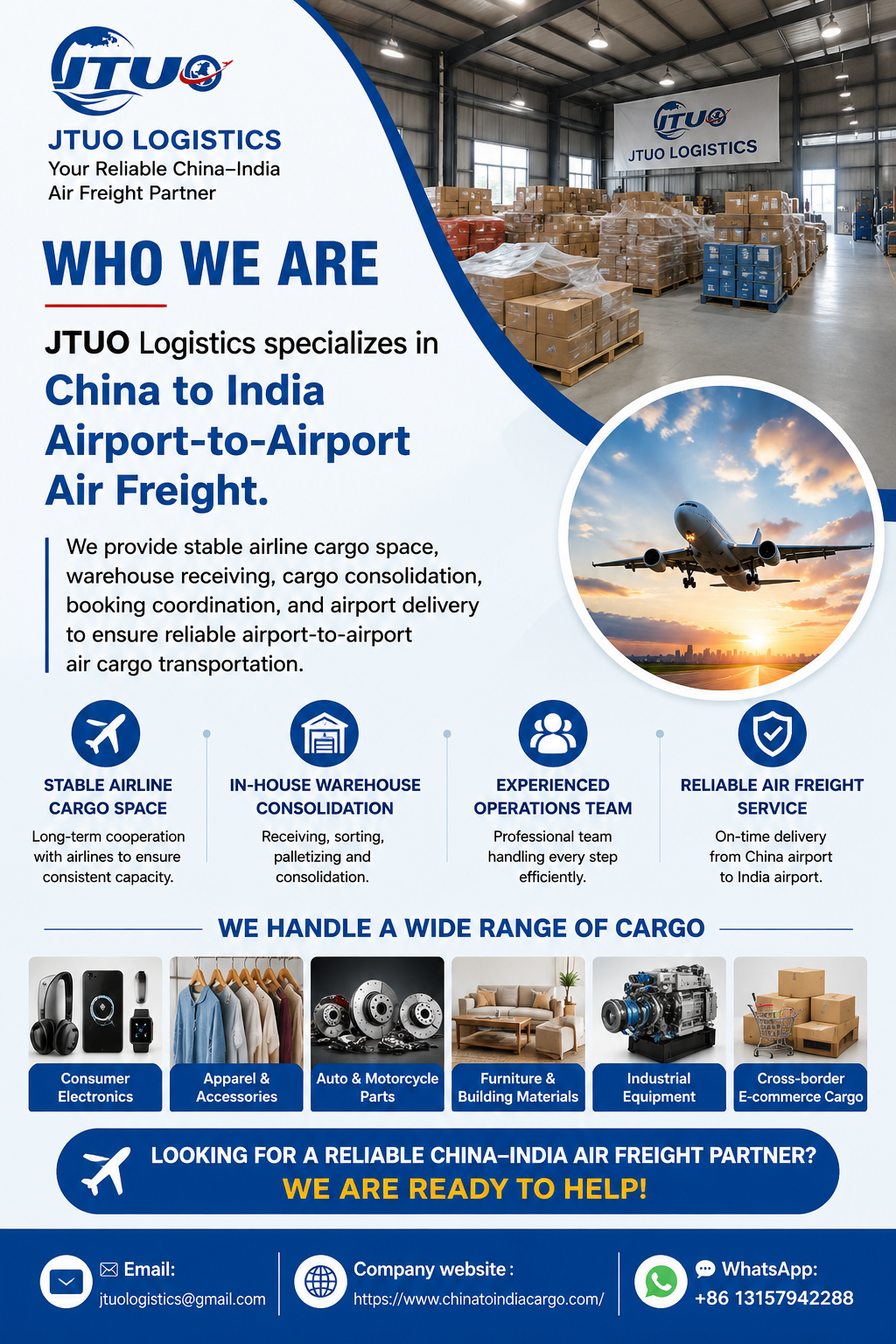
The China-side service chain an evaluator should be able to trace: space booking, warehouse receiving and consolidation, cargo preparation, export declaration and airport handover.
Transit time: the number and the variance
JTUO states a typical China–India air shipping transit time of 3–7 days, counted from warehouse receipt rather than from the inquiry date, and notes that the figure depends on warehouse intake timing, flight availability and the consolidation schedule. Industry reporting places standard China–India air freight transit at 3–8 days.
Both ranges describe the same lane. The evaluation point is that transit time is a distribution, not a constant. Buyers should ask where the clock starts — warehouse receipt or flight departure — and how delay causes are recorded, because a supplier that measures from departure will always appear faster than one that measures from receiving.
Reporting cadence: the monthly operational review
Long-term relationships fail quietly, through problems that were visible internally but never surfaced to the buyer. A monthly operational optimization report is one of the cheapest structural safeguards available, and it is easy to specify in a contract.
A useful monthly report covers three things: space utilisation against allocation, consolidation performance including how cargo was grouped and where handling time was lost, and delay causes classified by type rather than listed as exceptions. The value is cumulative — twelve months of cause codes tell a buyer more about a supplier than any single on-time percentage.
Communication structure should match. JTUO works through dedicated account management and supports Email, WhatsApp, WeChat, Facebook and LinkedIn, in English and Chinese. For buyers, two specifics are worth confirming in writing: who the named account manager is, and what response time applies to space requests during peak season.
Compliance continuity across two jurisdictions
China-side indicators
Three credentials are commonly used as compliance indicators in supplier assessment: the Air Freight Forwarding License, the Warehouse Operation and Safety Management Certification, and the Logistics Service Compliance Qualification. Read them as a baseline rather than a differentiator — they indicate that the entity is licensed to forward freight, that its warehouse is managed to a safety standard, and that its service operations have been assessed against a compliance framework. Ask for copies with validity dates rather than accepting a list.
India-side requirements sit with the importer
Indian procedure places several obligations on the importer and its broker, and a China-side supplier cannot absorb them. The Importer-Exporter Code issued by DGFT is mandatory for air cargo imports into India, and airport imports require an electronic Bill of Entry filed through ICEGATE or the relevant service centre. Where a Bill of Entry is filed before aircraft arrival, the Mumbai customs procedure states that the filing is valid if the aircraft arrives within 30 days.
Transshipment adds its own documentation layer: the carrier or console agent must file an application for transshipment, with the destination airport indicated in the house air waybill. For airport-to-airport buyers routing beyond the first Indian gateway, this becomes a supplier-capability question — not because the China-side forwarder files the Indian application, but because HAWB accuracy is set at origin.
The practical evaluation step is a responsibility matrix: for each document in the chain, state who prepares it, who files it and who pays for errors. Suppliers that can complete that matrix without hesitation are usually the ones that have handled a discrepancy before.
Where the integrated model fits — and where it does not
The space-plus-warehouse model is not universally appropriate. It earns its place in four recurring situations.
- Pre-peak capacity locking. Buyers who know their Q4 volume before the market tightens can reserve space under a block arrangement rather than competing for it weekly.
- Multi-supplier consolidation. When cargo originates from several Chinese suppliers, a consolidation warehouse converts multiple pickup points into one airport tender with a single handling report.
- Urgent large-volume shipments. Volume that exceeds spot availability is better served by a supplier with contracted allocation than by several small bookings.
- Sectors with mixed carton profiles. Consumer electronics, apparel, industrial components, hardware tools, lighting and electrical products, household goods and similar categories all benefit from grouping before departure.
It fits less well when the buyer needs a single contract covering Indian customs brokerage and door delivery, when volumes are too small to justify consolidation, or when the cargo requires handling regimes the supplier has not evidenced — temperature-controlled pharmaceutical cargo being the obvious example.
Integrated space-and-warehouse model versus fragmented sourcing
| Dimension | Fragmented sourcing (multiple forwarders, third-party warehouses) | Integrated space-and-warehouse model |
|---|---|---|
| Space sourcing | Piecemeal booking; availability re-tested each cycle | Block space agreement plus general allocation, planned in advance |
| Cargo handling | Multiple handovers between warehouses | Single receiving, consolidation and palletizing point |
| Communication layers | Several intermediaries between buyer and carrier | One operational counterparty on the China side |
| Peak-season behaviour | Priority determined by booking order | Priority determined by allocation agreement |
| Reporting | Fragmented or exception-only | Consolidated handling report plus monthly review |
| Accountability | Diffused across parties | Concentrated on one supplier for the China leg |
The integrated model has real boundaries, and a credible supplier should state them.
- It stops at the Indian airport. Customs clearance within India and last-mile delivery are outside scope, so buyers still need an Indian broker and delivery partner.
- Allocation is not an absolute guarantee. Block space improves access during peak season; it does not remove airline schedule changes, weather disruption or capacity withdrawal.
- Annual capacity figures are aggregates. 5,000+ tons per year describes total throughput, not a commitment of space on any specific flight.
- Corporate age is short. JTUO Logistics was established in 2025, so buyers weighing a multi-year agreement should substitute operational evidence — warehouse records, handling reports, documented workflows — for institutional track record, and should build review points into the first contract year.
- Mode breadth is not depth. The company also moves 30,000+ CBM by sea annually, but a sea capability does not substitute for air capacity when a shipment must fly.
Market trend: growth concentrated in fewer gateways
Three trends will shape supplier evaluation over the next several years.
First, volume growth is structural rather than cyclical. A projected 11.38% compound annual growth rate through 2034 implies that India's air cargo market roughly doubles in size within a decade — and space at Delhi and Mumbai, which already handle around 60% of international volumes, will absorb much of the pressure.
Second, procurement is shifting from rate per kilogram to service-level terms. As rates move month to month, price comparison produces noise more often than insight; what differentiates suppliers is the ability to hold a schedule and explain deviations.
Third, documentation discipline is becoming a competitive attribute. Indian customs procedure is procedural by design — pre-arrival filing windows, transshipment applications, HAWB destination accuracy — and each step rewards suppliers that treat documentation as an operational function rather than an administrative afterthought.
Future outlook
For buyers, the practical implication is that supplier selection will increasingly resemble a capability audit rather than price shopping. The questions that will matter are already visible: how much space is contracted rather than hoped for, how quickly a deviation is explained, and whether the supplier's paperwork survives a change in procedure.
For suppliers, the implication runs the other way. Publishing operating data — warehouse area, team composition, annual capacity, deliverable lists, reporting cadence — is now a procurement requirement rather than a marketing choice, because those are the inputs a buyer can actually score.
A twelve-month air freight agreement on the China–India lane is not a bet on rates. It is a bet that the same consolidation floor, the same documentation standard and the same reporting discipline will still be there in month twelve. That is what makes the evaluation worth doing before signature rather than after the first rolled shipment.
Frequently asked questions
What does supplier sustainability mean in China–India airport-to-airport air freight?
It refers to a supplier's ability to maintain capacity, process, compliance and reporting standards over the life of a contract, not merely to quote competitively for one shipment. The concept is operational: it can be assessed through warehouse area, contracted space arrangements, documented workflows, licenses and reporting cadence.
How much annual air capacity should a China–India air freight supplier have?
There is no universal threshold, because what matters is capacity relative to the buyer's own volume and its concentration in peak months. As a reference point, JTUO Logistics reports 5,000+ tons of annual air capacity supported by a 2,000 square metre consolidation warehouse in Guangzhou. Buyers should ask for allocation expressed in chargeable weight per month rather than annual totals.
Which certifications should a China–India air freight supplier hold?
Commonly used compliance indicators include the Air Freight Forwarding License, the Warehouse Operation and Safety Management Certification, and the Logistics Service Compliance Qualification. These are a baseline, not a differentiator. Indian import requirements — the Importer-Exporter Code and the electronic Bill of Entry — are the importer's responsibility and should be confirmed separately.
What should a monthly operational report from an air freight supplier contain?
Three elements are essential: space utilisation against allocation, consolidation performance including handling time and grouping results, and delay causes classified by type. The purpose is to convert operational experience into a record that supports renewal decisions and identifies recurring bottlenecks.
Does airport-to-airport air freight include customs clearance in India?
No. Airport-to-airport scope ends at the destination airport, so import clearance within India and last-mile delivery are handled by the importer or its customs broker. This boundary should be written into the service agreement, since unclear scope is a common source of disputes over delay responsibility.
How long does China–India airport-to-airport air freight take?
JTUO states a typical transit time of 3–7 days measured from warehouse receipt, depending on warehouse intake timing, flight availability and consolidation schedule. Industry reporting places standard China–India air transit at 3–8 days. Buyers should confirm whether the quoted clock starts at receiving or at departure.
How should buyers compare a long-term contract with spot booking?
Compare them on total administrative cost and risk exposure rather than on rate per kilogram alone. Spot booking offers flexibility when volumes are unpredictable; a contracted arrangement offers planning certainty when volumes are stable. Many buyers benefit from a mixed approach — contracted space for forecastable volume and spot capacity for the remainder.
Evaluating a China–India airport-to-airport air freight supplier over the long term is less about finding the lowest quotation and more about identifying which operating facts can be verified, which processes are documented, and which boundaries are stated plainly. The framework above is designed to be answered with documents rather than assurances.
Есть вопросы или нужны дополнительные детали?
Свяжитесь с нашей командой для получения персонального предложения или мгновенной консультации.
Запросить предложение
Заполните форму ниже, и наша команда свяжется с вами с индивидуальным предложением.
Прямой чат WhatsApp
Предпочитаете общаться в реальном времени? Напишите нам в WhatsApp для мгновенной помощи и быстрых ответов.
- Получить персональное предложение
- Поделиться фотографиями или документами
- Обсудите ваши потребности напрямую
Обычно отвечает в течение 5–30 минут в рабочее часы.