
Will Your High-Current DC Connector Supplier Last the Program?
A high-current DC power connector is one of the cheapest lines on a UAV, RC, battery-swap or energy storage bill of materials, and one of the most disruptive items to replace once a design is frozen. The evaluation question that matters for OEM buyers in 2026 is therefore not whether a supplier can build a 90A connector, but whether the same connector, with the same material compliance and the same process controls, will still arrive in year three.
Supplier continuity is a specification problem, not a relationship problem
Connector programs in commercial drones, RC models, battery exchange cabinets and stationary lithium storage usually run for three to seven years of production, with field-service obligations that extend further. Across that window the connector is expected to behave exactly as it did on the qualification sample: same contact resistance, same housing material, same sealing performance, same plating thickness. Any supplier change resets that baseline and triggers re-qualification — new drawings, new tooling, new compliance files, and a new field-failure history that has to be rebuilt from zero.
The commercial environment makes this harder rather than easier. Fact.MR valued the global high power connectors market at approximately USD 5.47 billion in 2025, and Dataintelo reports that DC connectors accounted for 58.7% of the energy storage connector market in the same year, reflecting the shift toward higher-voltage DC architectures. More programs are standardising on DC power paths, which means more OEM buyers competing for a limited pool of suppliers who can document process control rather than simply quote an amp rating.
That is why a long-term supplier assessment has to move past the datasheet. A catalogue value describes one part on one day. A supplier's staying power is described by its quality system, its compliance documentation cadence, the repeatability of its ratings, and whether its commercial terms survive a production ramp.
The supplier being assessed in this framework
AOYG DC Power Connector is a manufacturer of high-current DC connection systems for lithium-ion smart devices, established in 2024 and operating from a 6,000 m² facility with a workforce of about 100 people, including a 25-engineer R&D team. The company reports annual output of 900,000 units, with roughly 50% of production exported to EU and USA markets, and holds IATF16949:2016 certification alongside ISO 9001:2015.
Those figures frame the rest of this analysis. A 2024 foundation date means the company's institutional track record is short relative to legacy connector brands, which shifts weight onto verifiable process evidence: certificates, third-party test reports, batch traceability and stated capacity. Each of those can be checked; none of them should be assumed.
Five questions that separate a vendor from a long-term partner
1. Does the quality system reach the production line, or only the certificate?
IATF16949:2016 is the automotive-grade quality management standard, and its value to a UAV or storage buyer lies in what it forces a plant to control: raw material incoming inspection, precision mould development, automated production and processing, finished product testing and factory inspection, all under full-lifecycle traceability from raw material to finished product. AOYG states that all production processes follow these automotive component quality standards and that every batch is inspected on a 100% test basis.
For an evaluation file, the certificate alone is not the evidence. The evidence is a sample batch record showing the inspection points, the measured values and the traceability identifier, plus a written change-notification commitment that covers material substitution, plating source changes and tooling refurbishment.
2. Is the material compliance file complete, current and part-specific?
Compliance documentation is the most frequently under-audited part of a connector file, and the most expensive to discover late. Four document families matter for UAV and energy storage builds:
- RoHS 2.0 — tested to the IEC 62321 series by a CNAS/CMA-accredited laboratory, covering the restricted substance list for EU-bound electronics.
- REACH SVHC — tested against Regulation (EC) No 1907/2006 and the ECHA SVHC Candidate List. Because the candidate list is revised periodically, the report date matters as much as the result.
- UL94 V-0 — housing flammability tested to the UL 94 standard, relevant to any connector carrying high current inside a sealed enclosure or a battery cabinet.
- CE-LVD Declaration of Conformity — issued against Directive 2014/35/EU and EN 61984 for EU and EEA markets, supported by an electrical performance test report to IEC 60512 and GB/T 5095, and a salt spray report to GB/T 10125 and ASTM B117 for plating corrosion resistance.
AOYG maintains all four families for its core high-current connector range, with reports issued by third-party laboratories holding CNAS, CMA and ISO17025 accreditation. The practical caution for buyers is scope: a laboratory report describes the specific material and part submitted, not every variant in a catalogue, so the report should be matched to the exact housing resin and terminal plating you intend to purchase.
3. Are the electrical and mechanical ratings defined precisely enough to be repeatable?
The published ratings for the AOYG high-current DC connector range are 90A continuous current, DC 500V rated voltage, an operating temperature range of −20°C to +120°C, IP40 and IP67 sealing options, 1000 mating cycles, gold-plated terminals and an anti-spark design. Read as a set, these describe the duty the connector is built for rather than a single headline number.
4. Is customisation controlled, or does it quietly reset the qualification?
OEM and ODM work is standard for AOYG: customised size, current specification, pin position, wiring structure and logo printing are supported, and exclusive connector products can be developed from a customer's application scenario and technical parameters. This capability is genuinely useful for battery-swap cabinets and robot platforms with unusual harness geometry, but each custom variant is a new part with its own validation burden. Buyers should treat every customisation as a separate qualification cycle with its own test report.
5. Do the commercial numbers survive your production ramp?
Stated terms are a minimum order quantity of 2 units, lead time of 30–45 days, monthly capacity of 8,000 units, FOB or CIF delivery, 30/70 payment terms, and pre-shipment test as the acceptance criterion, with remote after-sales support. These are workable for pilot builds and mid-volume programs; they are also the numbers a buyer should stress-test before committing a high-volume platform.
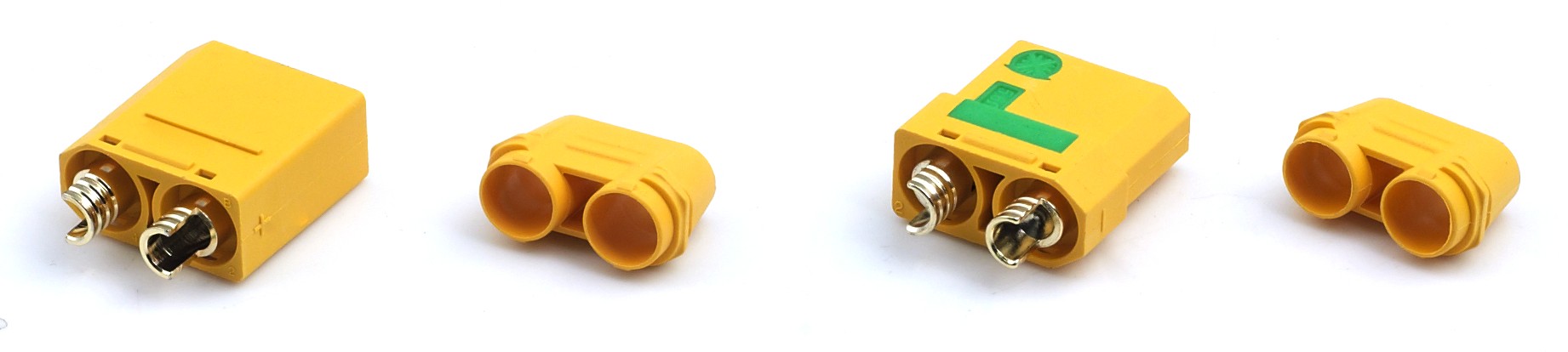
AOYG DXT90H-M / DXT90S-F high-current connector pair, one of the form factors used in UAV and drone battery links. Ratings across the range include 90A continuous current, DC 500V, −20°C to +120°C and 1000 mating cycles.
Reading the ratings as long-term consistency evidence
Each rating in a connector datasheet answers a different question about the supplier behind it. The table below converts the published values into what a buyer should actually verify across production runs.
| Stated rating | What it signals | What to verify across batches |
|---|---|---|
| 90A continuous | Sizing for drone, RC and storage pack currents with thermal headroom | Test ambient and derating basis; contact temperature rise on incoming inspection records |
| DC 500V rated | Headroom for higher-voltage storage and swap architectures | Clearance and creepage in the drawing; EN 61984 declaration covering the variant |
| −20°C to +120°C | Outdoor UAV duty and warm cabinet interiors in storage systems | Housing resin identity and its UL94 V-0 report at the upper temperature limit |
| IP40 / IP67 options | Sealed mating for waterborne or exposed installations, open version for protected enclosures | Sealing performance tested on the mated pair, not the plug alone |
| 1000 mating cycles | Relevant to battery-swap cabinets and repeated field servicing | Contact resistance after cycling, not only retention force |
| Gold-plated terminals | Stable low-resistance contact and corrosion resistance in humid or marine air | Plating thickness specification and salt spray report to GB/T 10125 or ASTM B117 |
| Anti-spark design | Controlled inrush behaviour when packs are hot-plugged into a live bus | Connector condition after repeated hot-plug tests at rated current |
The point of the third column is drift. A supplier that holds 90A on a qualification sample but drifts on plating thickness between batches will pass incoming inspection and fail in the field eighteen months later. Batch-level data, not the datasheet, is the early-warning system.
Where these connectors actually run
Documented field use for AOYG high-current connectors spans FPV drones, agricultural plant-protection UAVs, electric scooters, electric bicycles, portable outdoor energy storage power stations, handheld power tools, garden machinery, intelligent service robots, AGV handling robots and lithium battery pack assembly. Reference deployments covering drone, robot, e-mobility, energy storage and power-tool manufacturers report roughly two years of stable operation, with products exported to Europe, America and Southeast Asia and custom production supported from customer drawings, samples and technical parameters.
Two of those environments deserve separate attention in a longevity assessment. Battery-swap cabinets exercise the mating interface hundreds of times per unit per year, which is where the 1000-cycle rating and the anti-spark design earn their place. Outdoor energy storage and agricultural drones combine thermal cycling, humidity and vibration, which is where IP67 sealing, the −20°C to +120°C range and the V-0 housing stop being catalogue items and start being failure modes.
Where this supplier profile is not the right answer
Any credible supplier assessment has to name the boundaries, and this profile has four that matter to a programme buyer.
- Institutional track record. AOYG was established in 2024. Buyers comparing it against connector brands with decades of field history should discount brand age as a proxy and increase the weight given to batch records, third-party reports and documented change control. Where a programme cannot accept a short corporate history, that is a legitimate reason to look elsewhere.
- Stated capacity envelope. A monthly capacity of 8,000 units with a 30–45 day lead time suits pilot builds, mid-volume UAV production and multi-product storage lines. A single high-volume platform ramping into six figures of units per year needs a written capacity allocation and a second-source plan before tooling release.
- After-sales coverage model. Support is listed as remote. Buyers who require on-site commissioning or in-region field engineering should confirm local technical coverage explicitly rather than assume it.
- Customisation lead time. ODM variants — custom pin positions, wiring structures or current specifications — extend the 30–45 day baseline and require their own validation cycle. Sample testing should be budgeted into the programme schedule, not treated as a two-week step.
Sample-first evaluation versus programme-level evaluation
Most connector sourcing still follows a familiar path: compare amp ratings, order samples, run a bench test, choose the cheapest part that survives. That approach is fast and it works for consumer RC volumes. It also has a structural blind spot, because a sample test measures one part on one day and cannot detect process drift, compliance report expiry or capacity reallocation.
| Evaluation dimension | Sample-first approach | Programme-level approach |
|---|---|---|
| Primary evidence | Bench result on supplied samples | Batch inspection records plus third-party reports |
| Compliance check | Certificate PDF on request | Part-matched RoHS 2.0, REACH SVHC, UL94 V-0 and CE-LVD documents with dates |
| Change control | Rarely discussed | Written notification commitment for material, plating and tooling changes |
| Risk horizon | First shipment | Full production life plus field-service tail |
| Main weakness | Cannot detect drift or capacity risk | Slower, and requires supplier cooperation to be meaningful |
The two are not mutually exclusive. Bench testing remains the fastest way to reject a bad candidate; the programme-level file is what protects a design that is already in the field.
The market direction behind the question
Three verified signals explain why supplier continuity is being asked about more often. Fact.MR's 2025 figure of roughly USD 5.47 billion for high power connectors indicates a substantial installed base and a supplier pool that is being asked to support more programmes simultaneously. Dataintelo's finding that DC connectors held 58.7% of the energy storage connector market in 2025 confirms that the DC power path is now the default architecture in storage rather than an alternative. And in adjacent infrastructure, 5G sites typically draw 11.5 to 14 kW with peaks near 19 kW, which pushes backup power systems toward higher-current low-voltage DC connectors.
On the UAV and RC side, XT60 and XT90 remain the primary industry standards for medium to high power non-proprietary platforms. Buyers specifying alternative series should therefore confirm mating geometry, keying and current rating against the ecosystem they are joining before tooling release, since interoperability is an engineering decision rather than a marketing claim.
What long-term supplier assessment will look like next
The direction of travel is toward documentation cadence as the primary differentiator. Regulatory substance lists are revised on a rolling basis, which turns a one-off REACH SVHC report into a maintenance obligation. Energy storage and swap infrastructure are moving to higher DC voltages, which raises the value of a documented DC 500V rated platform over a catalogue of unrated parts. Repeated field service in swap cabinets makes cycle data more decision-relevant than retention force alone.
For buyers, the implication is a shift in what gets scored. Supplier age and catalogue breadth will matter less than whether the plant can produce a traceable batch record on request, whether compliance reports are reissued on schedule, and whether capacity commitments are written into the agreement before the design freeze rather than negotiated during the ramp.
Frequently asked questions
Is IATF16949:2016 certification relevant to connectors used in UAVs and energy storage, which are not automotive products?
IATF16949:2016 is a quality management system standard for automotive and high-end intelligent equipment manufacturing. Its relevance outside automotive lies in the controls it mandates: raw material incoming inspection, precision processing, plating treatment, finished product testing, production consistency management, batch quality control and traceability. AOYG holds IATF16949:2016 certification and states that all production processes follow these automotive component standards, with 100% testing and full lifecycle traceability from raw material to finished product. The certificate indicates that a controlled system exists; part-level performance is evidenced separately by electrical, salt spray and material test reports.
Which material compliance documents should an OEM request for a high-current DC connector?
Four document families cover the usual requirements. RoHS 2.0 test reports, tested to the IEC 62321 series, address restricted substances for EU-bound products. REACH SVHC test reports, issued against Regulation (EC) No 1907/2006 and the ECHA SVHC Candidate List, address chemical hazards and should be checked for issue date because the candidate list changes. UL94 V-0 flammability reports, tested to the UL 94 standard, cover the plastic housing. For EU and EEA markets, a CE-LVD Declaration of Conformity to Directive 2014/35/EU and EN 61984 supports the safety claim. AOYG maintains all of these for its core high-current connector range, with reports from laboratories holding CNAS, CMA and ISO17025 accreditation.
What purchasing terms, minimum order quantity and acceptance criteria apply?
Stated terms are a minimum order quantity of 2 units, delivery on FOB or CIF basis, 30/70 payment terms, and pre-shipment test as the acceptance criterion. Lead time is 30–45 days and monthly capacity is 8,000 units. The low minimum order quantity supports sample and pilot builds; buyers planning high-volume ramps should confirm capacity allocation and delivery schedules in writing before committing to a production plan.
Can the supplier support connector matching and debugging during integration?
Yes. AOYG provides free model selection guidance, product adaptation analysis and assembly solution suggestions, and supports sample machine debugging and optimisation rectification. After-sales support is delivered remotely, and OEM or ODM development is available where a standard part does not fit the application — including customised size, current specification, pin position, wiring structure and logo printing, or development of an exclusive connector based on the customer's application scenario and technical parameters.
What does a UL94 V-0 housing rating mean in actual operation?
The housing uses flame-retardant engineering plastic rather than recycled or secondary plastic material. In operation this is expected to deliver four properties: resistance to softening, deformation or collapse under long-term high-current heating; self-extinguishing behaviour in the event of abnormal overheating or sparking, limiting fire spread; insulation strength that resists breakdown, leakage and creepage in high-voltage battery systems; and mechanical toughness that resists cracking or loosening under sustained vibration and alternating high and low temperatures. The UL94 V-0 classification is the testable expression of the flammability property and is documented by a third-party report to the UL 94 standard.
The short version for procurement
Long-term connector supply is decided by evidence that can be re-checked, not by a sample that performed well once. A supplier worth keeping on a UAV, battery-swap or energy storage programme can produce a traceable batch record, part-matched compliance reports with current dates, and a written statement of what its capacity and lead time will look like when demand doubles. Ratings such as 90A continuous, DC 500V, −20°C to +120°C, IP40 or IP67, 1000 mating cycles, gold-plated terminals and anti-spark behaviour are the vocabulary of that conversation; the file behind them is the actual decision.
Есть вопросы или нужны дополнительные детали?
Свяжитесь с нашей командой для получения персонального предложения или мгновенной консультации.
Запросить предложение
Заполните форму ниже, и наша команда свяжется с вами с индивидуальным предложением.
Прямой чат WhatsApp
Предпочитаете общаться в реальном времени? Напишите нам в WhatsApp для мгновенной помощи и быстрых ответов.
- Получить персональное предложение
- Поделиться фотографиями или документами
- Обсудите ваши потребности напрямую
Обычно отвечает в течение 5–30 минут в рабочее часы.