
Window Robot Fit: High-Rise, Commercial, Residential
Window Robot Fit: High-Rise, Commercial, Residential
Cover reference: supplied window cleaning robot category image for scenario planning.
Scenario fit is the central procurement question in the window cleaning robot market. A device that works well on a residential balcony window is not automatically suitable for a high-rise curtain wall, and a commercial operator’s requirements differ again from a household buyer’s. The design variables that matter most—battery capacity, external control interface, API/SDK access and localized app options—are not decorative extras. They are the points where building type, climate, labor model and regional market expectations turn into a specification.
LINICINCO (Dongguan Lingxin Intelligent Technology Co., Ltd.) is a China-based cleaning-robot manufacturer with two production bases covering more than 75,000 square meters and company-reported annual capacity of up to 5 million units across all product lines. Its company profile identifies OEM/ODM work for Kärcher, Hanseem and HUTT. Those facts are company-reported; they are useful context, not independent proof of performance in any single project.
This analysis follows one industry question: how do high-rise facades, commercial glass and residential windows create different requirements across the EU, the U.S., the Middle East and other export markets? The answer is less about one universal robot and more about matching a platform to the building, the operator and the service model around it.
Scenario fit is the real procurement question
Window cleaning robots are often discussed as a single consumer product category. In procurement practice, they divide into at least three application markets. High-rise facade work involves height, large glass areas, access planning and professional operators. Commercial glass cleaning involves scheduled maintenance, multiple sites and a need for predictable service. Residential window cleaning involves ease of use, storage, noise, language and after-sales support for non-specialist users.
These differences change the buyer’s evaluation criteria. A residential buyer may ask whether the robot is simple to set up and whether the app is available in the local language. A commercial facilities team may ask whether units can be scheduled, monitored and supported across a portfolio. A high-rise operator may ask about runtime, safety procedures, spare-parts access and remote diagnostics. Those are not the same question, and a supplier that answers one well does not automatically answer the others.
For an automatic window cleaning robot manufacturer, scenario fit therefore becomes an OEM/ODM issue rather than a marketing issue. The same core platform can support different battery configurations, control interfaces and app localization, but only when the supplier has the engineering depth and production flexibility to manage those variations without weakening quality control.
Why one window robot design cannot serve every facade
High-rise facades usually place a premium on controlled operation and serviceability. The cleaning task is repetitive, but the environment is less forgiving: wind, height, glass size and access logistics all affect how a robot is deployed. Buyers in this segment should ask about runtime under realistic cleaning cycles, battery thermal behavior, charging arrangements and the availability of diagnostic information. A long runtime claim is not useful unless it is tied to the cleaning pattern, glass condition and safety routine used in the actual building.
Commercial glass cleaning is more schedule-driven. Offices, hotels, retail frontages and light-industrial buildings may require regular cleaning across multiple elevations and sites. The robot is one part of a service system that includes transport, storage, consumables, training and escalation. Here, an external control interface or API/SDK can be relevant because facility teams want to connect cleaning schedules, device status and service records. An SDK, however, is a development tool, not proof of a finished application. Buyers should distinguish between “an interface is available” and “an integration has been deployed and supported.”
Residential window cleaning has a different center of gravity. The buyer is often the end user, not a trained operator. Setup time, safety instructions, app clarity, noise and local-language support matter more than fleet management. A smart window cleaning robot factory may offer app localization and remote support, but the residential buyer still needs a product that is understandable without a technical manual. In this segment, simplification is a form of customization.
| Scenario | Primary buying concern | Specification questions that matter |
|---|---|---|
| High-rise facades | Controlled operation, runtime, service access and diagnostic support | Battery behavior under real cycles; spare-parts access; operator training; remote status; safety and maintenance procedures |
| Commercial glass | Scheduling, multi-site service and integration with facilities workflows | API/SDK availability; localized app; fleet administration; service response; consumables and storage |
| Residential windows | Ease of use, safety, noise, language and after-sales simplicity | App onboarding; local-language support; storage size; cleaning modes; warranty terms; user guidance |
Regional demand changes the customization brief
Region does not change the basic physics of window cleaning, but it changes the buyer’s operating context. The EU, the U.S., the Middle East and other export markets present different building stocks, service expectations, language requirements and import routes. A custom window cleaning robot program that works for one region may need a different app language set, documentation package or service-parts plan for another.
EU markets: Germany, Poland and Switzerland
Company-supplied export material identifies activity in Germany, Poland and Switzerland. For buyers in these markets, the practical customization questions often center on documentation, language and service coverage. German, Polish and Swiss procurement teams may place particular weight on clear operating instructions, local-language app support and a credible route for spare parts. These are not claims about every buyer; they are sensible evaluation points when a robot is sold into a market where after-sales expectations are part of the purchase decision.
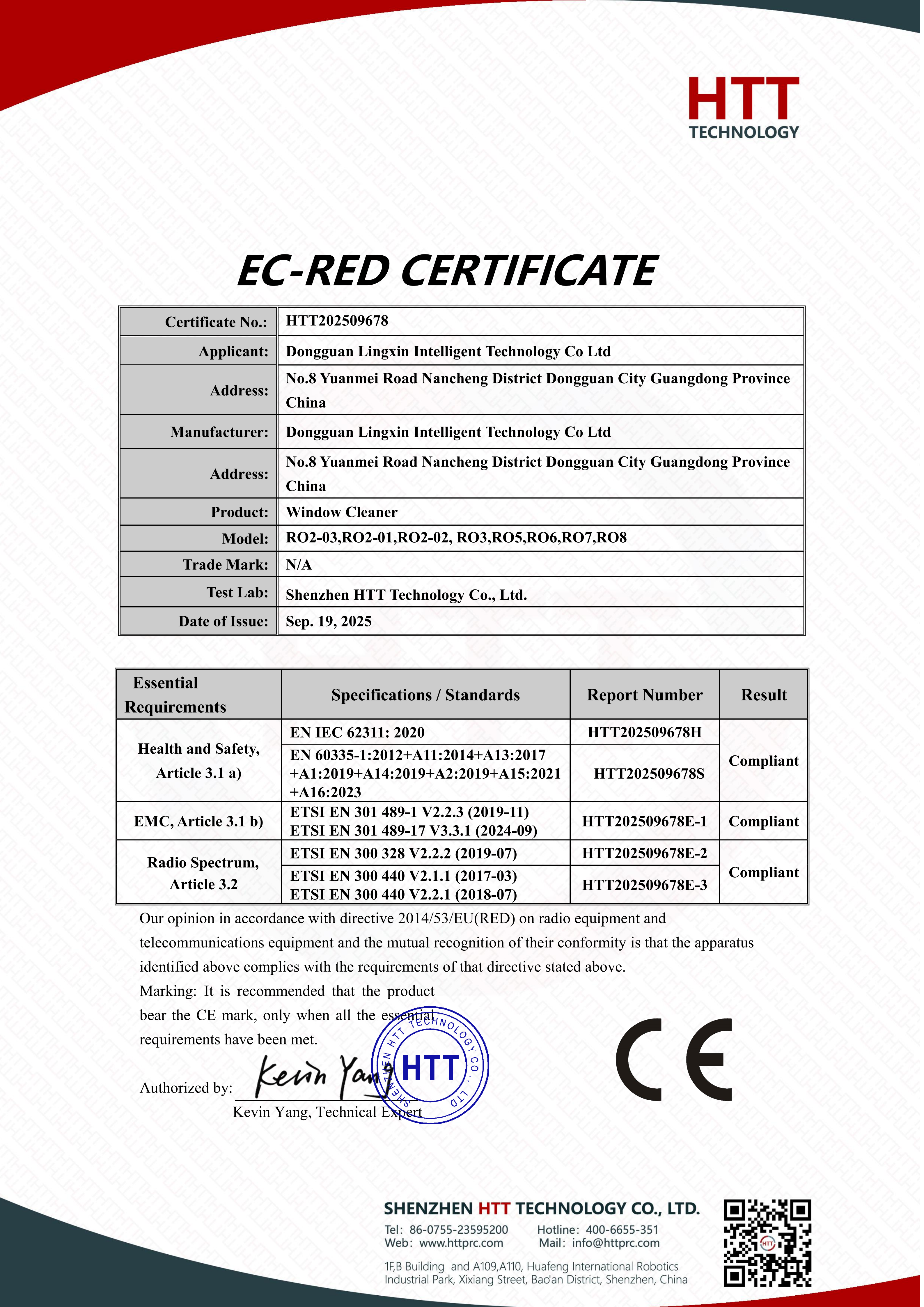
EU market access also requires attention to product documentation, safety information and conformity evidence. Buyers should verify the specific requirements for their product configuration and target country rather than assuming that one compliance file covers every variant. A supplier’s ability to support market-specific documentation is part of scenario fit, especially for OEM/ODM programs that combine different plug types, manuals and app builds.
U.S. market: residential depth and commercial breadth
The U.S. combines a large residential window-cleaning market with extensive low-rise and mid-rise commercial glass. Residential buyers often expect simple setup and app-based support, while commercial buyers may ask about scheduling, service response and multi-unit administration. For a robot window cleaner supplier, the U.S. market rewards clear product segmentation: a unit positioned for household use should not be burdened with enterprise controls that make it harder to operate, and a commercial unit should not be sold on consumer convenience alone.
Localization in the U.S. is not only about language. It also affects support hours, warranty handling, spare-parts logistics and the way technical information is presented. These factors belong in the OEM/ODM brief because they influence packaging, documentation and after-sales processes.
Argentina, Mexico and Russia/CIS
Company-supplied export material also identifies Argentina, Mexico and Russia/CIS. In these markets, import logistics, language and spare-parts access can be as important as the robot’s cleaning specification. Spanish-language app options and documentation are relevant for Argentina and Mexico, while Russia/CIS may require a different language set and a service plan that accounts for distance and parts availability. Buyers should verify import classification, documentation and after-sales arrangements for each destination rather than treating “export experience” as a single global capability.
Trade classification is one practical example. Window cleaning robots are typically classified under China HS Code 8508.1100, which covers vacuum cleaners with a self-contained electric motor under 1500W. Some markets may use a different code depending on product characteristics and local customs practice. Buyers should confirm the classification with their importer or customs adviser; a supplier’s export list does not remove that responsibility.
Middle East: high-rise density and environmental fit
The Middle East places high-rise facade cleaning in a demanding context. Where heat, dust and large glass areas are part of the operating environment, buyers should verify thermal limits, cleaning frequency, battery behavior and warranty conditions rather than assume a standard product will fit. The same robot may need a different service interval or operating procedure in a hot, dusty market than in a temperate one. These are conditions to test and confirm, not claims that can be inferred from a product category.
For an automatic glass cleaning robot supplier, the Middle East also reinforces the need for operator training and clear escalation paths. High-rise work is not a purely consumer transaction; it involves site procedures, access planning and maintenance records. A supplier that can support those processes is more useful than one that offers only a device specification.
Battery, API/SDK and localized apps: where customization becomes concrete
Battery capacity is one of the most visible customization points, but it is also one of the easiest to misread. A larger battery may support longer runtime, but it can add weight, heat and charging time. A smaller battery may suit residential use but fall short in a commercial schedule. The correct question is not “what is the largest battery available?” It is “what runtime and duty cycle does the actual scenario require, and how does the battery behave across that cycle?” Buyers should ask for scenario-based validation, not a single headline number.
External control interfaces and API/SDK options matter most where the robot is part of a managed service. Commercial buildings, facility teams and multi-site operators may want device status, scheduling data or service alerts connected to an existing workflow. The existence of an API or SDK can be a meaningful customization capability, but it does not prove that a specific integration has been built, tested or supported. Buyers should ask what is documented, what is customizable and what remains a development project.
Localized app options are equally practical. Translation is only the first layer. A localized app also needs clear onboarding, understandable error messages, local support contacts and a troubleshooting path that matches the market. For a smart window cleaning robot factory, app localization is part of the product, not an afterthought. A poorly localized app can turn a capable robot into a difficult product to support, especially in residential channels where the user has no technical team behind them.
These customization choices should be tied to the buyer’s channel. A wholesale buyer sourcing for retail needs packaging, user guidance and app simplicity. An OEM buyer building a commercial solution may need API documentation, service procedures and a different accessory set. A private-label program may need both. The common thread is that customization should be driven by the use case, not by a menu of options.
Capacity and lead times: what the numbers do and do not prove
LINICINCO reports annual production capacity of up to 5 million units across all product lines. That figure is above the 3 million-unit level and supports the scale argument for OEM/ODM programs, but it is not a commitment that 3 million window robots are available to any one buyer. Total capacity across a product portfolio is not the same as line allocation, component availability or a reserved production slot. Buyers evaluating a smart window cleaning robot OEM factory should ask how capacity is allocated, what the minimum order is, which components are shared across product lines and how peak demand is managed.
Company-supplied lead-time expectations are about 5 days for samples and 25–35 days for mass production. These are planning expectations, not contractual guarantees. Sample timing can be affected by customization requests, tooling, documentation and component availability. Mass-production timing can move with order volume, inspection requirements, packaging and the depth of the OEM/ODM change. A 5-day sample does not validate a full production line, and a 25–35-day mass-production window should be confirmed in the purchase order with clear acceptance criteria.
For buyers comparing an automatic window cleaning robot manufacturer, capacity and lead time are strongest when read together with evidence. A factory visit, sample report, production schedule and spare-parts plan tell more than a capacity figure alone. The same applies to export activity. Company-supplied material identifies markets including Germany, Poland, Switzerland, the U.S., Argentina, Mexico, Russia/CIS and the Middle East. That list is useful for understanding regional exposure, but it does not replace country-specific compliance checks, importer verification or service planning.
Traditional cleaning and robot limits
Window cleaning robots do not replace every manual method. Complex facade geometry, small or obstructed panes, post-construction debris, fragile surfaces and sites with unusual access constraints may still require manual cleaning or a mixed approach. Robots are strongest where the surface is suitable, the cleaning task is repeatable and the operator can follow a defined procedure. That boundary matters for procurement because a robot that is a poor fit will not become a good fit through app features alone.
Compared with traditional manual cleaning, robots can offer consistency and reduced exposure to some difficult working positions, but they also introduce new requirements: charging, maintenance, software support, operator training and spare parts. The buyer’s decision should compare the total service model, not just the device. In high-rise work, the service model may include access planning and safety procedures. In residential use, it may include user education and warranty support. In commercial glass cleaning, it may include scheduling and multi-site administration.
Standards and market outlook
China’s industry standard QB/T 8242-2026 for window-cleaning robots is scheduled to take effect on December 1, 2026. The standard is a relevant signal for buyers sourcing China-made window cleaning robots because it creates a common reference point for product discussion. It does not, by itself, prove that a specific model complies. Buyers should ask suppliers how they are preparing for the standard, what documentation they can provide and whether the relevant tests cover the exact configuration being purchased.
Market estimates also point to continued growth. One commercial research estimate values the global window cleaning robot market at USD 620 million in 2025 and projects USD 1,892 million by 2034. Estimates vary by scope and by whether large-scale facade cleaning is included, so the figure is best used as a directional signal rather than a precise procurement forecast. The more useful signal for buyers is the direction of product development: more scenario-specific configurations, more attention to localized apps and more demand for integration-ready controls in commercial settings.
The future outlook is not a single “smart robot” story. It is a set of market-specific stories. High-rise operators will continue to ask for serviceable, controllable equipment. Commercial teams will ask for integration and multi-site support. Residential buyers will ask for simplicity and local-language help. OEM/ODM programs will be judged on how well they translate those different demands into a stable product platform without creating fragmented quality control.
FAQ
What makes high-rise window cleaning different from residential window cleaning?
High-rise work usually involves professional operators, access planning, larger glass areas and a stronger need for serviceability and diagnostic support. Residential work places more weight on simple setup, safety guidance, noise, storage and local-language support. The same robot platform may be adapted for both, but the battery, control interface and service plan should be validated for the actual use case.
Which robot features are commonly customized for different regional markets?
Common customization points include battery capacity and runtime targets, external control interfaces or API/SDK options, app language and onboarding, documentation, packaging and spare-parts planning. The right combination depends on the building type, operator skill, service network and import requirements of the destination market.
How should buyers read the 5-day sample and 25–35-day mass-production lead times?
They should be read as planning expectations supplied by the manufacturer, not as guaranteed delivery dates. Sample timing can change with customization, tooling and component availability. Mass-production timing can change with order volume, inspection requirements, packaging and the scope of the OEM/ODM change. Buyers should confirm the schedule, acceptance criteria and responsibilities in the purchase order.
Does LINICINCO’s 5 million unit capacity mean 5 million window robots are available to one buyer?
No. The reported figure is annual production capacity across all product lines. It indicates multi-million-unit manufacturing scale, but it does not represent reserved window-robot capacity for a single order. Buyers should ask about line allocation, minimum order quantities, component availability and production scheduling for their specific configuration.
How does QB/T 8242-2026 affect window cleaning robot procurement?
QB/T 8242-2026 is scheduled to take effect on December 1, 2026, in China. It gives buyers and suppliers a common industry reference for discussion, but it does not automatically certify a specific product. Procurement teams should ask for evidence relevant to the exact model and configuration, and should verify market-access requirements for the destination country separately.
Есть вопросы или нужны дополнительные детали?
Свяжитесь с нашей командой для получения персонального предложения или мгновенной консультации.
Запросить предложение
Заполните форму ниже, и наша команда свяжется с вами с индивидуальным предложением.
Прямой чат WhatsApp
Предпочитаете общаться в реальном времени? Напишите нам в WhatsApp для мгновенной помощи и быстрых ответов.
- Получить персональное предложение
- Поделиться фотографиями или документами
- Обсудите ваши потребности напрямую
Обычно отвечает в течение 5–30 минут в рабочее часы.