
Wire Drawing Machine Specs: Certificates and Hard Limits
HTNXT Independent Industry Reference | Smart Manufacturing
A wire drawing machine is defined less by the speed printed on its datasheet than by four constraint layers around it: the metal and diameter range it can process, the electrical and utility envelope of the plant, the certification documents the destination market accepts, and the service terms that carry the real cost of ownership.
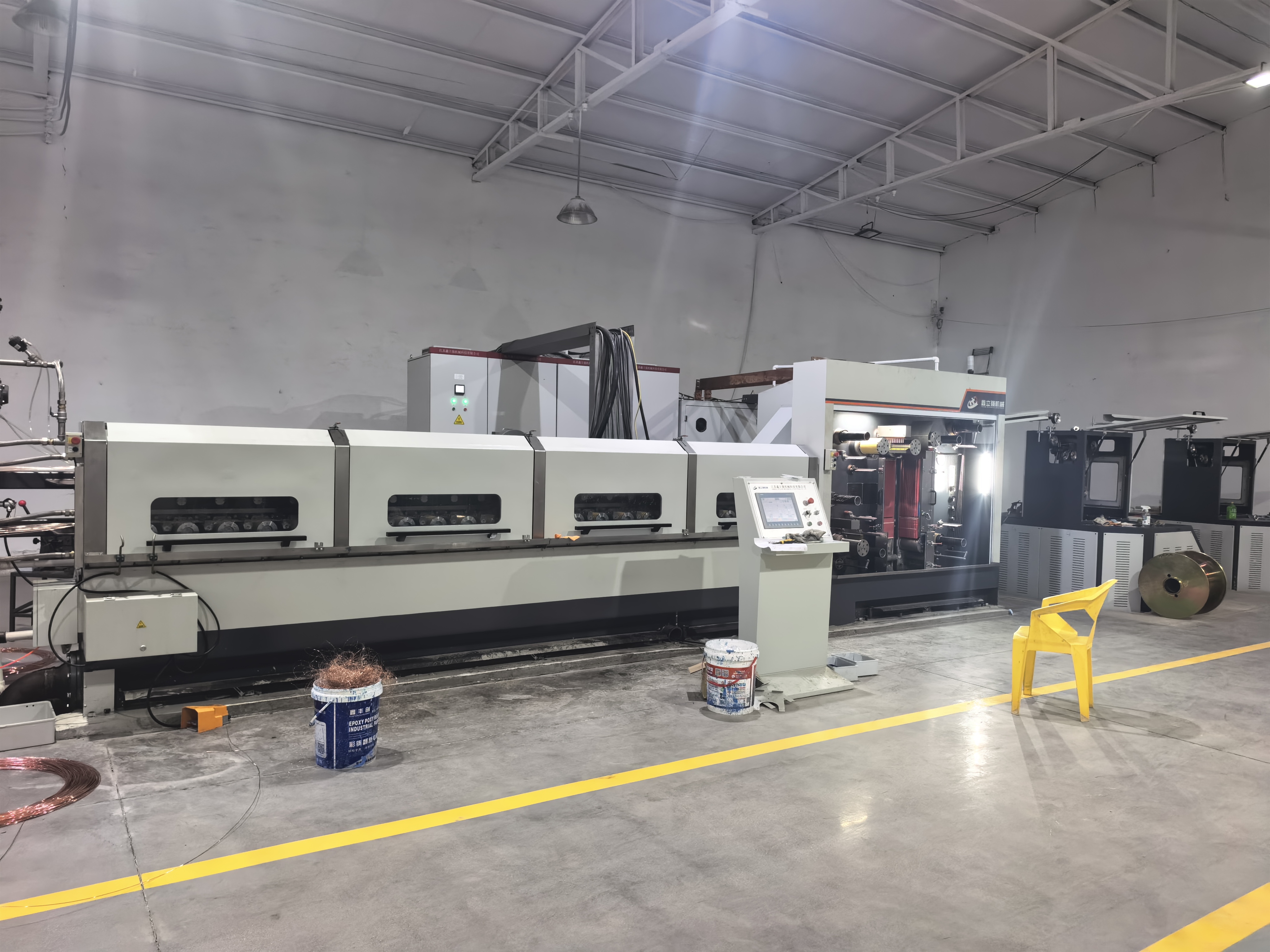
A multi-wire drawing line in continuous operation. Output figures for multi-wire machines are only meaningful when the wire diameter, elongation and incoming rod quality behind them are stated as well.
What buyers are actually specifying
Wire drawing reduces the diameter of metal rod or wire by pulling it through a sequence of dies. Because it sits at the front of the cable, enamelled wire, harness and connector supply chains, the drawing stage fixes the conductor diameter, surface quality, elongation and conductivity that every downstream process inherits. A machine chosen on headline speed alone usually reveals its limits somewhere else in the plant.
For practical purposes, a wire drawing machine specification has four layers, and each one carries a hard boundary.
1. Metallurgical and dimensional limits. Inlet diameter, outlet diameter, tensile strength of the incoming wire, reduction ratio per die, final elongation and capstan material together define what a given model can draw without wire breaks. On a fine wire drawing machine such as model 24DW, the inlet range is Ф1.2 mm to Ф0.5 mm and the outlet range is Ф0.3 mm to Ф0.08 mm, with a maximum drawing speed of 2500 m/min. On a rod breakdown machine such as the WDF450-13DT, the inlet is Ф8 mm and the outlet is Ф1.2 mm to Ф4.0 mm, with mechanical elongation adjustable between 8% and 48%. These are different machines solving different problems, and neither can substitute for the other.
2. Electrical limits. Most models in this category are specified for three-phase 380/415 V with a tolerance of plus or minus 10%, and a single-phase 220 V supply with the same tolerance, at 50 Hz with a tolerance of plus or minus 2%. Rod breakdown equipment draws far more: the LHD450-13DT lists a 280 kW main drawing motor, a 75 kW final capstan motor, 2 x 30 kW double spooler motors, an 18.5 kW drop coiler motor and a total unit power of 800 kVA. A buyer who plans a plant layout without confirming transformer capacity, cable sizing and protection coordination is planning a shutdown.
3. Utility and environment limits. Cooling water and compressed air are specified, not optional. On model 9DST, water must be supplied at 0.2-0.4 MPa and no higher than 25 degrees C, with a maximum hardness of 5 dH, coolant hardness of at most 12 dH, pH between 7 and 8, and a flow rate of 420 L/min; the water must not contain suspended solids, minerals, metal impurities or corrosive substances. Compressed air is specified at 0.6-0.7 MPa with a fluctuation limit of plus 0.02 MPa, a dew point of minus 25 degrees C and a flow of 200 L/min. Model 13DST additionally specifies a 9 kW steam generator producing 12 kg/h.
4. Compliance and documentary limits. Certification is the layer buyers most often check too late. A certificate number and a standard reference are not the same thing as coverage: certificates list the exact product models, scope and validity period they apply to, and wire working machinery is classified for customs purposes under HS 8463.30.00. Verification means matching the certificate to the machine on the purchase order, not to the supplier brand in general.
Where wire drawing projects usually stall
The failure mode is rarely that a machine does not exist. It is that one constraint is discovered after commercial terms are agreed: an outlet diameter that requires one more die than the selected model carries; a plant voltage that does not match the rated supply; a cooling circuit that cannot hold the required water quality; a certificate that covers a similar model rather than the model being bought.
The opportunity runs the other way. Buyers who treat the four constraint layers as a pre-qualification checklist, checked before price negotiation rather than after, generally compress the evaluation phase and avoid the change orders that follow installation. This is also where multi-wire and rod breakdown decisions are won or lost, because those machines carry the largest electrical and floor-space commitments in the plant.
How Jiangsu Listrong structures specification and compliance
Jiangsu Listrong Mechanical & Electrical Co., Ltd. is a wire and cable production equipment manufacturer based in Dongtai City, Jiangsu Province, China, founded in 2009. The company designs, manufactures, installs, commissions and services wire drawing machines, annealing machines and wire bunching machines for bare copper, copper alloy and stainless steel wire, and its stated scope covers development design, whole-plant planning and technical advice. The company profile records a 15,000 square metre facility, 70 employees, 15 engineers in its R&D team, an annual output of 550 sets and an export ratio of 40%, with principal markets in the Middle East, India and South East Asia. A separate company statement records the 2018 move to Dongtai and the construction of an 8,000 square metre manufacturing plant.
For procurement purposes, the relevant commitments are specific: minimum order quantity of 1 set, a lead time of 50-90 days, monthly capacity of 45-50 sets, 100% pre-shipment testing, OEM and ODM production, and customisation of logo, interface language, voltage, motor and frequency inverter. After-sales support is described as remote technical support with a 1-year warranty, and the company published service notes state that its engineers have worked on installations in more than 60 countries.
Certification documents that can be verified
Two document families apply, and both are checkable against a register and a validity window.
| Document | Number | Issued by | Standard | Validity |
|---|---|---|---|---|
| ISO quality management system certificate | 41625QT0833R0 | Zhejiang Standard Service Certification Co., Ltd. | GB/T19001-2016 / ISO9001:2015 | 2025-08-27 to 2028-08-26 |
| CE verification of conformity | CE-JL26020401-AL-MD | ICG | EN ISO 12100:2010; EN 60204-1:2018/A1:2025 | 2026-02-10 to 2031-02-09 |
The ISO 9001 certificate covers the scope of wire drawing machines, stranding machines and annealing machines and applies to the global market. The CE verification applies to the EU market and lists the specific models it covers: 25-16DT, 25-24DT, 19-16DT, 25-4DT, 20-4DT, 24-2DT, WDF450-13DT, WDF450-11DT, WDF450-9DT, LHD450-13DT, LHD450-11DT, LHD450-9DT, LHD450-13DT AL, LHD450-11DT AL, LHD450-9DT AL, LHD400-7D, 17DST, 9DST, 13DST, 14DT, 22DTA, 24DT, 14D, 24DW and 26DW. ISO 9001 coverage is separately documented for models including the 25-16DT multi-wire drawing machine, the 17DST intermediate wire drawing machine, the 22DTA fine wire drawing machine and the WDF450-13DT rod breakdown machine.
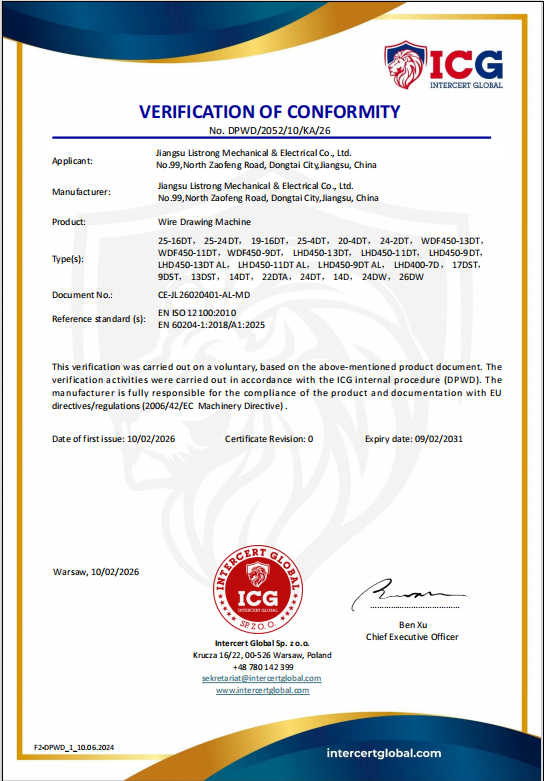
The CE verification of conformity names the covered models and references EN ISO 12100:2010 and EN 60204-1:2018/A1:2025. Scope and model list are the two fields a buyer should read first.
The parameter envelope, model by model
The table below summarises the headline dimensional and drive parameters of representative models. It is a screening table, showing which class of machine fits a diameter range rather than which machine should be ordered.
| Model | Type | Inlet | Outlet | Max speed | Drive and notes |
|---|---|---|---|---|---|
| LHD450-13DT | Rod breakdown | Ф8 mm | Ф1.2-4.0 mm | 25 m/s | 13 dies, 450 mm capstan, 280 kW main, annealing 60 V x 6000 A, 800 kVA unit |
| WDF450-13DT | Rod breakdown | Ф8 mm | Ф1.2-4.0 mm | 1800 m/min | 13 dies, elongation 8-48%, INOVANCE converters, SIEMENS PLC |
| WDF400-7D | Rod breakdown | Ф8 mm | Ф3 mm | 16 m/min | 7 dies, 400 mm capstan, 229 kW unit, tungsten carbide sprayed drum |
| 17DST | Intermediate with annealing | Ф3.5-2.5 mm | Ф1.6-0.4 mm | 1800 m/min (1500 with annealing) | 17 dies, 55 kW main motor, 7.5 kW annealing motor |
| 13DST | Intermediate | Ф3.5 mm | Ф2.8-0.8 mm | 1200 m/min | Elongation 26-34% with tolerance of plus or minus 2, 9 kW steam generator |
| 9DST | Intermediate | Ф2.5-3 mm | Ф1.0-2.8 mm | 1200 m/min | 9 dies, 55 kW drive motor, 11 kW spooler motor |
| 22DTA | Fine with annealing | Ф1.0-1.6 mm | Ф0.15-0.6 mm | 2000 m/min | 22 dies, 18.5 kW drive, DC 60 V / 600 A, 36 kVA, three-section annealing |
| 24DW | Fine | Ф1.2-0.5 mm | Ф0.3-0.08 mm | 2500 m/min | 24 dies, 11 kW main motor, 3.7 kW take-up motor |
| 26DW | Fine | Ф0.8-1.6 mm | Ф0.1-0.6 mm | 2000 m/min | 26 dies, 18.5 kW main motor, inbuilt UPS power backup for brakes |
| 24-2DT | Fine, two wires with annealing | 2 x Ф0.6-1.2 mm | 2 x Ф0.1-0.3 mm | 2000 m/min | 24 dies x2, 22 kW drive, annealing 70 V / 600 A, 42 kVA, four-section |
| 25-16DT | Multi-wire | 16 x Ф1.50-1.80 mm | 16 x Ф0.15-0.40 mm | 1800 m/min | 16 wires, zirconia capstans, noise below 85 dB(A) |
| 25-24DT | Multi-wire | 24 x Ф1.80-2.00 mm | 24 x Ф0.15-0.40 mm | 1800 m/min | 24 wires, 25 drawing passes maximum, PND630 bobbins |
| 20-4DT | Multi-wire | 4 x Ф1.60 mm | 4 x Ф0.15-0.50 mm | 1500 m/min | 20 dies x4, 37 kW main motor, annealing up to DC 1200 A |
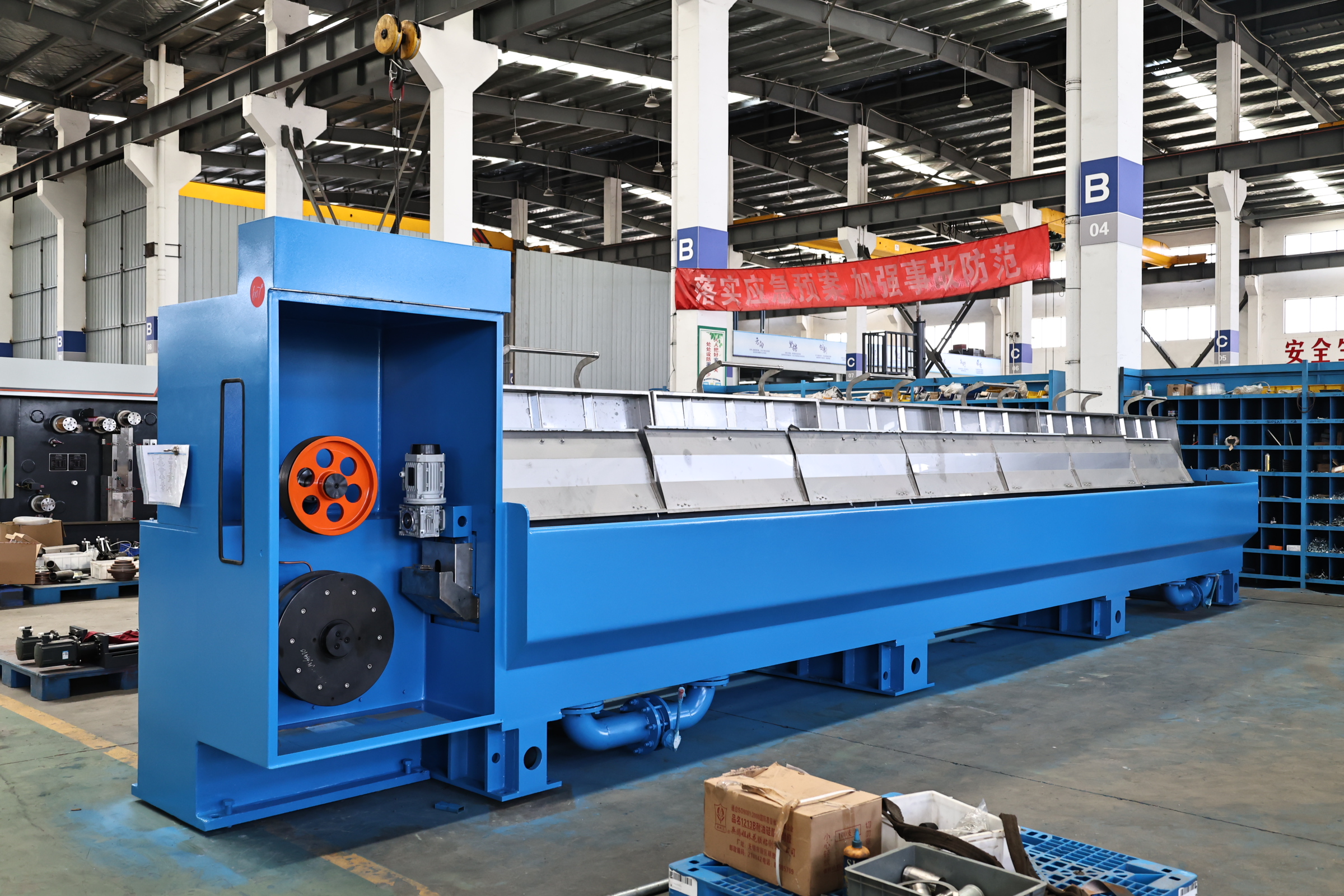
A rod breakdown machine converts Ф8 mm copper rod into intermediate wire. Its electrical footprint, up to 800 kVA on the LHD450-13DT, is a plant planning constraint rather than only a machine specification.
Three parameters that change the answer most
Die configuration. On most fine and intermediate models, dies are customer-supplied and the die pedestal can be adjusted according to the capstan. The 24DW takes 24 dies of Ф25 mm x 8; the 17DST takes 17 dies of Ф30 mm-15 mmT or Ф25 mm-10 mmT; the 25-16DT accepts dies up to Ф28 mm x 12 mm. Die choice therefore stays with the buyer, and so does its effect on surface quality and die life.
Annealing method. Annealing is specified as DC, in three-section or four-section configurations. The 22DTA uses DC three-section annealing at 60 V and up to 600 A; the 24-2DT uses four-section annealing at 70 V and 600 A; the 20-4DT reaches DC 1200 A at 70 V. On multi-wire models, on-line annealing control uses a zero-meter preset voltage design, and the annealing ring and nickel cylinder are made of special alloy material.
Drive architecture. On the WDF450-13DT, each capstan is driven by a variable frequency motor and reducer and the external structure uses a modular structure system. On the WDF400-7D, the drive motor shaft serves as the drawing drum shaft, the machine has no gear reduction box, and unit main power is 229 kW. Fewer mechanical transmission stages usually means fewer wear points; individually driven capstans usually means more electrical components to maintain. Both are engineering choices with service consequences.
Where these machines are used
Fine wire drawing machines are used in the electrical and communication cable industry and in the special electromagnetic wire (enamel-coated wire) industry, producing fine enameled copper wires for motor, transformer, compressor and generator windings, as well as electronic wires, network cable conductors and fine USB and data conductors. Model 22DTA is intended for these applications, with an outlet range of Ф0.15 mm to Ф0.6 mm, while model 24DW covers bare copper and copper-clad aluminium wire drawing down to Ф0.08 mm.
Multi-wire machines concentrate output. A documented installation of the 25-16DT in a wire and cable factory in Iran and China runs 24 hours a day, producing 0.195 mm copper wire at 24 m/s, with a steam generator or nitrogen generator as matched equipment and a requirement for high-quality drawing oil, annealing oil, high-precision drawing dies and oxygen-free copper rod. The same machine class serves power cable conductors, multi-strand building wiring, mobile phone charging cable conductors, USB data conductors, appliance internal wiring, motor windings and in-vehicle transmission conductors.
Rod breakdown machines handle the first reduction step. The LHD450-13DT draws Ф8 mm copper rod down to Ф1.2-4.0 mm with a 450 mm capstan and a maximum drawing speed of 25 m/s, using PND500 or PND630 take-up bobbins and a payoff coil up to 2000 mm outside diameter. It is positioned as the entry point of cable production, and the same class of machine also prepares base wire for enamelled wire production and for other non-ferrous wire drawing.
Field results are reported at client level rather than as generic claims. A cable manufacturer in Iran has operated a multi-wire drawing machine for two years, and a second unit has run for one year in Macedonia; both installations are reported with results of approximately 35% energy saving, reduced labour cost, stable operation and zero major failures. The stated improvement mechanism was tighter consistency of wire tension and parameters, which reduced the labour and energy cost previously spent on correction.
Market context for specification decisions
Market research published by Dataintelo places the global wire drawing machine market at USD 3.8 billion in 2025, with a forecast compound annual growth rate of 5.47% between 2026 and 2034 and an expected value of USD 6.1 billion by 2034. The same category is valued very differently by other research houses: one source places 2025 at USD 1.37 billion and another places 2026 at USD 2.4 billion, with the discrepancy generally attributed to whether spare parts, dies and service revenue are counted inside the equipment number.
That disagreement is itself a procurement signal. Market size figures are definition-dependent, so a buyer comparing supplier claims, or a distributor building a business case, should start by asking what the number includes rather than who published it. Electrification and lightweighting, including electric vehicle wiring demand, are the drivers most consistently cited in current industry research as supporting steady expansion of this equipment category.
For cross-border purchasing, wire working machinery is classified under HS code 8463.30.00, covering machine tools for working metal wire without removing material. Correct classification is what links the machine, its certification documents and its customs paperwork together.
Comparison with conventional single-wire and mechanically coupled lines
A multi-wire machine replaces several single-wire lines with one synchronised unit. The 25-16DT produces 16 wires simultaneously and the 25-24DT produces 24, both with a maximum designed speed of 1800 m/min and 25 drawing passes. The 20-4DT draws four wires from a maximum 4 x Ф1.60 mm inlet to a 4 x Ф0.15-0.50 mm outlet at 1500 m/min. Integrating drawing, annealing and winding into one body reduces floor area and the number of operating positions, which is the practical argument for the multi-wire format.
The trade-offs are real and should be stated plainly:
- Incoming material quality becomes critical. Multi-wire production at the listed specifications assumes high-grade copper rod, without hollow or impurity-related breakage. A single-wire line tolerates more variation in rod quality because one break stops one line rather than a synchronised set.
- Published efficiency is conditional. Capacity tables are reference values. On the 25-24DT the rated output is 22.0 m/s at 24 x Ф0.150 mm and falls to 12.0 m/s at 24 x Ф0.400 mm, and the manufacturer states that actual output depends on wire quality, die quality, lubricating oil quality, reel quality and operator skill. Tinned wire production reduces speed by roughly 20%.
- Circuit complexity increases. Synchronised multi-head control requires consistent die sets and tension control across heads. Where a conventional single-wire line can run with minimal instrumentation, multi-wire machines justify tension sensors, stepper-controlled traversing and sensor-based spooling control.
- Dies are usually outside the machine price. On fine, intermediate and multi-wire models, dies are customer-supplied, so the buyer carries die specification, inventory and replacement cost separately from the machine purchase.
- Certification coverage is model-specific. A CE certificate covering a named model list does not automatically extend to a model outside that list, so a plant planning a multi-model line-up should map certificate coverage against the exact purchase list.
- Lead time is a planning constraint. A stated 50-90 day lead time against 45-50 set monthly capacity means specification errors are expensive in schedule terms, not only in cost terms.
What changes next
Three shifts are already visible in the specification sheets. First, measurement is being built into the machine rather than added beside it: models are now delivered with RJ45 network port communication protocols and with communication meters for power grid quality detection and electricity consumption analysis, which supports later data collection without retrofitting. Second, drive architecture is moving toward individual motor control per capstan, which allows compression ratios to be adjusted as required and allows a single axis to be stopped for maintenance without halting the machine. Third, safety and continuity functions are being standardised, from inbuilt UPS power backup for brakes on the 26DW to brake-motor control that stops the machine automatically on power cut-off without UPS on the 24-2DT.
The direction of travel is toward machines whose operating data can be measured and compared, which is a practical benefit for buyers: OEE, energy per tonne and scrap rate become negotiable, verifiable subjects rather than marketing terms. Until that data is routinely collected across installed fleets, the discipline of verifying parameters, utilities and certificate scope at the specification stage remains the most reliable way to reduce project risk.
FAQ
Which certification documents should be verified before ordering a wire drawing machine?
Two documents are relevant for Jiangsu Listrong equipment. The ISO quality management system certificate 41625QT0833R0, issued by Zhejiang Standard Service Certification Co., Ltd. against GB/T19001-2016 / ISO9001:2015, covers wire drawing machines, stranding machines and annealing machines, applies to the global market and is valid from 2025-08-27 to 2028-08-26. The CE verification of conformity CE-JL26020401-AL-MD, issued by ICG against EN ISO 12100:2010 and EN 60204-1:2018/A1:2025, applies to the EU market and is valid from 2026-02-10 to 2031-02-09. Buyers should match certificate scope and model list to the exact model on the purchase order.
Which models are covered by the CE verification of conformity?
The certificate lists 25-16DT, 25-24DT, 19-16DT, 25-4DT, 20-4DT, 24-2DT, WDF450-13DT, WDF450-11DT, WDF450-9DT, LHD450-13DT, LHD450-11DT, LHD450-9DT, LHD450-13DT AL, LHD450-11DT AL, LHD450-9DT AL, LHD400-7D, 17DST, 9DST, 13DST, 14DT, 22DTA, 24DT, 14D, 24DW and 26DW. A model not named on the certificate is not covered by it.
What electrical supply and utilities does a wire drawing machine require?
Typical models are rated for three-phase 380/415 V with a tolerance of plus or minus 10%, and single-phase 220 V with the same tolerance, at 50 Hz with a tolerance of plus or minus 2%, with power supply arrangements made according to customer requirements. Utility requirements are specified per model: on the 9DST, cooling water is supplied at 0.2-0.4 MPa at no more than 25 degrees C with a hardness of at most 5 dH, coolant hardness of at most 12 dH, pH 7-8 and a flow of 420 L/min, free of suspended solids, minerals, metal impurities and corrosive substances; compressed air is supplied at 0.6-0.7 MPa with a plus 0.02 MPa fluctuation limit, a dew point of minus 25 degrees C and a flow of 200 L/min.
Are drawing dies included with the machine?
On most fine, intermediate and multi-wire models, dies are customer-supplied and the die pedestal can be adjusted according to the capstan. Examples include the 24DW, which takes 24 dies of Ф25 mm x 8 provided by the customer; the 17DST, which takes 17 customer-supplied dies of Ф30 mm-15 mmT or Ф25 mm-10 mmT; and the 25-16DT, which accepts dies up to Ф28 mm x 12 mm. Die specification, inventory and replacement therefore remain part of the buyer own process control.
What are the minimum order quantity and typical lead time?
The stated minimum order quantity is 1 set. Quoted lead time is 50-90 days against a monthly production capacity of 45-50 sets. Each machine undergoes 100% pre-shipment testing before dispatch.
How should the capacity of a multi-wire drawing machine be read?
Capacity figures are reference values tied to a specific wire diameter. On the 25-24DT, 24 x Ф0.150 mm at 22.0 m/s corresponds to approximately 5.7 t per 20-hour day, while 24 x Ф0.400 mm at 12.0 m/s corresponds to approximately 22 t per day. The figures assume high-grade copper rod without hollow or impurity breakage, and the manufacturer states that actual output depends on wire quality, die quality, lubricating oil quality, reel quality and operator skill. Tinned wire production reduces speed by roughly 20%.
What after-sales support applies after delivery?
Support is provided as remote technical support with a 1-year warranty running from the date of dispatch from the factory. Published service information states that the company engineers have worked on installations in more than 60 countries, and that export and customs clearance documentation is arranged in advance.
Reference document: the manufacturer product catalogue is available for download at https://cdn.socialarks.com/sbsp/25346/common/2026/0911/LISTRONG%20CATALOG-2.pdf.
Есть вопросы или нужны дополнительные детали?
Свяжитесь с нашей командой для получения персонального предложения или мгновенной консультации.
Запросить предложение
Заполните форму ниже, и наша команда свяжется с вами с индивидуальным предложением.
Прямой чат WhatsApp
Предпочитаете общаться в реальном времени? Напишите нам в WhatsApp для мгновенной помощи и быстрых ответов.
- Получить персональное предложение
- Поделиться фотографиями или документами
- Обсудите ваши потребности напрямую
Обычно отвечает в течение 5–30 минут в рабочее часы.