
Wire Harness BOM Compliance: IATF 16949, IP67, UL94
Wire Harness BOM Compliance: IATF 16949, IP67, UL94
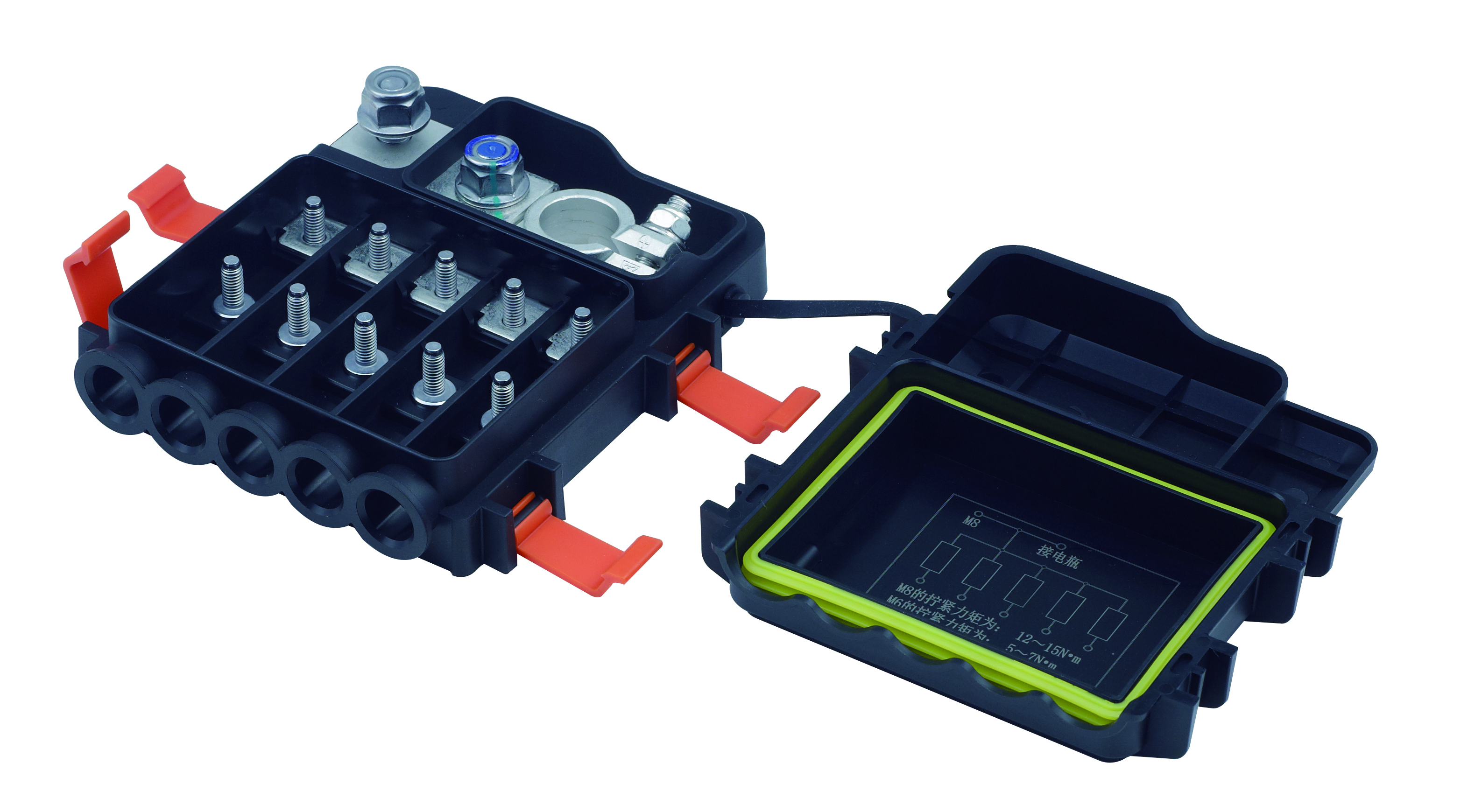
A sealed battery fuse box is one component in a BOM that may carry four or five separate compliance claims, each resting on different evidence.
A wire harness connector bill of materials can look fully compliant and still fail approval, because compliance in this category is rarely a property of a supplier, and often not even a property of a product family. It is a property of an exact part number, a stated application and an acceptance criterion that someone wrote down. IATF 16949 is a quality management system certification with a defined scope. IP66 and IP67 are ingress-protection results that depend on a sealing interface being present and correctly assembled. UL94-V0 and UL94-V2 are material flammability classifications tied to a specific specimen and grade. Compressing all four into one sentence removes precisely the information a procurement or quality engineer needs in order to release the part.
This article sets out a component-level reading of compliance clauses in automotive wire harness connector BOMs, and applies it to published product data from Zhejiang Daou Electronics Co., Ltd. (CNDO), a manufacturer of automotive wire harnesses, battery terminals, fuse boxes and connectors. The point is not that blanket claims are dishonest. It is that they are unactionable, and that a buyer who maps each claim to a model, an application and a document can approve faster and with fewer surprises.
Why a blanket compliance statement fails BOM review
Procurement documents in this category tend to repeat the same shorthand: a connector is described as IATF 16949 certified, IP67 sealed and UL94 flame retardant. Each of those three phrases points to a different kind of evidence, held by a different party, with a different validity period and a different scope.
A system certificate is issued to an organisation for a defined scope of activity and is audited periodically. An ingress-protection rating is a test result produced under a defined setup, and in a connector it is frequently conditional on assembly. A flame rating is a classification of a material specimen and does not describe the finished assembly. Merging them produces a statement that is impossible to verify, because there is no single document that contains all three, and no single entity that issues them.
The practical consequence is a predictable sequence of delays. A supplier sends a certificate. The buyer notices the certificate scope names categories of product rather than part numbers. A second request goes out. The second request arrives as a data sheet that states IP67 without test conditions. A third request follows. None of this signals a bad supplier; it signals a BOM clause that was written as a slogan instead of as an evidence requirement.
The alternative is a five-field release line for every compliance claim: the claim itself, the exact model, the application and zone, the acceptance criterion your programme defines, and the document that will demonstrate it. That structure is what the rest of this article applies.
Four clause families, four different kinds of evidence
Compliance clauses in a harness connector BOM cluster into four families that behave differently during review: quality management system certification, ingress protection, material flammability, and thermal and material specification. Each has its own rules about what it does and does not prove.
IATF 16949 certifies a scope, not a part number
IATF 16949:2016 is the automotive quality management system standard, and a certificate against it confirms that the management system covering a defined scope of activity has been assessed by a certification body. Zhejiang Daou Electronics Co., Ltd. holds certificate 0596976, issued by URS, with an issue date of 21 March 2020 and an expiry date of 8 February 2029. The recorded scope is the design and manufacture of electronic connectors and wire harnesses, and the certificate is positioned for the global automotive supply chain market under IAF mutual recognition.
What that establishes is a certified management system for connector and harness design and manufacture. What it does not establish is that a specific part number has passed a specific durability test, that a specific moulding lot meets a specific flame class, or that a particular cavity configuration has been validated for a particular vehicle programme. Those are separate questions with separate answers.
The useful layer sits between the certificate and the part. The supplier's certificate record associates particular models with the certification: the DOBXS4-1A and DOBXS5-1F battery fuse boxes, the DOCB24001 wiring harness support bracket, the DOE24022 terminal, the D520023 three-way tube conduit connector, and the DOBP22001 and DOBN22006-D5 battery terminals. That mapping is what a buyer should actually read, because it is the supplier's own statement of which part numbers it links to the certified scope.
Where a part is not on that list, the correct action is a written confirmation rather than an assumption in either direction. The DOH0001-1 housing illustrates the case: its parameter sheet lists IATF 16949 as its automotive standard, while it does not appear among the models the certificate record associates with the certification. A written statement that the part falls inside the certified design and manufacturing scope closes that gap in one document. Inferring it, or rejecting the part for the absence of a list entry, both go further than the evidence supports.
IP66 and IP67 are conditional on the sealing interface
Ingress protection codes describe protection against solid particle and water ingress under defined test conditions in the IEC 60529 framework, and the second digit distinguishes levels rather than ranking a single capability. IP66 and IP67 answer different water-exposure questions. For a harness connector, the more important issue is usually not which digit applies but what the rating was measured on.
The D520023 three-way tube conduit connector makes the dependency explicit. Its parameter sheet lists IP66 and IP67 with sealing gaskets, alongside a continuous operating temperature of −40 °C to +120 °C, a short-term peak of 150 °C, PA66 material, chemical resistance to engine oil, mineral oil, grease, weak acid and alkali and partial solvents, and non-conductive electrical behaviour. The rating is therefore attached to an assembled joint that includes a gasket, not to the moulded body in isolation.
Four questions follow from that wording. Is the gasket supplied with the part or ordered separately? Is the gasket material rated across the same temperature window, including the 150 °C short-term peak? Was the ingress test performed on the connector alone or on a representative conduit joint? And does the assembly instruction define gasket seating, orientation and torque? A buyer who asks those four questions before approval avoids the most common field failure mode in sealed harness systems, which is a correctly rated component installed without its sealing element.
The same discipline separates descriptive language from numbered ratings. The DOBXS4-1A and DOBXS5-1F battery fuse boxes describe a flame-retardant plastic shell with a sealed cover and a waterproof and dustproof structure. That is a design description, not a numbered IP grade, and a programme that requires IP67 on the fuse box should request the corresponding test evidence rather than convert the word sealed into a rating. The DOH0001-1 housing, by contrast, states IP67 directly, together with a −40 °C to +125 °C operating range and claims for waterproof, dustproof, oil, acid and alkali resistance and automotive vibration compliance.
One boundary applies to all of them: a housing rated IP67 does not make the finished harness IP67. Wire seals, cavity plugs, the mating half, crimp quality and process control all participate in the result, which is why the acceptance criterion belongs to the assembled part, not to the moulded component alone.
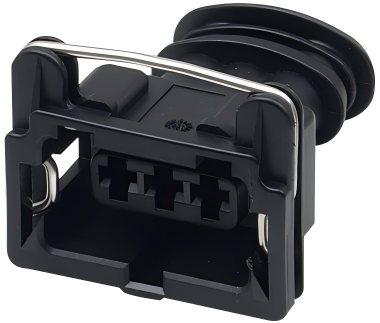
The DOH0001-1 housing states IP67 directly and pairs it with a −40 °C to +125 °C range; the rating still depends on the mating interface and assembly process.
UL94-V0 and UL94-V2 belong to a material and a variant
UL94 is a flammability classification applied to plastic materials using small-scale specimen tests, and V0 and V2 are distinct classifications rather than synonyms, with V0 the more stringent of the two in vertical burning performance. The DOCB24001 wiring harness support bracket lists UL94-V0 and UL94-V2 as compliant with automotive flame retardant standards, and in the same parameter block lists two material options, PA66 and PA66 GF30, along with a −40 °C to +125 °C range in which engine bay versions withstand higher transient temperatures.
Two ratings and two materials in one block is exactly the situation where a BOM line should be specific. Because the classification follows the material and the variant, the release line should name the class and the material together, and the buyer should ask which rating is tied to which material and part variant. A BOM entry reading only UL94 leaves the supplier free to supply either grade, and leaves the quality function unable to demonstrate which one was approved.
It is also worth keeping the scope of the claim visible. A material flammability classification describes the specimen under the standard test, not the fire performance of the assembled harness in service, and it does not replace whatever burning-behaviour requirement the vehicle manufacturer writes into its own specification. The bracket sheet's other claims, covering UV, ageing and salt spray resistance and resistance to engine oil, coolant and cleaning agents, sit in the same category of material and finish evidence and should be requested as test documentation rather than accepted as adjectives.
Temperature ceilings and materials decide the zone
Continuous temperature ratings are the quiet constraint in most harness BOMs, because they are stated per part and read as if they were interchangeable. They are not. In the CNDO data set reviewed here, the fuse boxes, the housing and the bracket list −40 °C to +125 °C, while the D520023 conduit lists −40 °C to +120 °C continuous with a +150 °C short-term peak. In an engine-bay run where the conduit sits closest to a heat source, that difference is a genuine selection constraint, and the 150 °C figure must not be read as a continuous capability.
Material choices follow the same per-part logic rather than a general preference for one polymer. The conduit uses PA66, consistent with its insulation and chemical-resistance claims in engine bay, chassis and body wiring. The housing uses PA/PBT alongside its IP67 and temperature claims. The bracket uses PA66 or PA66 GF30, with the glass-filled option offered in the same parameter set. Conductive parts follow the same pattern: the fuse box main busbar is described as high-conductivity copper or brass with tin, nickel or zinc surface plating, and the DOE24022 terminal lists pure copper, red copper, copper alloy and tin-, nickel- or gold-plated variants across a 12 V/24 V DC rating, up to 48 V DC for special models, with current ratings that vary by size across a 5 A to 200 A span.
Where a parameter sheet offers a menu, the BOM line has to close it. Plating, current size and material grade are specification decisions that affect the contact interface and the corrosion environment, and leaving them to supplier default converts an engineering choice into a purchasing variable.
Reading the CNDO data set component by component
The table below converts the published parameter statements into the form a BOM reviewer can use: what the claim is, which model it attaches to, and what condition or document the claim depends on.
| Component and model | Published claim | Condition the claim depends on |
| Battery fuse box DOBXS4-1A / DOBXS5-1F | Associated with IATF 16949 certificate 0596976; 12 V/24 V DC; −40 °C to +125 °C; PA66 and copper | Main fuse rating is left open in the published parameter list and must be fixed per part number; sealed cover is described but no numbered IP grade is stated |
| Housing DOH0001-1 | IP67; −40 °C to +125 °C; PA/PBT; oil, acid, alkali and vibration resistance | Not listed among the models associated with the certificate record; written scope confirmation and IP test conditions should be requested |
| Support bracket DOCB24001 | UL94-V0 / UL94-V2; −40 °C to +125 °C, higher transient in engine bay versions; PA66 or PA66 GF30 | Rating must be tied to the ordered material and variant; two classes and two materials appear in one block |
| Three-way conduit D520023 | IP66 / IP67; −40 °C to +120 °C continuous, +150 °C short-term peak; PA66 | Ingress ratings stated with sealing gaskets; 150 °C is a peak and not a continuous rating |
| Terminal DOE24022 | 12 V/24 V DC, up to 48 V DC special; current varies by size across 5 A to 200 A; multiple copper and plating options | Size and plating must be fixed on the BOM line; the family rating is not a single current value |
| Battery terminal DOBP22001 / DOBN22006-D5 | SAE top post for 12 V; brass; positive 19.05 mm and negative 17.46 mm tapered posts; M8 thread; 500 A maximum; 8 N·m tightening torque; tin-plated | The 500 A maximum belongs to this terminal, not to the DOE24022 terminal family; torque belongs in the assembly control plan |
Compiled from published CNDO product parameter sheets and the supplier's IATF 16949 certificate record.
Two observations emerge from putting the data side by side. First, the strength of the documentation is uneven across the range in a way that is normal and manageable: the conduit names the condition of its IP rating, the bracket names its flame classes, the housing names its IP grade, and the fuse box names neither an IP grade nor a main fuse value. Second, the gaps are all closable with a single document request per part, which is a very different position from a supplier who cannot say what its own sheet means.
Scenario fit: engine bay, chassis, body and battery positive
Compliance clauses become decision criteria only when they are read against a mounting location, because the same part number can be correctly rated in one zone and marginal in another. The applications described for this product family span automotive manufacturing, new energy vehicle production and wiring harness processing, with sealed connectors reaching IP67 or IP6K9K and unsealed types reserved for dry interior environments, and with vibration requirements commonly referencing ISO 16750 and USCAR-2 alongside IATF 16949, flame retardance and RoHS obligations.
In the engine bay, heat and fluid exposure dominate. That is where the bracket's engine bay variants with higher transient temperature capability, the conduit's PA66 body and its oil, grease and weak acid resistance, and the sealed fuse box cover earn their place in the BOM. It is also where the conduit's 120 °C continuous ceiling needs to be checked against the actual measured temperature at the mounting point rather than assumed adequate because a neighbouring part is rated to 125 °C.
On the chassis, splash and vibration dominate, and the ingress claim moves to the centre of the review. Here the gasket condition on the D520023 conduit and the IP67 statement on the DOH0001-1 housing carry the weight, together with the vibration-resistance claims attached to both the housing and the bracket. In the body and interior, dry-environment parts can legitimately be unsealed, which is often the cheapest correct answer and the one most often over-specified.
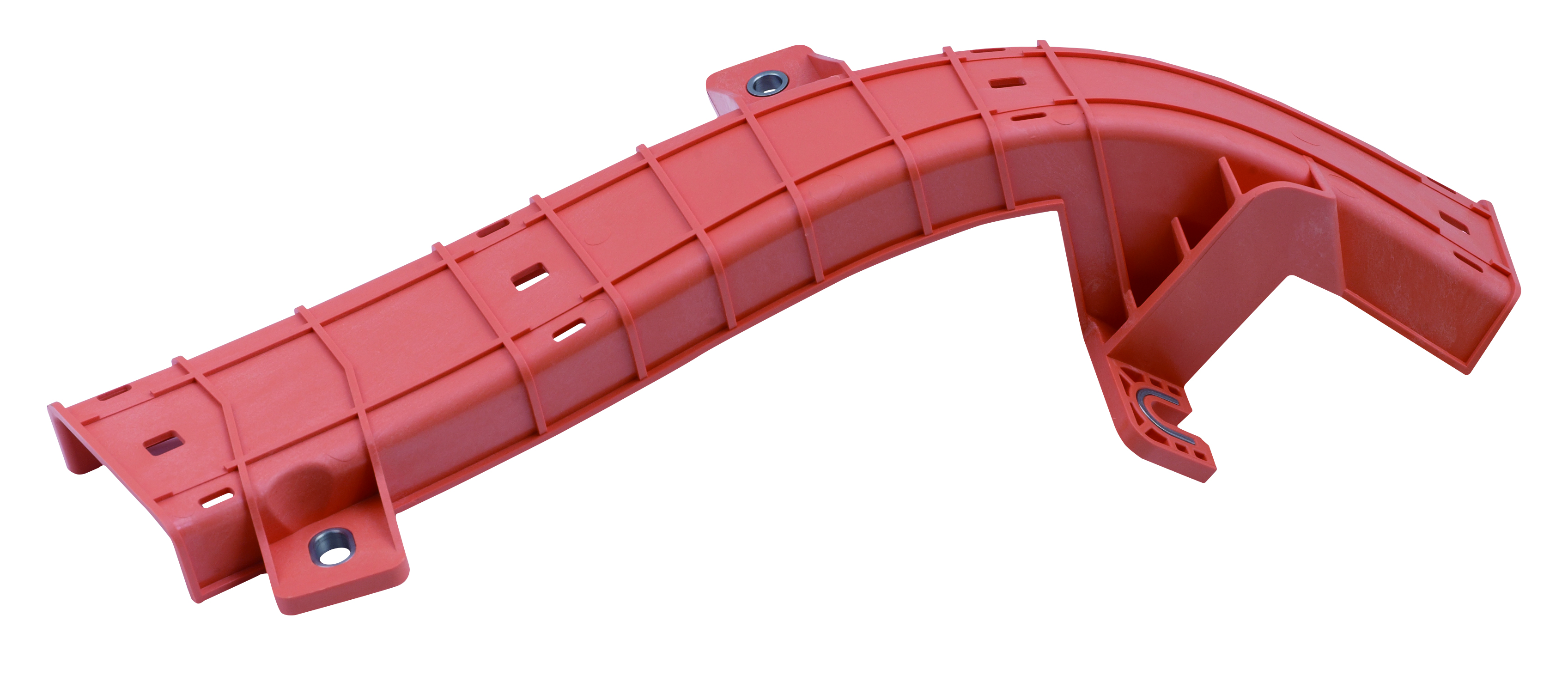
The DOCB24001 bracket is offered in PA66 and PA66 GF30, with engine bay versions described as withstanding higher transient temperatures.
At the battery positive terminal, the acceptance criteria are mechanical and electrical rather than environmental. The DOBXS4-1A and DOBXS5-1F fuse boxes are described for fixed mounting with direct battery positive connection, with a bolt-type mega fuse whose value is left open on the published sheet, auxiliary blade fuses at 5 A, 10 A, 15 A, 20 A or 30 A, and a busbar in copper or brass with tin, nickel or zinc plating. The DOBP22001 and DOBN22006-D5 terminals add an 8 N·m tightening torque and a 500 A maximum against tapered posts of 19.05 mm positive and 17.46 mm negative diameter on an M8 thread. Torque and post diameter are assembly acceptance criteria, and they belong in the control plan rather than in a marketing description.
One clarification matters for anyone reading across the range. The application brief mentions IP6K9K as a sealed-connector grade, but the individual product sheets reviewed here state IP66 and IP67 rather than IP6K9K. A programme that requires the higher designation should request it per part number rather than inherit it from the application description.
The market and regulatory pressure behind the paperwork
The documentation burden is increasing because the number of qualified parts per vehicle is increasing, not because buyers have become more demanding for its own sake. Global Market Insights estimated the automotive wiring harness market at USD 71.2 billion in 2025 and USD 74.7 billion in 2026, with Asia Pacific holding 47.1 percent of 2025 revenue. SNS Insider estimated the automotive high-voltage connector segment at USD 4.99 billion in 2026, with a forecast growth rate of 11.90 percent across 2026 to 2035. The two figures measure different scopes and should not be combined, but both point in the same direction: more connector positions, and a higher share of them carrying voltage and sealing requirements that attract documentation.
Regulatory scope adds a second layer that is often missing from connector BOMs entirely. In the European Union, the ACEA automotive industry REACH guide, published as AIG 4.0 in 2024, sets out how companies in the automotive chain identify substances and preparations and discharge their REACH obligations. For a harness connector, that translates into material declarations per part number and per material grade — PA66, PA/PBT and PA66 GF30 in the examples above — rather than a single statement covering a product family. The RoHS obligation referenced in the application requirements for this product range works the same way.
None of this changes what a connector does. It changes what a buyer must be able to produce when an auditor, a vehicle programme or an export customer asks why a specific part was approved.
Blanket claim versus clause-mapped release
The comparison that matters here is not between suppliers but between two ways of documenting the same part. A blanket claim is faster to write and cheaper to administer. A clause-mapped release costs more review time up front and returns that cost during audits, engineering changes and field investigations.
| Review dimension | Blanket claim | Clause-mapped release |
| Certification | IATF 16949 stated for the supplier | Certificate number, issuer, validity dates, scope, and the part numbers the supplier associates with it |
| Ingress protection | Described as sealed or waterproof | IP grade, gasket dependency, test conditions, and whether the test covered the assembled joint |
| Flame rating | UL94 stated without class | Class, material grade and variant named on the BOM line |
| Temperature | A single range quoted for the family | Continuous versus peak separated, checked against the measured zone temperature |
| Change control | No defined trigger for re-approval | Material, plating or gasket change triggers documented re-verification |
The limitation should be stated plainly, because clause mapping is sometimes oversold inside procurement teams. Mapping claims to part numbers improves traceability and audit readiness. It does not by itself demonstrate field reliability, and it does not replace design verification and production validation testing on the assembled harness. A BOM can be perfectly documented and the assembly still fail validation because of crimp parameters, routing or a mating interface outside the reviewed scope. Clause mapping is a precondition for a defensible release, not a substitute for testing.
It also carries an administrative cost that should be proportionate. For a low-volume, dry-interior body harness run, insisting on test reports for every property claim is unnecessary. The proportionate approach is to map clauses tightly where a failure would be safety-relevant or expensive to correct — battery positive connections, sealed engine bay joints, high-voltage positions — and to accept descriptive statements with a material declaration elsewhere.
What changes next
Two directions are visible in the data reviewed here, and both are conditional rather than certain. The first is the shift in documentation from certificate-level to part-level. A supplier that already publishes per-model parameter sheets, as CNDO does across its fuse box, housing, bracket, conduit and terminal ranges, has most of the raw material for that shift already; the remaining step is attaching evidence documents to the same model identifiers that appear on the BOM. Its capability record, which describes OEM customisation of waterproof grade, pin count, wire gauge and terminal current specification alongside a 7 to 15 day stated lead time, suggests that configuration changes are frequent enough that part-level documentation is a practical necessity rather than a formality.
The second is the continued growth of high-voltage positions, which the SNS Insider forecast of 11.90 percent annual growth across 2026 to 2035 supports if the underlying vehicle mix develops as assumed. Higher voltage positions typically attract more clauses per part, not fewer, because insulation coordination, sealing and material declarations all become explicit requirements. If that forecast holds, the connectors that will be easiest to approve are not necessarily the most sophisticated ones; they are the ones whose documentation was already organised by part number before the RFQ arrived.
FAQ
Does an IATF 16949 certificate cover every part number a supplier lists?
No. The certificate covers a defined scope and a management system, not individual part numbers. Certificate 0596976, issued by URS to Zhejiang Daou Electronics Co., Ltd., carries the scope of design and manufacture of electronic connectors and wire harnesses and runs from 21 March 2020 to 8 February 2029. Within that scope, the supplier's certificate record associates specific models, including the DOBXS4-1A and DOBXS5-1F fuse boxes, the DOCB24001 bracket, the DOE24022 terminal, the D520023 conduit and the DOBP22001 and DOBN22006-D5 battery terminals. For any part number outside that list, written confirmation of coverage is the appropriate request.
Why does an IP67 rating depend on a sealing gasket?
Ingress protection is a property of the assembled sealing system, not of the moulded body alone. The D520023 three-way conduit connector states IP66 and IP67 with sealing gaskets, so the rating applies when the gasket is present, compatible with the operating temperature range, and seated according to the assembly instruction. Without the gasket, or with one that has degraded outside its temperature window, the rating no longer describes the joint. That is why the gasket is a separate line on the BOM and a separate check in the control plan.
What is the difference between UL94-V0 and UL94-V2 on a harness bracket?
Both are UL94 flammability classifications for plastic materials, and V0 is the more stringent of the two in vertical burning performance. The DOCB24001 bracket sheet lists UL94-V0 and UL94-V2 together with two material options, PA66 and PA66 GF30. Because the classification follows the material and the variant, the BOM line should name the class and the material together rather than the string UL94 alone, and the buyer should confirm which rating applies to the ordered combination.
How should temperature range and material be matched to a vehicle zone?
Match the part's stated continuous ceiling to the highest sustained temperature at the mounting point, and keep peak values separate. The fuse boxes, housing and bracket list −40 °C to +125 °C, while the D520023 conduit lists −40 °C to +120 °C continuous with a +150 °C short-term peak, so the peak must not be treated as a continuous figure. Material follows the same logic: PA66 on the conduit for insulation and chemical resistance, PA/PBT on the DOH0001-1 housing, and PA66 or PA66 GF30 on the bracket, each matched to the zone rather than chosen as a general preference.
Where to continue
The full parameter data behind the examples in this article, together with the company's product range and manufacturing information, is available from Zhejiang Daou Electronics Co., Ltd. A downloadable English-language brochure covering the connector, terminal, fuse box and battery terminal ranges is also available: CNDO company brochure (PDF).
Market figures are attributed to their publishers and measure different scopes; company, product and certification statements are drawn from CNDO's published documentation and remain supplier-reported unless independently verified. Buyers should confirm current certificate validity and part-level applicability directly with the supplier before approval.
Есть вопросы или нужны дополнительные детали?
Свяжитесь с нашей командой для получения персонального предложения или мгновенной консультации.
Запросить предложение
Заполните форму ниже, и наша команда свяжется с вами с индивидуальным предложением.
Прямой чат WhatsApp
Предпочитаете общаться в реальном времени? Напишите нам в WhatsApp для мгновенной помощи и быстрых ответов.
- Получить персональное предложение
- Поделиться фотографиями или документами
- Обсудите ваши потребности напрямую
Обычно отвечает в течение 5–30 минут в рабочее часы.