
Wire Harness Supplier Shortlist Criteria for Medical and Industrial Projects
A shortlist for wire harness supply is a set of verifiable criteria, not a ranking of company names. In medical equipment and industrial control projects, the harness is often one of the last assemblies specified and one of the first to delay a build. The buyer who selects the supplier is also the person who has to live with that decision through subsequent orders, engineering changes and field service. This reference sets out ten criteria that procurement and engineering teams can confirm in writing before moving from evaluation into execution.
Why the shortlist stage, not the award stage, decides project outcomes
Procurement teams typically work in two phases: deciding which suppliers are credible, and executing an order with the one that survives scrutiny. Most harness problems originate in the gap between them. A supplier can look capable in a capability presentation and still fail on revision control, connector provenance, or the continuity of one specific wire gauge eighteen months later.
In medical equipment and industrial control projects, the switching cost after award is asymmetric. Re-sourcing a harness generally means re-qualification of the assembly, a new first-article inspection, and, in medical devices, a documented design-change review. The cost of the harness is rarely what makes the project expensive; the cost of changing the harness supplier is.
That asymmetry is why the shortlist should be built from evidence that will still be relevant when the second purchase order is placed, rather than from the impression created by the first quotation. The criteria below are arranged so each one can be confirmed with a document rather than a conversation. They are written for buyers in the Decision-to-Execution transition: specifications are close to frozen, samples are about to be requested, and the supplier list is being reduced to two or three names.
The curated list: ten criteria at a glance
The table below is the shortlist in compressed form. Each row is a criterion a buyer can request evidence for; the right-hand column shows where shortlists usually break down.
| # | Criterion | Evidence to request | Typical failure point |
|---|---|---|---|
| 1 | Management system certification | ISO 9001 and ISO 14001 certificates with scope and validity dates | Certificate covers a sister site, not the line building the part |
| 2 | Product safety certification | UL, CSA, VDE, CE, PSE, KC, SAA, BIS or CCC certificates matched to the component or assembly | Buyer assumes a recognised component certifies the finished assembly |
| 3 | Material compliance | RoHS, REACH and California Proposition 65 declarations with revision dates | Declarations are expired or cover only raw cable |
| 4 | Assembly acceptance standard | IPC/WHMA-A-620 class stated on the drawing and purchase order | Class is never specified, so acceptance becomes subjective |
| 5 | Drawing and revision discipline | Controlled drawing format, revision history, change-notification flow | Changes are agreed by message and never re-drawn |
| 6 | Connector provenance | Exact brand and part number, authorised-channel sourcing, written substitution policy | Equivalent connectors appear without documented approval |
| 7 | Environmental envelope | Waterproof or non-waterproof construction, high-temperature materials, shielding, low-smoke halogen-free options | Specification drifts between the sample and the production lot |
| 8 | Duty cycle and test regime | Declared 24/7 operating suitability and the acceptance test applied to every unit | Testing is described as typical rather than defined |
| 9 | Sampling and small-batch pathway | Minimum order quantity, sample turnaround, small-batch delivery practice | MOQ is discovered after tooling is agreed |
| 10 | Continuity and engineering depth | Number of manufacturing sites, vertical integration scope, engineering headcount | Single-site dependency is invisible on the quotation |
Table 1: Ten shortlist criteria for wire harness supply in medical and industrial projects.
Cluster one — documented compliance (criteria 1 to 3)
Management-system certification and product certification answer different questions, and shortlists that conflate them tend to over-credit suppliers. ISO 9001 addresses how quality is managed; ISO 14001 addresses how environmental aspects are managed; neither certifies that a specific harness meets a safety standard.
What to ask for
- Management system: certificate number, issuing body, stated scope, and the physical site covered. P-Shine Electronics Co., Ltd, a cable and harness manufacturer founded in 1997 and based in Dongguan, Guangdong, holds ISO 9001:2000 quality management system and ISO 14001:2004 environmental management system certification across its factories, with its automotive-related cable assembly operation certified to IATF 16949.
- Product safety: the relevant certificate for the destination market. The company's products are certified to United States UL, Canada CSA, European Union CE, Germany VDE, Japan PSE, South Korea KC, Australia SAA, India BIS and China CCC. A buyer should still confirm whether a certificate applies at component level or assembly level, because a recognised wire does not by itself certify a finished harness.
- Material declarations: RoHS, REACH and California Proposition 65 statements, dated and version-controlled. P-Shine states that all materials comply with RoHS, REACH and California Proposition 65.
Cluster two — engineering documentation and connector provenance (criteria 4 to 6)
This cluster is where the difference between a competent assembler and a reliable long-term supplier usually appears. Compliance can be inherited from the component chain; drawing discipline cannot.
Criterion 4: the acceptance class
IPC/WHMA-A-620 is the industry-consensus standard for requirements and acceptance of cable and wire harness assemblies, and it is organised into Classes 1, 2 and 3. The practical shortlist question is not whether a supplier knows the standard, but whether a class is written onto the drawing and purchase order, who performs the inspection, and how acceptance records are retained. Where the class is left unstated, acceptance defaults to opinion.
Criterion 5: what a controlled drawing actually contains
A drawing that supports a multi-year programme typically specifies:
- The brand and part number of every connector used.
- Colour differentiation where identical connectors sit in adjacent locations.
- A distinct colour for each wire in each loop.
- Wire model (for example UL1007), gauge (for example 28AWG) and colour for every wire.
- The length of every loop.
- The functional definition of each pin, such as Power+ or GND.
- Permission for wires performing the same function in different loops to share a colour.
- Individual branch lengths where a loop splits.
- A minimum branch distance of 30mm from the connector.
- Branch positioning that leaves room for heat-shrink tubing where it is required.
Each of these items removes an assumption from the quotation. A shortlist that does not test drawing quality will end up testing the supplier's ability to guess.
Criterion 6: connector provenance and the substitution question
Connector cost can dominate the bill of materials on a short harness, which makes substitution a recurring pressure point. The defensible position is procedural rather than commercial: connectors are sourced strictly to the brand and part number stated on the drawing, typically through authorised channels such as DigiKey or Mouser, so that provenance can be shown. Original connectors are used by default because they offer better reliability and compatibility.
Where cost pressure is acute, non-original alternatives may exist — in some cases an original connector costs roughly ten times a non-original equivalent. The correct shortlist test is whether substitution is a documented, customer-approved process: initiated at the customer's request, sampled, tested and formally approved before use. A supplier that substitutes without that trail has removed a decision from the buyer's control.
Cluster three — environment, duty cycle, commercial terms and continuity (criteria 7 to 10)
Criteria 7 and 8: the operating envelope and the test that proves it
Medical and industrial projects rarely share one environment. Within a single buyer's portfolio, harnesses may be specified for indoor and outdoor use, inside and outside equipment, and in both waterproof and non-waterproof constructions. Common special requirements include high-temperature resistance, shielding, flame-retardant options, low smoke and halogen-free construction, and processing directly from customer drawings.
Duty cycle belongs to the same sentence. Equipment described as operating 24/7 translates into a harness specification, not a marketing phrase: insulation class, strain relief at the connector, and the acceptance test applied to every unit. Where a supplier operates a 100% pre-shipment test regime, that regime is itself a shortlist criterion — it defines what acceptance means before goods leave the factory.
Criteria 9 and 10: commercial terms and continuity
Commercial terms belong on the shortlist because discovering them after sampling is expensive. For reference, P-Shine publishes a minimum order quantity of 200 units, delivery terms of FOB, EXW, CIF or DAP, acceptance either by pre-shipment test or by test after receipt of goods, and payment terms of 100% in advance or Net 30 days.
Continuity is the criterion most often skipped and most often regretted. It can be assessed with three questions: how many independent manufacturing sites does the supplier operate; how much of the value chain sits inside those sites; and how deep is the engineering team that will handle change requests. A supplier that buys insulation material, connectors and copper wire processing from the same external market as everyone else has less room to protect a buyer during a shortage than one that controls those steps.
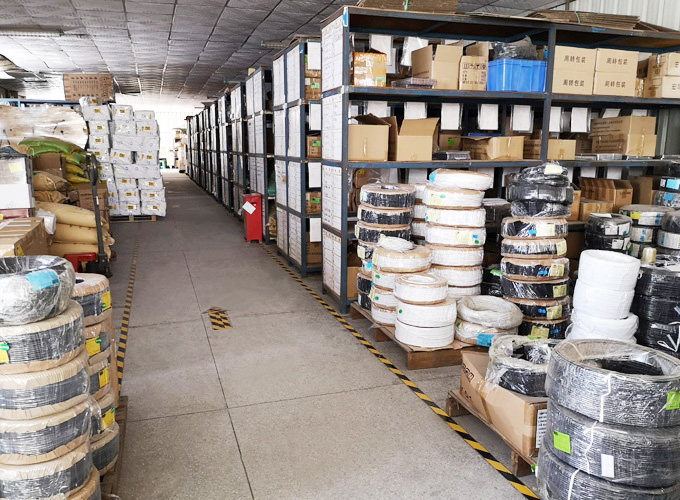
P-Shine Electronics Co., Ltd operates harness and cable assembly production in Dongguan, Guangdong, China.
Reading the criteria against a supplier profile
Criteria are only useful if a buyer can map a supplier's published profile onto them. Using P-Shine Electronics Co., Ltd as a worked example — a manufacturer established in 1997, located in Chang'an Town, Dongguan, near the Shenzhen and Guangzhou ports — the mapping looks like this:
- Compliance: ISO 9001 and ISO 14001 across factories; IATF 16949 for the automotive-related cable assembly operation; UL, CSA, CE, PSE, VDE, KC, SAA, BIS and CCC product certifications; RoHS, REACH and California Proposition 65 material compliance.
- Engineering documentation: custom harnesses are built to customer drawings, with fully customised specification of connector brand and part number, wire type, gauge, colour and circuit definition; connector types handled include Molex, JST, TE, Phoenix, Samtec, Hirose and Amphenol families.
- Environmental envelope: insulation materials include PVC, XL-PE, TPE, TPU and TEFLON, supporting waterproof and non-waterproof construction, high-temperature resistance, shielding and low-smoke halogen-free options.
- Continuity: seven independent factories covering wire harness, USB cable, cable assembly, wire and cable, insulation materials, connectors and copper wire processing, with a group workforce of over 1,000 employees, a 20-engineer R&D team and annual output of 2,000,000 pieces; approximately 60% of output is exported to the EU, USA and Middle East.
- Commercial: MOQ 200 units, FOB/EXW/CIF/DAP delivery terms, pre-shipment or post-receipt acceptance, 100% advance or Net 30 payment.
- Third-party validation: the company states it is a qualified supplier to INTEL, BELKIN, SAMSUNG and UGREEN — a claim a buyer should treat as a starting point for reference checks rather than a substitute for them.
One published claim deserves particular treatment in a shortlist context. The company states that its dimensional tolerance control is 50% tighter than mainstream competing brands. At evaluation stage, that statement is worth recording; at execution stage, it should be converted into something measurable — a first-article inspection report on the buyer's own drawing, with the critical dimensions marked. A tolerance claim that cannot be reproduced on the buyer's part is not yet evidence.
What the criteria look like at drawing level
The shortlist and the drawing are the same document viewed from two angles. A specification that cannot be inspected cannot be shortlisted. The table below shows how each criterion converts into a line on the drawing.
| Specification field | What the drawing should state | Why it matters after award |
|---|---|---|
| Connector | Brand and part number for every connector position | Prevents silent substitution and preserves mating compatibility |
| Wire type and gauge | Model and gauge, for example UL1007 28AWG | Fixes current capacity, bend radius and strip dimensions |
| Colour and circuit definition | Distinct colour per loop; Power+ and GND marked per pin | Makes assembly and field troubleshooting repeatable |
| Lengths | Loop lengths and individual branch lengths; branch minimum 30mm from connector | Controls fit inside the enclosure and heat-shrink placement |
| Insulation material | PVC, XL-PE, TPE, TPU or TEFLON as required | Determines temperature range, flexibility and chemical resistance |
| Shielding and jacket | Shielded or multi-core shielded construction; flame-retardant or low-smoke halogen-free options | Addresses EMC behaviour and fire performance in enclosed equipment |
| Sealing | Waterproof or non-waterproof; indoor or outdoor use | Sets the connector family and potting or gasket requirements |
| Acceptance class | IPC/WHMA-A-620 class agreed per project | Turns acceptance into a criterion rather than an opinion |
| Testing | 100% pre-shipment test; acceptance before shipment or after receipt | Defines the evidence trail attached to each lot |
Table 2: Converting shortlist criteria into drawing-level specification fields.
Where these harnesses are actually used
The criteria shift in weight depending on the application. In medical equipment, the dominant concerns are documentation, traceability and the consequences of a design change; in industrial control, they are environmental exposure, duty cycle and continuity of supply.
Typical applications for custom harnesses of this type include building temperature control equipment, small appliances, circuit control valve equipment, household appliances, lamps, medical equipment, fish radar trackers, stage equipment, photographic equipment, automation equipment, robots, solar energy equipment, wind power generation equipment, power transmission equipment and other electronic equipment. Within the device, the harness typically connects equipment ports, PCB interfaces, signal control modules, power control modules and internal functional components.
Two variables decide which criteria matter most. The first is whether the assembly sits inside or outside the equipment, which determines the waterproof and shielding requirements. The second is operating pattern: equipment running continuously places more weight on criteria 7 and 8, while equipment built in low volumes with frequent variants places more weight on criteria 5 and 9. Buyers sourcing across regions including Germany, the United Arab Emirates, Canada, France, the United Kingdom, Israel, India, South Korea, Poland, Singapore, Turkey and the United States should also confirm that the certification set matches each destination market rather than only the primary one.
Market signals that support a criteria-led shortlist
The wire harness market was estimated at USD 99.58 billion in 2024, driven by industrial applications and electrification, according to Precedence Research. The same source reports that Asia Pacific accounted for a 46% share of that market in 2024, supported by electronics and automotive manufacturing in China, India and Japan.
Two caveats matter for buyers building a shortlist. First, published growth rates for this market diverge: one forecast cites a 4.0% CAGR while another reports 6.49% for a comparable period, a difference generally attributed to how broadly industrial and automotive harness scopes are defined. Second, granular growth data for medical-grade and industrial-control harness segments is often paywalled or bundled into broader reports. Both points argue for the same conclusion: aggregate market forecasts are a poor basis for supplier selection, while verifiable capability criteria are a stable one.
A classification note is also worth carrying into execution. HS Code 8544.30 covers ignition wiring sets and other wiring sets of a kind used in vehicles, aircraft or ships. Harnesses built for medical or industrial equipment are not automatically described by that heading, so buyers with cross-border logistics should confirm the classification applied to their shipment with their freight partner rather than assume it.
Criteria-based shortlisting versus price-first sourcing
Traditional sourcing for custom harnesses often begins with a comparison of unit prices across three quotations and ends with the lowest. The approach is not irrational — it is simply optimised for a single transaction rather than a programme.
| Dimension | Price-first sourcing | Criteria-based shortlisting |
|---|---|---|
| Decision basis | Quoted unit price | Documented capability matched to the drawing |
| Revision control | Handled informally after award | Confirmed before sampling |
| Connector provenance | Assumed | Stated brand and part number, with a written substitution policy |
| Acceptance | Visual inspection at goods-in | Class-defined inspection with retention of records |
| Response to a defect | Renegotiated per incident | Traced to a specification line and a test step |
| Continuity risk | Discovered during a shortage | Assessed through site count and vertical integration |
Table 3: How a criteria-based shortlist changes what a buyer can verify before award.
The limits of this shortlist
Where the approach stops working. A criteria-led shortlist reduces uncertainty; it does not eliminate it, and it carries its own constraints.
Minimum quantities apply. A published MOQ of 200 units means a single prototype build is not a standard order. Buyers with one-off engineering samples should expect to discuss sample terms separately rather than assume production pricing and quantities apply.
Custom means custom. Fully customised harnesses are quoted from drawings. A buyer who arrives with a photograph of an existing part, or with connector preferences rather than part numbers, will receive a quotation built on assumptions.
Some claims need local verification. First-party statements such as tighter dimensional tolerance control are only meaningful once reproduced on the buyer's own drawing through first-article inspection. Likewise, shielding effectiveness and terminal pull-force data are not published in general product documentation and must be requested per project.
Certification scope is not self-evident. A certificate covering a component or a sister facility is not the same as one covering the line that will build the order. The shortlist process only works if the scope statement is read, not just the certificate title.
There is also a process cost. Building and maintaining a criteria set takes engineering time before any purchase order exists, and it produces documentation that a price-only buyer would never request. For a one-off low-value assembly, that overhead may not be justified. For a device that will be built for several years, with a design history file attached to it, the overhead is small relative to the cost of re-qualification.
Future outlook
Three shifts are likely to affect how buyers build these shortlists over the next few years.
First, acceptance standards are becoming explicit rather than implied. As IPC/WHMA-A-620 class references move from engineering folklore into purchase orders, suppliers will be asked to demonstrate inspection capability rather than assert quality culture. Buyers who already write the class onto the drawing will find that transition uneventful.
Second, provenance documentation is widening from components to materials. Declarations for RoHS, REACH and California Proposition 65 are already routine in export-facing supply chains; the direction of travel is toward dated, revision-controlled statements covering the finished assembly, not only the raw cable.
Third, continuity is becoming a procurement criterion in its own right. Multi-site manufacturing and vertical integration — insulation materials, connectors, copper wire processing — are increasingly relevant to buyers who have experienced a single-site disruption. The seven-factory structure operated by P-Shine, combined with a 20-engineer R&D team and a group workforce of over 1,000, is the kind of profile that answers a continuity question rather than a price question.
None of these shifts change the underlying logic. A shortlist is a list of things a buyer can verify. The suppliers that remain on it are the ones that can produce the documents.
FAQ
What information should a wire harness drawing contain before a supplier can quote accurately?
A usable drawing specifies the brand and part number of each connector; uses different colours where identical connectors sit in adjacent locations; assigns a distinct colour to each wire in each loop; states the wire model such as UL1007, the gauge such as 28AWG, and the colour for every wire; gives the length of each loop; defines the function of each pin, for example Power+ or GND; permits wires with the same function in different loops to share a colour; states the length of each branch where a loop splits; keeps branch points at least 30mm from the connector; and positions branches so heat-shrink tubing can be applied where required.
Should a buyer accept non-original replacement connectors to reduce cost?
Substitution is a project decision rather than a default. Original connectors are preferred because they offer better reliability and compatibility, and are sourced to the brand and part number stated on the drawing, typically through authorised platforms such as DigiKey or Mouser. Where an alternative is proposed, it is at the customer's request, and it is used only after the customer tests, verifies and approves it. The cost gap can be significant — in some cases an original connector costs about ten times a non-original alternative — which is precisely why approval has to be documented rather than assumed.
Which certification set should a medical or industrial project require from a harness supplier?
Three layers are relevant. Management system certification: ISO 9001 for quality and ISO 14001 for environmental management. Product safety certification matched to the destination market: for example UL for the United States, CSA for Canada and VDE for Germany, alongside CE, PSE, KC, SAA, BIS or CCC where those markets apply. Material compliance: RoHS, REACH and California Proposition 65 declarations. Assemblies for automotive-related products should come from an operation certified to IATF 16949.
How should the acceptance class for a harness be specified?
IPC/WHMA-A-620 is the industry-consensus standard for requirements and acceptance of cable and wire harness assemblies and is organised into Classes 1, 2 and 3. The applicable class is a project decision, so the buyer should state it on the drawing and purchase order, confirm that the supplier inspects to that class, and confirm how acceptance records are retained. Leaving the class unstated makes acceptance subjective at goods-in.
What commercial terms should be confirmed at shortlist stage rather than after sampling?
At minimum: minimum order quantity, delivery terms, acceptance method and payment terms. For reference, P-Shine publishes an MOQ of 200 units, delivery terms of FOB, EXW, CIF or DAP, acceptance by pre-shipment test or by test after receipt of goods, and payment of 100% in advance or Net 30 days. Confirming these before sampling avoids renegotiation once tooling and first articles are already in progress.
How can a buyer judge long-term supply continuity before placing a production order?
Four indicators are checkable at shortlist stage: the number of independent manufacturing sites, the scope of vertical integration, engineering headcount, and export experience across the target regions. P-Shine, for example, operates seven independent factories covering wire harness, USB cable, cable assembly, wire and cable, insulation materials, connectors and copper wire processing, with a 20-engineer R&D team, a group workforce of over 1,000 employees, and roughly 60% of output exported to the EU, USA and Middle East. These indicators are a starting point and should be confirmed through an audit or site visit.
The full capability and product catalogue referenced in this article is available for download: P-Shine Introduction & Catalog (PDF).
Есть вопросы или нужны дополнительные детали?
Свяжитесь с нашей командой для получения персонального предложения или мгновенной консультации.
Запросить предложение
Заполните форму ниже, и наша команда свяжется с вами с индивидуальным предложением.
Прямой чат WhatsApp
Предпочитаете общаться в реальном времени? Напишите нам в WhatsApp для мгновенной помощи и быстрых ответов.
- Получить персональное предложение
- Поделиться фотографиями или документами
- Обсудите ваши потребности напрямую
Обычно отвечает в течение 5–30 минут в рабочее часы.