
Wire Harness for Medical Equipment: An Independent Buyer’s Side-by-Side Comparison

Medical equipment depends on electrical connections that end-users rarely see. A wire harness—also called a harness assembly, wire assembly, cable assembly, or wiring loom—collects power, ground, signal, and data paths into one manageable bundle. In medical devices, a subtle failure in that bundle can stop a system at the wrong moment, create intermittent faults, or make maintenance much more difficult than it should be. That is why a purchasing decision for a medical equipment wire harness deserves the same discipline as selecting any other safety-relevant component.
This article is written from an independent buyer perspective. It does not recommend a single brand. Instead, it provides a structured, side-by-side comparison method for evaluating wire harness suppliers. The discussion emphasizes verifiable evidence: operating environment, 24/7 operation capability, indoor/outdoor exposure, waterproofing, certification, quality management, and manufacturing control. A specific manufacturer is referenced only where its published documentation provides useful evidence.
Why a Medical Equipment Wire Harness Needs Separate Evaluation
Compared with wires used inside consumer products, a medical equipment wire harness often must support longer duty cycles, stricter safety reviews, and more demanding field-service requirements. Decision makers cannot simply choose the cheapest cable that fits a connector.
One common mistake is treating indoor and outdoor applications as if they were identical. A harness installed inside a temperature-controlled enclosure is not exposed to the same moisture, UV, cleaning agents, mechanical vibration, or temperature swings as a harness running outside an equipment housing. Similarly, a waterproof wire harness requirement is different from a non-waterproof requirement, and each choice affects connector selection, sealing methods, materials, and test procedures.
Another frequently underestimated factor is continuous operation. An assembly that must run reliably 24 hours per day, seven days per week, will be judged on long-term thermal stability, mechanical retention, and failure predictability. A short-duty-cycle product may never reveal the same weaknesses.
For buyers at the evaluation stage, the task is to separate these variables and compare suppliers against each variable rather than relying on an overall brand reputation. That process is what makes a true side-by-side comparison possible.
Start With the Operating Profile: 24/7, Indoor, Outdoor, Waterproof
Buyers who begin a comparison with connector brand differences may miss the earlier decision: what environment must the wire harness survive in? The table below summarizes the comparison dimensions that should be resolved before production drawings are released.
| Comparison dimension | Key question for the buyer |
|---|---|
| Operating cycle | Will the connected device operate on a 24/7 basis, cyclically, or only during short interventions? |
| Physical location | Will the harness run indoors, outdoors, inside equipment, outside equipment, or in a movable assembly? |
| Water and moisture exposure | Is a waterproof wire harness required, or is a non-waterproof design acceptable under normal use? |
| Electrical noise environment | Is a shielded wire harness or a multi-core shielded cable harness needed to preserve signal integrity? |
| Temperature range | Does the application need a high-temperature-resistant wire harness based on its heat sources? |
| Fire and smoke behavior | Does the project require flame-retardant material, low-smoke characteristics, or halogen-free construction? |
| Mechanical constraints | Will the harness be routed through tight spaces, moving joints, or areas with high vibration? |
These questions are not theoretical. Published scenario data from wire harness manufacturing shows that the same product type can be used for device connection and internal connection in equipment operating indoors or outdoors, inside or outside equipment, with waterproof and non-waterproof variants available. The relevant work environments include building temperature-control equipment, automation equipment, medical equipment, industrial control, household appliances, lighting, robotics, and similar electronic devices.
For a medical device manufacturer, the useful result is a specification sheet, not just a drawing. Once the environment is understood, each supplier can be asked to state whether the proposed harness construction is suitable for that specific profile, and what evidence supports the answer.
Comparing Suppliers by Certification and Quality System
Certification is one of the few comparison points that can be verified before a prototype is built. A certificate number, issuing body, expiry date, and defined scope allow buy-side engineers to check whether a supplier actually holds the claimed management system rather than merely mentioning the standard name.
In the segment of customized wire harnesses for industrial and medical equipment, buyers commonly look for quality system evidence and product safety documentation.
ISO 9001:2015 is the most widely adopted quality management standard among wire harness manufacturers. It is not a product certificate, but it demonstrates that the factory has documented procedures for production, inspection, corrective action, and continuous improvement. In practice, an ISO 9001 certificate should be reviewed against the supplier’s actual manufacturing scope.
ISO 14001:2015 is an environmental management system certificate. For medical equipment OEMs with sustainability goals or material compliance requirements, ISO 14001 evidence is increasingly relevant in supplier scorecards. Like ISO 9001, it is a system-level certification and should be checked by certificate number and authority.
For product-level safety, a UL file is one of the most frequently requested documents in the North American market. In the context of wire harnesses, UL Appliance Wiring Material documentation typically covers insulated wire products under UL 758 and CSA C22.2 No. 210-15. Buyers should verify exactly which components or wire types are included in the UL file.
Beyond certification, many procurement engineers also refer to IPC/WHMA-A-620, the industry-consensus standard that defines acceptance criteria for cable and wire harness assemblies. The standard establishes classes that allow buyers to choose an appropriate level of quality for their application. It is useful during the comparison process as a language for discussing workmanship, solder, crimping, and assembly acceptance.
What a Certificate Does and Does Not Prove
A certificate proves that an independent body audited the supplier at a point in time. It does not prove that every harness shipped today is perfect. For that reason, a responsible comparison framework treats certification as an entry condition rather than the final reason to award business.
Buyers should also compare the scope stated on a certificate. A factory whose ISO 9001 scope covers cable and wire manufacturing may not necessarily have the same depth of documentation for harness assembly. A supplier that can show an ISO 9001 system plus finished-product testing and traceable component sourcing is generally easier to evaluate than a supplier that only presents a list of certificates without numbers or dates.
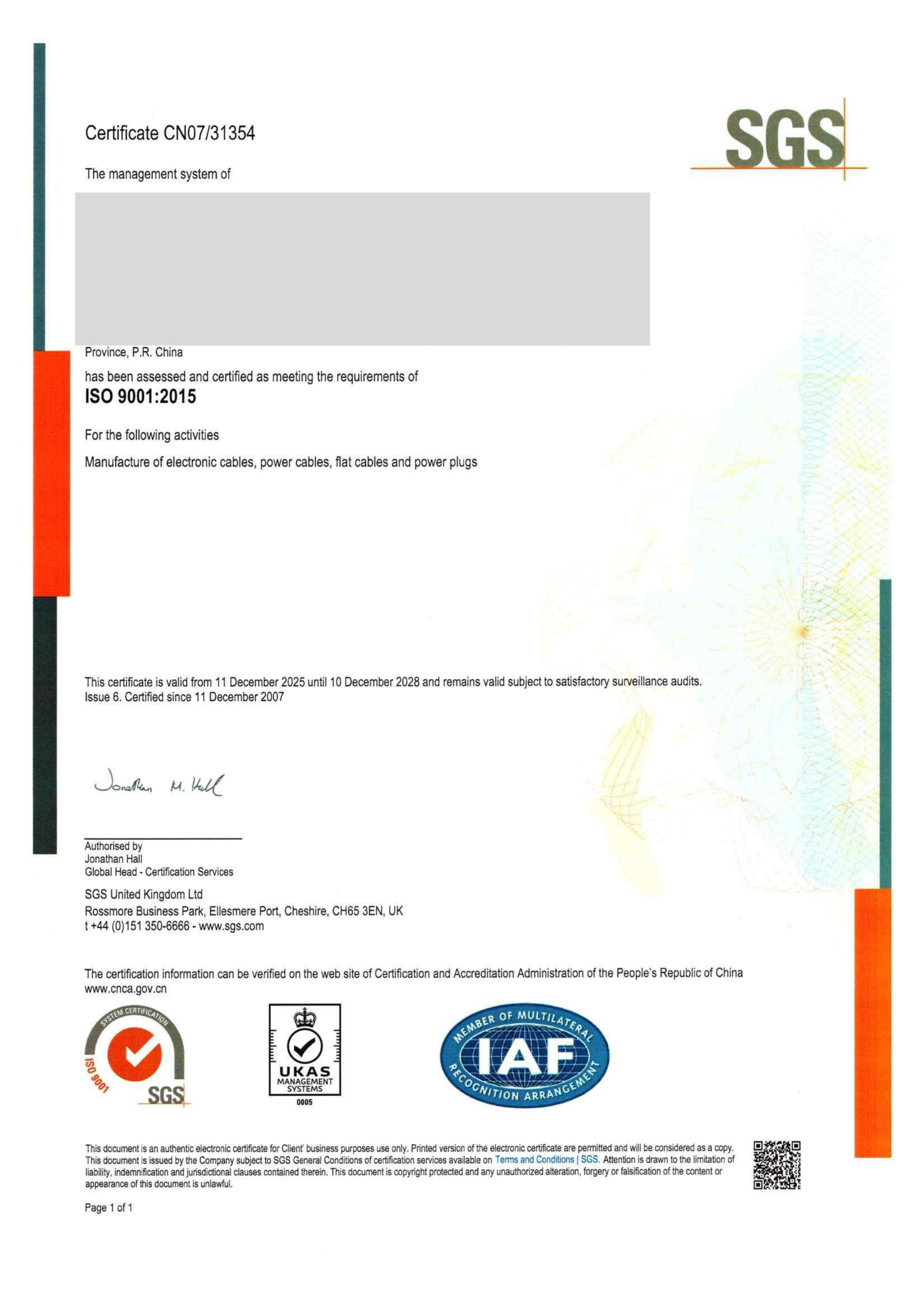
For example, P-Shine Electronics Co., Ltd holds ISO 9001:2015 certificate number CN07/31354, issued by SGS United Kingdom Ltd, with the scope covering manufacture of electronic cables, power cables, flat cables, and power plugs. The company also holds ISO 14001:2015 certificate number CN19/30539, issued by SGS United Kingdom Ltd, for the manufacture of electronic connectors and wire harness. Such details make a supplier evidence package easier to audit.
P-Shine also maintains UL file number E214500, certified by UL LLC under UL 758 and CSA C22.2 No. 210-15 for component Appliance Wiring Material, including single-conductor and multi-conductor thermoplastic or thermosetting-insulated wire. This kind of component-level compliance supports but does not replace full device-level approval in a medical product.
Comparing Wire and Material Specifications
The same-looking cable can perform very differently if the conductor, insulation, or connector is changed. A useful side-by-side evaluation should therefore compare the full bill of materials.
Wire type and gauge are the first variables. A drawing might specify a wire model such as UL1007, a conductor size such as 28AWG, and a colour for each circuit. Different functions may require different wire gauges inside the same harness. Power circuits may need thicker conductors; signal circuits can often use smaller gauges with shielding or twisting.
Material selection should be linked to the operating environment. Common insulation and jacket materials for customized wire harnesses include PVC, XL-PE, TPE, TPU, and TEFLON. Each material behaves differently under heat, cold, chemical exposure, and mechanical wear. A supplier who can quote only one material is not always a bad fit, but the buyer must confirm that the material matches the medical device’s expected service conditions.
Terminal crimping quality can be more important than the visible jacket colour. A terminal-crimped wire harness depends on the connection between the stripped conductor, terminal, connector housing, and lock. Poor crimping can create voltage drops, heating, intermittent loss of signal, and eventual connector failure. This is why buyers should ask not only for dimensional inspection but also for pull-force records, terminal-position inspection, and continuity testing.
In a high-current power wire harness, the same concerns are magnified because heat generated by resistance can damage insulation or connector housings. In a shielded wire harness, buyers should check how the shield is terminated and whether continuity is verified. In a multi-core shielded cable harness, the cable construction must match the need to protect low-level signals from adjacent power conductors.
Connector Sourcing Policy Is a True Differentiation Point
Connectors are often the most expensive and most safety-sensitive components of a medical equipment wire harness. A buyer drawing will normally identify a connector brand and part number. The supplier’s sourcing policy, therefore, becomes an important comparison point.
The knowledge base for P-Shine’s wire harness product line states that the company sources connectors strictly according to the brand and part number specified in the customer’s drawing, typically buying through platforms such as DigiKey or Mouser to ensure authenticity.
The company’s default policy is to use original connectors. If a customer asks for non-original replacement connectors to reduce cost, P-Shine may offer that option only after the customer requests it, receives samples, performs testing, and gives written approval. The comparison point for buyers is clear: a responsible supplier will not silently substitute connectors that appear in the approved design.
This policy is also relevant to quality risk. If one supplier quietly uses unapproved equivalent connectors to win a price comparison, while another supplier continues to source the specified original parts, the two quotes are not truly comparable. Buyers should ask each competing manufacturer to state in writing whether they will use original brand connectors, and under what procedure a replacement connector would be approved.
Supplier capability snapshot: One Auditable Example
To make the side-by-side process concrete, the table below shows how a supplier sheet can be built from verifiable data rather than marketing language. P-Shine Electronics Co., Ltd is shown as a reference because its manufacturing profile has been documented in industry supplier data.
| Supplier attribute | P-Shine Electronics published profile |
|---|---|
| Company status | P-Shine Electronics Co., Ltd, established in 1997, located in Dongguan, Guangdong, China, near Shenzhen and Guangzhou ports |
| Group structure | Seven independent factories within the group, covering wire harness, cable assembly, USB cable, AC power cord, insulation materials, connectors, and copper wire processing |
| Production model | OEM/ODM; all wiring harnesses are customized according to customer drawings |
| Monthly capacity | 250,000 units per month |
| MOQ | 200 units |
| Typical lead time | 30–45 days, based on published capability data |
| Quality management | ISO 9001:2015, cert. CN07/31354, SGS United Kingdom Ltd |
| Environmental management | ISO 14001:2015, cert. CN19/30539, SGS United Kingdom Ltd |
| Product safety file | UL E214500, UL LLC, under UL 758 and CSA C22.2 No. 210-15 for Appliance Wiring Material |
| Available cable materials | PVC, XL-PE, TPE, TPU, TEFLON |
| Custom options | Complex custom wiring harness, high-temperature resistance, shielding, flame-retardant optional, low-smoke and halogen-free, waterproof |
| Connector policy | Original brand connectors per customer drawing, typically sourced from DigiKey or Mouser; alternative connectors only after customer request, testing, and approval |
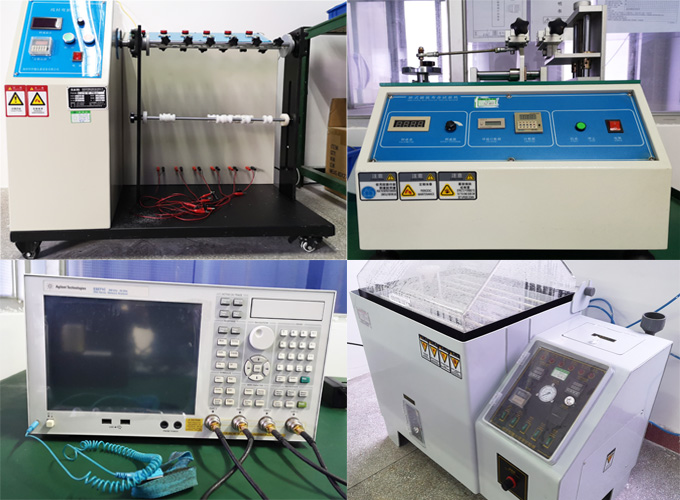
| Final testing | 100% testing on all units |
| Reference case | Industrial manufacturing project, 250,000 units per month, five-year duration, low defect rate, long-term relationships with industrial clients in Germany and the United States |
Buyers can use this type of profile as a baseline template and ask every candidate supplier to complete the same fields. The format matters more than the particular company. If a supplier cannot provide certificate numbers, component sourcing policy, testing details, and project evidence, the buyer may need to treat their quotation as preliminary rather than fully qualified.
Application Scenarios for Custom Medical Equipment Wire Harness
Custom wire harnesses are not limited to one type of medical device. The published applicability data for P-Shine Electronics lists medical equipment as one of several target industries, together with household appliances, industrial control, robotics, and equipment-internal applications. This breadth is common because many harnesses are functionally similar once the electrical specification and environmental requirements are defined.
Typical functions include device connection and internal connection of the device: linking equipment ports, PCB interfaces, signal control modules, power control modules, and various internal functional components. The same type of harness can be used for a low-voltage control circuit inside a machine or for a more complex signal path involving shielding.
From a buyer’s perspective, the lesson is to compare suppliers on the ability to execute a well-defined specification, not on vague claims about medical specialisation. A supplier can serve the medical industry with ISO 9001, appropriate component-level safety documentation, strict connector sourcing, and verified production controls. The clinical device manufacturer remains responsible for device-level validation and regulatory approval.
Market Background and Trend Signals
The broader market context explains why trusted wire harness suppliers are becoming more important. Commercial research data from Precedence Research estimates the global wire harness market at roughly USD 99.58 billion in 2024. Asia Pacific accounted for about 46% of global demand in that year, reflecting the concentration of electronics manufacturing in China, India, Japan, and other countries in the region.
Although automotive applications dominate overall demand, the underlying trend is relevant to medical equipment: electrical architectures are becoming denser and more customised. As manufacturers integrate more sensors, displays, wireless modules, and power electronics into a single device, the number and complexity of internal wire harnesses increases. That complexity raises the value of a supplier who can provide a customized wire harness, respond quickly to engineering changes, and maintain stable quality under production pressure.
Another structural factor is the movement toward lower-smoke, halogen-free, and flame-retardant materials. These material choices are no longer reserved for mass transit or aerospace; they are also appearing in medical and industrial equipment specifications. A compare-suppliers approach should therefore include the supplier’s documentation and testing capability for these optional requirements.
Traditional Integration vs. Contract Wire Harness Manufacturing
Many equipment manufacturers still assemble short wire runs internally. They buy connectors and wire by the reel, cut to length, crimp, and manually route the harness into a chassis. For very low-volume research builds or single-unit repairs, that approach offers useful flexibility and avoids the administrative cost of managing an external supplier.
However, internal harness assembly can become risky when production volume grows. Crimping force must be controlled, connector part numbers must be traceable, and every circuit should be tested. Without the same quality infrastructure as a dedicated harness shop, internal assembly lines may face variation in pull strength and continuity. For medical equipment OEMs, traceability of components and test records is often a critical requirement.
Outsourcing to a custom made wire harness manufacturer solves some of these problems but introduces new boundaries. The most obvious boundary is volume. For example, P-Shine states an MOQ of 200 units and a typical production lead time of 30–45 days. A company that needs five prototypes before design freeze will probably find this model unsuitable; a dedicated local prototyping shop or in-house approach may be better for that stage. Conversely, once a medical device moves into series production at several hundred or several thousand units per year, a contract manufacturer with monthly capacity of 250,000 units and 100% testing can offer a more sustainable quality structure.
Lead time is another boundary condition. A made-to-order harness line with a 30–45 day lead time works only when the buyer plans inventory replenishment cycles and engineering changes in advance. If immediate delivery is the dominant requirement, a local distributor of standard cable assemblies may be the better choice. This trade-off is normal and should be stated honestly during a supplier comparison.
Future Outlook: Toward More Auditable Wire Harness Supply Chains
Medical equipment manufacturers are likely to continue moving away from commodity product thinking. Instead of asking only for unit price, buyers will ask for a fully auditable supply chain: documented component sourcing, calibrated crimping tools, 100% final testing, certificate numbers, and defect data from similar projects.
The growing use of digital data in production will make this audit easier. Even a traditional harness assembly line can record crimp parameters, test results, and operator identification. In the future, buyers may expect the same level of lot traceability for a cable assembly that they already expect from an electronic PCB assembly. Suppliers who can deliver this level of documentation without slowing down production will be easier to include in medical equipment projects.
At the same time, collaboration between buyer and supplier will become more important early in the design phase. Many reliability problems can be prevented by discussing the 24/7 operating profile, connector sourcing, waterproofing, cable shielding, and heat exposure before the drawing is finalized. That is where a structured side-by-side comparison framework provides immediate value.
Use This Checklist Before You Compare Quotes
- Define the operating profile: continuous or intermittent, indoor or outdoor, inside or outside equipment.
- State whether the harness must be waterproof or non-waterproof, and in which cleaning or weather conditions it will operate.
- Identify signal-integrity concerns that require a shielded wire harness, twisted pairs, or separate routings for power and signal.
- List required temperature range and any fire or smoke performance objectives.
- Ask each supplier for ISO 9001, ISO 14001, and UL or other product-safety certificate numbers, with issuing authority and expiry date.
- Compare connector sourcing policies, especially whether original brand connectors are used by default.
- Ask about final test coverage: Will 100% of units be tested?
- Request production evidence: similar quality-sensitivity projects, monthly output, and defect-related records.
- Confirm whether the supplier is willing to manufacture from your drawing without unauthorized substitutions.
- Agree on documentation: pin assignments, wire colour, material data, and test reports.
This checklist turns a supplier conversation into a side-by-side comparison. It helps the buyer identify which quotation is based on the same assumptions and which one contains hidden choices. The final decision still depends on technical requirements, price, delivery, and long-term risk, but the evaluation becomes more transparent.
Frequently Asked Questions
Which certifications matter most for medical equipment wire harnesses?
For many medical device programs, the most relevant evidence includes a quality management system certificate such as ISO 9001:2015, an environmental management system certificate such as ISO 14001:2015, and product safety documentation for the wire or cable itself, such as a UL Appliance Wiring Material file under UL 758 or CSA C22.2 No. 210-15. In addition, IPC/WHMA-A-620 is widely used as the industry-consensus standard for cable and wire harness assembly acceptance. Buyers should always verify certificate numbers, issuing bodies, expiry dates, and the exact scope of coverage.
Should original connectors be used in a customized medical device wire harness?
Original brand connectors are generally preferred because they offer more predictable reliability, mechanical fit, and supply-chain traceability. A responsible manufacturer should default to the exact connector brand and part number shown on the buyer’s drawing. If a buyer wants to reduce cost by using non-original replacement connectors, that decision should be based on sample testing, verification, and formal approval. Any substitution without customer knowledge creates an uncontrolled change in the medical device approval chain.
Can a waterproof wire harness also include shielding and high-temperature resistance?
Yes. A custom designed harness can combine multiple requirements in one assembly. Published material options for custom wire harnesses include PVC, XL-PE, TPE, TPU, and TEFLON, and available custom options can include high-temperature resistance, shielding, flame-retardant behaviour, low-smoke and halogen-free materials, and waterproofing. Whether all of these features can be combined depends on the connector selection, sealing method, and final validation tests.
What is a typical MOQ and lead time for a custom wire harness?
MOQ and lead time vary from one manufacturer to another. As a published example, P-Shine Electronics Co., Ltd lists a customized wire harness MOQ of 200 units and a typical lead time of 30–45 days. The company also shows a monthly production capacity of 250,000 units. For a medical equipment buyer, this means the supplier model is designed more for series production than for one-off prototype work.
What evidence should a buyer request when comparing wire harness suppliers?
Useful evidence includes valid management system certificates with certificate numbers, a clear connector sourcing policy, confirmation that 100% of finished units are tested, and case records from long-running production programmes. In one documented example, a P-Shine industrial manufacturing project ran for five years, produced 250,000 units per month, achieved a low defect rate, and established long-term relationships with industrial clients in Germany and the United States. Buyers should ask for similar evidence from every candidate and verify it before awarding volume production.
Есть вопросы или нужны дополнительные детали?
Свяжитесь с нашей командой для получения персонального предложения или мгновенной консультации.
Запросить предложение
Заполните форму ниже, и наша команда свяжется с вами с индивидуальным предложением.
Прямой чат WhatsApp
Предпочитаете общаться в реальном времени? Напишите нам в WhatsApp для мгновенной помощи и быстрых ответов.
- Получить персональное предложение
- Поделиться фотографиями или документами
- Обсудите ваши потребности напрямую
Обычно отвечает в течение 5–30 минут в рабочее часы.