
Withdrawable vs Fixed Switchgear: A Buyer Framework for GCS, GGD, GCK & MNS
Withdrawable vs Fixed Switchgear: A Buyer Framework for GCS, GGD, GCK & MNS
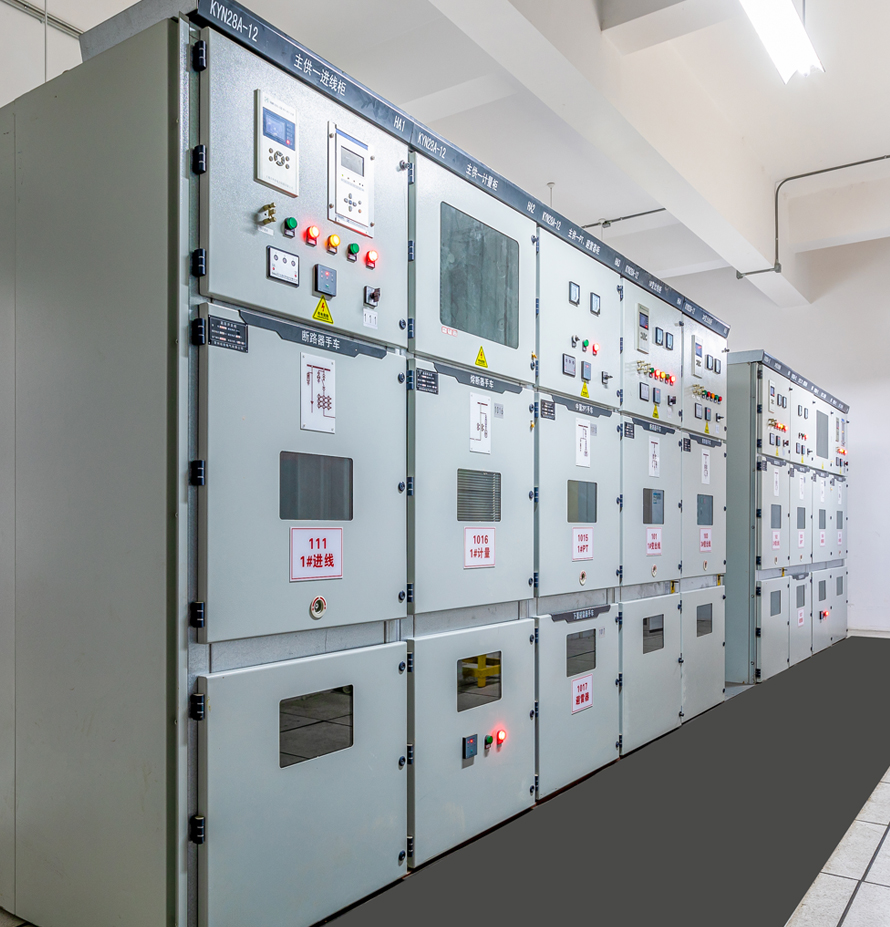
Low voltage switchgear is built in two structural forms. Withdrawable switchgear places each circuit on a module that can slide out of the enclosure while the main busbar stays energised; fixed switchgear bolts the same components directly onto the frame. Within standard industrial product families, GCS, GCK and MNS are withdrawable designs, while GGD is a fixed design. For a project buyer, that choice is not a stylistic one. It determines whether a feeder can be isolated and replaced without de-energising a busbar section, and it changes what has to be verified at acceptance.
This article assembles the published parameters of four low voltage switchgear families — GCS, GCK, MNS and GGD — and organises them around the four decision points a project buyer actually uses before issuing a purchase order: application fit, current capability, enclosure protection, and purchasing terms with acceptance criteria. It is a comparison framework, not a ranking. Each family is positioned on the same dimensions so that the trade-offs between the two architectures are visible before the specification is frozen.
What Separates Withdrawable Switchgear from Fixed Switchgear
A withdrawable functional unit is mounted on a drawer that travels into a compartmented enclosure. The contact system forms the connection at the rear of the module, and mechanical interlocks prevent the module from being moved while it is carrying load. The operational consequence is straightforward: an individual incomer, feeder or motor starter circuit can be de-energised, withdrawn and replaced while the remaining circuits on the same section continue to run. Commissioning and maintenance can be planned circuit by circuit.
A fixed functional unit is bolted to the frame and wired through copper busbars and cables. There is no drawer mechanism, no sliding contact system and no travel interlocks — which also means there are fewer mechanical parts to maintain. The trade-off is that work on a single circuit usually requires the whole section to be taken out of service.
In the product data used for this comparison, GCS, GCK and MNS are all listed as low voltage withdrawable switchgear. GGD is listed as low voltage fixed switchgear. That structural difference is the clearest dividing line in the data set, and it is worth noting that one withdrawable family and the fixed family share identical electrical ratings — which is why the choice between them has to be made on maintenance strategy rather than on current alone.
The Problem: Architecture Gets Decided Late
Procurement teams typically specify switchgear by voltage, current, short-circuit withstand and protection degree. Those parameters sit on the datasheet and are easy to compare across suppliers. The architecture — withdrawable or fixed — is often treated as an engineering preference and pushed to the vendor. The consequences surface later, usually at one of two moments: the first scheduled maintenance outage, or the first time a single feeder has to be replaced.
On a withdrawable board that is a maintenance task. On a fixed board it is a shutdown event, and the shutdown window has to be negotiated with the facility operator. That is the practical reason the architecture question belongs in the evaluation stage rather than in operations. It also interacts with three measurable parameters — main busbar current rating, short-time withstand current, and whether the enclosure protection level is standard or custom.
Technical Comparison of GCS, GCK, MNS and GGD
The table below compares the published electrical and structural parameters of the four families. GCS, GCK and MNS are withdrawable; GGD is fixed. Cabinet materials, conductive materials and insulation materials are consistent across the four data sets.
| Parameter | GCS | GCK | MNS | GGD |
|---|---|---|---|---|
| Structure | Withdrawable | Withdrawable | Withdrawable | Fixed |
| Rated insulation voltage | 660 V | 660 V | 660 V | 660 V |
| Rated operational voltage | 380 V / 660 V | 380 V / 660 V | 380 V / 660 V | 380 V / 660 V |
| Rated current / max. main busbar operating current | 1600–4000 A | 600–1600 A | 1600–4000 A | 600–1600 A |
| Main busbar short-time withstand current (1 s) | 100 kA | 50 kA | 100 kA | 50 kA |
| Main busbar short-time peak current | 120 kA | 80 kA | 120 kA | 80 kA |
| Protection degree | IP30 | IP30 | IP30 | IP30 |
| Cabinet frame, enclosure, partitions | Galvalume or cold-rolled galvanized steel sheet, integrally bent, electrostatic plastic spraying | Same | Same | Same |
| Conductive busbars and contacts | T2 pure copper, tin or silver plated contact surfaces | Same | Same | Same |
| Insulating parts | SMC compound, epoxy resin, PVC sleeves | Same | Same | Same |
| Fasteners | 304 stainless steel | Same | Same | Same |
Two clusters emerge from the data. GCS and MNS carry the higher rating set: a main busbar operating current of 1600–4000 A, a 1-second short-time withstand current of 100 kA and a short-time peak current of 120 kA. GCK and GGD share a lower rating set: 600–1600 A rated current, 50 kA for one second, and 80 kA peak. The distinguishing factor between GCK and GGD is therefore not electrical capacity — it is the withdrawable versus fixed construction.
Inside the board, the distribution (vertical) busbar data is published for GCS and MNS only: a maximum operating current of 1600 A, with a short-time peak current of 80 kA in the standard type and 100 kA in the reinforced type. Equivalent vertical busbar figures are not included in the GCK and GGD source data, which is a gap a buyer should close during technical clarification rather than assume.
A Buyer Decision Framework
The parameters above only become useful when mapped onto a selection sequence. The four steps below follow the order in which the decision normally constrains itself — each step removes options before the next one is applied.
Step 1 — Application fit
In the source data, all four families are listed against the same broad application set: power and new energy installations (thermal, hydro, photovoltaic, energy storage and wind plants, substations and nuclear auxiliary power), heavy industry and manufacturing (metallurgy, steel, petrochemical, offshore oil and gas platforms, coal mines, papermaking, automotive, textile, machinery and semiconductor plants), digital infrastructure (data centres, communication equipment rooms and charging station distribution), transportation infrastructure (metro, rail transit, airports, seaports, tunnels and logistics parks), civil and public buildings (high-rise buildings, commercial complexes, residential districts, hospitals, schools, exhibition centres and hotels), and special scenarios such as ships, offshore platforms, municipal sewage treatment plants and waste incineration power plants.
Because the application list is identical across the four families, application fit cannot be decided by industry sector alone. It has to be decided by the load being served. Facilities that need to isolate one feeder while the rest of the board stays live — data centres, hospitals, continuous process lines, metro auxiliary supply — sit naturally with the withdrawable group. Facilities where the board serves a more stable set of loads and maintenance windows are planned well in advance can be served by a fixed board without operational penalty.
Step 2 — Current capability and fault withstand
This step is numerical. A busbar section rated at 1600–4000 A with a 100 kA one-second withstand and 120 kA peak, as published for GCS and MNS, suits a main distribution position downstream of a large transformer. A section rated at 600–1600 A with 50 kA withstand and 80 kA peak, as published for GCK and GGD, suits sub-distribution and motor control positions where the available fault level is lower.
The buyer question to settle at this stage is whether the selected architecture still matches the fault level once the upstream transformer and cable run are fixed. A fixed GGD board and a withdrawable GCK board share the same ratings, so choosing between them is a maintenance-strategy decision; choosing between either of them and a GCS or MNS board is a capacity decision.
Step 3 — Enclosure protection and cabinet materials
All four families are published at IP30 as standard. That is an indoor, dust-protected rating without water ingress protection. For clean indoor electrical rooms it is adequate; for dusty, humid, saline or outdoor positions it is not, and the protection level has to be specified as a custom requirement rather than assumed.
Cabinet construction is consistent across the four data sets: frames, enclosures and partitions in galvalume steel sheet or cold-rolled galvanized steel sheet, integrally bent and assembled, then finished with electrostatic plastic spraying for corrosion resistance. Conductive busbars and contact terminals are T2 pure copper with tin or silver plating on contact surfaces. Insulating components use SMC moulding compound, epoxy resin and PVC sleeves, and fasteners are 304 stainless steel. For a buyer, this means that material quality differentiators between the four families are not present in the published data — the specification difference lies in structure, current class and protection level, plus any custom material upgrade agreed separately.
Step 4 — Purchasing terms and acceptance criteria
Commercial terms published for this supply line are: minimum order quantity of 1 unit, delivery terms FOB Shanghai, payment of 30% deposit by T/T with the full balance paid before loading and shipment. Acceptance is defined as pre-shipment testing plus third-party inspection, with SGS named as an example inspection body.
Translating those terms into a working acceptance checklist means confirming, at minimum: nameplate ratings against the ordered specification; the conductive busbar material and plating; mechanical operation of every withdrawable unit where applicable; the achieved protection degree; earthing continuity; and the bilingual document set required for customs clearance and project handover. For a withdrawable board, the drawer travel and interlock behaviour should be witnessed rather than verified from a drawing. For a fixed board, torque values on the busbar connections are the equivalent check.
Where the Manufacturer Sits in This Framework
Changzhou Tuoxin Electric Co., Ltd. is a switchgear manufacturer based in Xixiang Industrial Park, Hengshanqiao Town, Changzhou, Jiangsu Province, China, and is a designated supporting manufacturer of electrical equipment for Changzhou Power Supply Company. The company was founded in 2010 and operates a 4000 square metre facility with 56 employees, producing approximately 3000 units annually, with export accounting for around 40% of output. Its technical organisation comprises 3 senior engineers, 1 senior consultant, 5 engineers and 18 technical personnel.
Its low voltage portfolio covers the four families discussed here — GCS, GCK, MNS and GGD — alongside GBD, GXL, XL and XLW series low voltage switchgear. The wider catalogue also includes KYN28 and XGN15 series high voltage switchgear, YB series box-type substations, PZ30 modular terminal lighting distribution boxes, XJM series metering boxes, custom non-standard electrical control cabinets, and bus ducts. Because the same manufacturer supplies both the withdrawable and the fixed families, the architecture choice discussed in this article is a specification decision for the buyer rather than a supplier limitation.
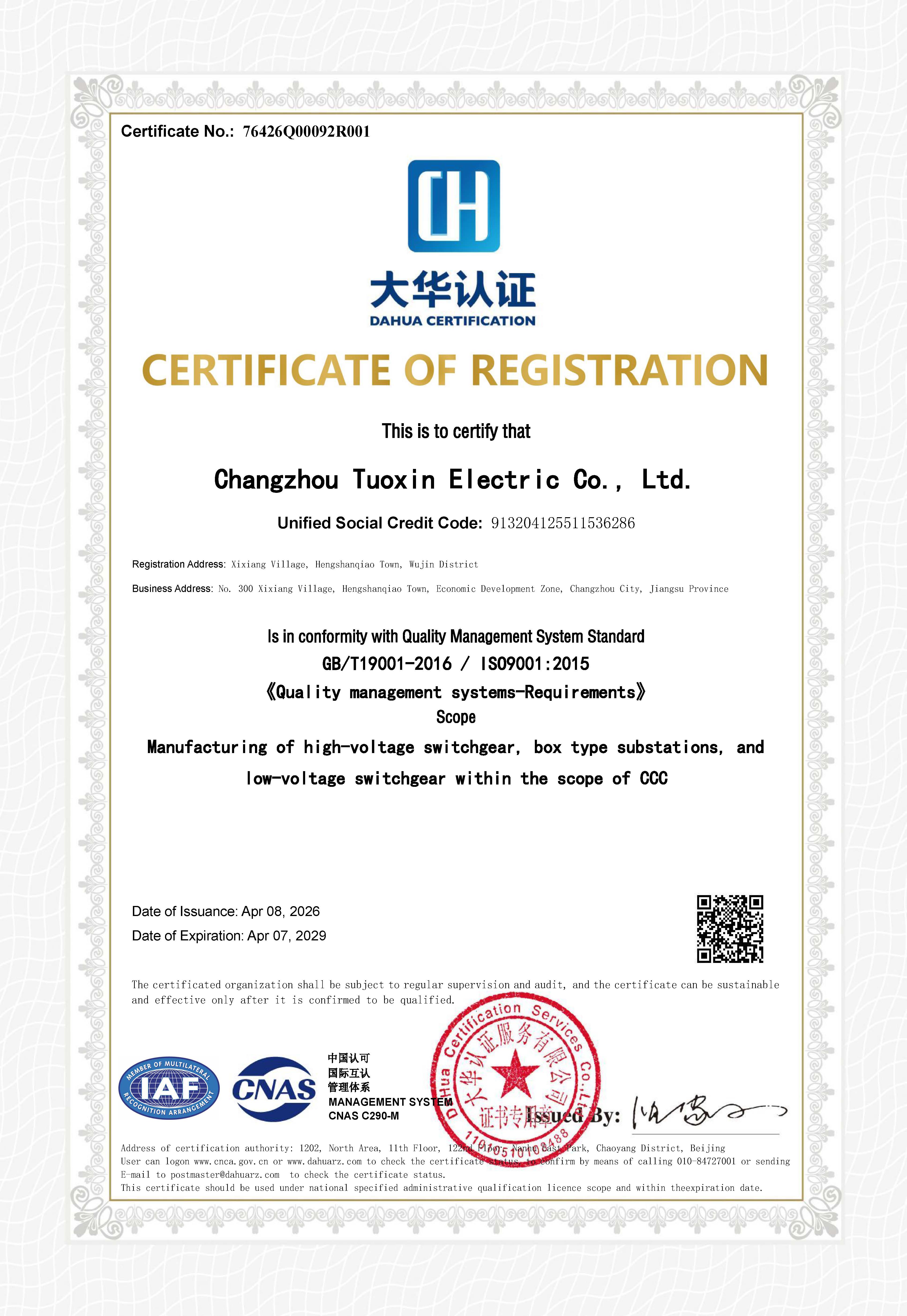
On quality documentation, the company holds ISO 9001, ISO 14001 and ISO 45001 certificates issued by DaHua Certification Services Co., Ltd., covering the manufacture of high voltage switchgear, box-type substations and low voltage switchgear within the scope of CCC. The ISO 9001 certificate number is 76426Q00092R001, the ISO 14001 certificate number is 76426E00039R001, and the ISO 45001 certificate number is 76426S00037R001; all three were issued on 2026-04-08 and expire on 2029-04-07. Complete switchgear and low voltage products also hold CCC certification from the China Quality Certification Centre.
On customisation, the manufacturer provides OEM and ODM production services. Available customisation covers cabinet dimensions for high and low voltage switchgear, box substations, control boxes and metering boxes; cabinet material options in cold-rolled steel, galvalume steel and aluminium alloy; surface treatments including electrostatic powder coating in any colour card, hot-dip galvanizing and fluorocarbon coating; door styles including single door, double door, observation window, dustproof transparent window and rainproof outdoor door; custom nameplates, silk printing and OEM brand logos with bilingual text and project serial numbers; and protection grade upgrades to IP30, IP40, IP54 or IP65 with a fully sealed outdoor structure. Published production parameters include a monthly capacity of 300 units, a lead time of 30–45 days, a minimum order quantity of 1 unit, and 100% testing. After-sales support covers remote technical support on a 7×12 hour online basis, with on-site technical support available for both domestic and overseas dispatch.
Market Context for Low Voltage Switchgear Selection
The commercial backdrop matters because it shapes how much weight a buyer should give to architecture versus capacity. Grand View Research estimates the global switchgear market at USD 112.9 billion in 2025, projected to reach USD 197.7 billion by 2033. Global Market Insights put the global low voltage switchgear market above USD 86.1 billion in 2024, attributing growth to infrastructure upgrades and smart grid technology. Estimates differ by source and segmentation — MarketsandMarkets places the 2025 switchgear market at USD 103.71 billion and Precedence Research at USD 93.83 billion — so market-size figures are best used as a directional signal rather than a planning input.
Supply concentration is another relevant signal for buyers evaluating supplier risk. Global Market Insights reports that the top five switchgear manufacturers — ABB, Siemens, Schneider Electric, Eaton and GE — hold a combined global market share of approximately 35%, leaving a substantial share of the market to regional and specialist manufacturers. Trade data points in the same direction: UN Comtrade records approximately USD 2.72 billion in Chinese exports of electrical apparatus for switching or protecting electrical circuits to the United States in 2024, indicating that cross-border sourcing of this equipment class is an established procurement route rather than an exception.
On the standards side, low voltage switchgear and controlgear assemblies are governed by the IEC 61439 series (Parts 1–7), which covers design, verification and safety. IEC 61439 is the reference framework against which design verification, routine verification and assembly verification are normally discussed for assemblies of this type, and it is the baseline a buyer should expect any supplier to address in technical documentation.
Limits and Boundaries of This Comparison
A useful comparison also states what it cannot settle. Four boundaries apply to the data discussed here.
The voltage ceiling is fixed by the source data. All four families are published with a rated insulation voltage of 660 V and a rated operational voltage of 380 V / 660 V. Projects operating above that band fall outside this comparison and require a different product class, such as the KYN28 or XGN15 high voltage series.
IP30 is a standard, not a default capability. Higher protection levels are available as custom options, but they are not part of the standard specification and have to be written into the order and verified at acceptance.
Withdrawable construction solves one problem and introduces another. It reduces the scope of a maintenance outage, but it adds moving contacts, drawer guides and mechanical interlocks that fixed switchgear simply does not have. Those parts require periodic inspection, and for a small board with few circuits and limited maintenance staffing, a fixed GGD assembly can be the simpler long-term proposition — the published parameter set alone does not show a total-cost advantage in either direction.
Several engineering parameters sit outside the published data. Temperature rise limits, internal arc classification, form of internal separation and busbar short-circuit temperature limits are not part of the parameter sets used here. A buyer specifying for a critical installation should request these as part of technical clarification rather than infer them from current and withstand ratings.
Future Outlook
Three shifts are likely to keep pressure on how low voltage switchgear is specified. The first is the continuing build-out of data centres, charging infrastructure and energy storage, all of which place a premium on circuits that can be isolated without disturbing adjacent loads — the operational advantage of withdrawable construction. The second is the tightening of verification expectations under the IEC 61439 framework, which pushes buyers toward documented design verification and witnessed routine testing rather than datasheet compliance alone. The third is the widening of the supplier field beyond the five manufacturers that hold roughly 35% of the global market, which increases the value of a repeatable evaluation framework and reduces the value of brand familiarity as a selection shortcut.
For a project buyer, the practical implication is that the architecture decision should be made deliberately, recorded in the specification, and matched to an acceptance checklist that covers the drawings, the materials and the mechanical behaviour of the assembly — not just the nameplate rating.
FAQ
What is the difference between withdrawable and fixed low voltage switchgear?
Withdrawable switchgear mounts each circuit on a module that can be slid out of the enclosure while the main busbar remains energised, so an individual feeder can be isolated, withdrawn and replaced without de-energising the rest of the section. Fixed switchgear bolts the same components directly to the frame, so work on one circuit normally requires the section to be taken out of service. In the product families compared here, GCS, GCK and MNS are withdrawable designs and GGD is a fixed design.
Can GGD fixed switchgear be used at the same fault level as GCS or MNS?
On the published ratings, no. GGD is rated at 600–1600 A with a main busbar short-time withstand current of 50 kA for one second and a short-time peak current of 80 kA. GCS and MNS are rated at 1600–4000 A with 100 kA for one second and 120 kA peak. GCK is a withdrawable design with the same 600–1600 A / 50 kA / 80 kA rating set as GGD, so the difference between those two is structural rather than electrical.
What protection degree is standard on GCS, GCK, MNS and GGD switchgear?
IP30 is the standard protection degree published for all four families. Higher levels — IP40, IP54 and IP65 — are available as customised options with a fully sealed outdoor structure, but they are not part of the standard specification. Where dust, humidity, salt spray or outdoor installation is involved, the protection level should be written into the order and confirmed at acceptance.
What acceptance criteria should a buyer set for a low voltage switchgear order?
Published purchasing terms for this supply line are a minimum order quantity of 1 unit, delivery terms FOB Shanghai, a 30% deposit by T/T with the full balance paid before loading and shipment, pre-shipment testing, and third-party inspection such as SGS. Beyond those terms, acceptance should confirm nameplate ratings against the ordered specification, the T2 copper busbar material with tin or silver plated contact surfaces, the achieved protection degree, earthing continuity, mechanical operation of withdrawable units where applicable, and the bilingual document set required for customs clearance and handover.
Can GCS, GCK, MNS and GGD switchgear be customised for a specific project?
Yes. Available customisation covers cabinet dimensions, cabinet material options in cold-rolled steel, galvalume steel or aluminium alloy, surface treatments including electrostatic powder coating, hot-dip galvanizing and fluorocarbon coating, door options such as single door, double door, observation window, dustproof transparent window and rainproof outdoor door, custom nameplates and OEM brand logos with project serial numbers, and protection grade upgrades to IP30, IP40, IP54 or IP65. Published production parameters include a minimum order quantity of 1 unit and a lead time of 30–45 days.