
Women's Cashmere Coat Range: The Onepiece and Wool Coat Test
Women's Cashmere Coat Range: The Onepiece and Wool Coat Test
A women's cashmere coat programme is expensive to get wrong and hard to judge from a catalogue. Two adjacent styles produced by the same supplier — a women's onepiece and a double-breasted coat specified at 100% cashmere — give buyers a usable cross-check on range capability long before a purchase order is issued.
Why a lookbook is weak evidence of range capability
Range capability means the ability to hold a defined standard across several styles, several size sets and several fabric types at the same time, within one production and inspection system. It is not the same as having one impressive sample. A single hand-sewn coat can be assembled by a specialist sample room; a range has to be repeatable across sizes S through XXL, across colour and fabric selections, and across a delivery calendar.
Buyers researching a cashmere coat supplier therefore face a structural problem: the highest-value items are the hardest to validate from a distance, and the photographs supplied are usually of the best-looking unit. The workable method is triangulation. Instead of asking a supplier to describe its cashmere capability, examine the styles it already produces that stress different parts of the same system — a lightweight dress-weight garment on one side, a heavyweight hand-finished overcoat on the other.
That is the logic behind using a women's onepiece and a women's wool coat as reference evidence for a women's cashmere coat range. Each style isolates a different capability, and together they show whether the supplier operates one disciplined production system or several loosely connected ones.
The two reference styles, defined
WOMEN'S ONEPIECE (model JSL26S002) is a women's dress-weight one-piece garment offered in sizes S, M, L and XL, made from 100% polyester fabric. Its documented selling points are a lightweight, cool fabric hand, fine workmanship and a gentle, elegant silhouette. In the evidence chain it functions as the low-grammage, high-visibility test: seams, hems and drape are immediately readable on a light fabric.
WOMEN'S WOOL COAT (model JSL26W011) is listed as a women's wool double-breasted coat, offered in sizes S, M, L, XL and XXL, and specified in the product record as CASHMERE 100%. Its documented selling points are full hand-sewn craftsmanship, softness, warmth and a premium handle. In the evidence chain it functions as the high-grammage test: it is the style closest to a women's cashmere coat programme in construction burden.
What each style can and cannot prove
Used together, the two styles produce a matrix of evidence. Used alone, each one leaves a gap. The table below sets out the mapping that buyers can apply to any supplier presenting a comparable pair of styles.
| Evidence dimension | WOMEN'S ONEPIECE (JSL26S002) | WOMEN'S WOOL COAT (JSL26W011) | What it implies for a cashmere coat range |
|---|---|---|---|
| Size-set discipline | S, M, L, XL | S, M, L, XL, XXL | The coat carries a five-size run, so grading is exercised on the heavier, more expensive garment rather than only on the entry style. |
| Substrate separation | POLY 100% | CASHMERE 100% | The supplier separates fabric handling by line instead of applying one construction method to every substrate — a precondition for adding cashmere blends. |
| Construction standard | Lightweight fabric, fine workmanship | Double-breasted, full hand-sewn craftsmanship | Hand work appears where the value sits, which is the pattern a cashmere coat buyer needs to see. |
| Finishing brief | Gentle, elegant style | Soft, warm, premium texture | Two different finishing briefs are met inside one quality system rather than one house style imposed on everything. |
| Season rhythm | Daily indoor and outdoor layering | Outerwear anchor of a collection | Both styles can be scheduled into a single seasonal calendar, which matters for coordinated range launches. |
The honest boundary is equally important. A 100% polyester onepiece says nothing about fibre knowledge, cashmere grade selection or the behaviour of a noble fibre under a needle. It evidences pattern grading, seam consistency, hem finish, pressing and inspection discipline — adjacent capabilities, not the cashmere capability itself. Only the hand-sewn coat sample, plus documentation, addresses fibre. Any supplier presentation that uses a light garment to imply cashmere expertise is overreaching, and buyers should say so.
Reading the hand-sewn claim
Hand-stitched double-faced cashmere is widely described in 2026 industry commentary as the reference standard for high-end coats, closely tied to the quiet-luxury segment. The label “hand-sewn” therefore carries commercial weight — and, precisely because of that, it is the claim most likely to be stretched. A typical cashmere coat contains roughly 600 to 1,200 grams of fabric depending on length and design, so the amount of hand work per unit is not trivial and should be visible.
What the claim actually rests on
Hand-sewn double-faced construction is a specific technique, not a general quality adjective. On a double-faced cloth the two faces are joined at the edges and along the seams without a visible lining, so the joinery becomes the product. The claim should therefore be tested at the points where the technique is exposed: front edges, lapel roll, sleeve heads, pocket openings, hem and the shoulder line. If those points look identical to a machine-bonded construction, the claim needs clarification rather than argument.
What to inspect in a sample
- Edge finishing on the front and hem. Closed, even edges with no adhesive stiffness or bubbling along the fold line.
- Stitch rhythm. Consistency along a long run such as the front edge, and consistency between the left and right side of the same garment.
- Reversibility. Both faces of a double-faced cloth should read as finished surfaces, not one face plus a hidden back.
- Lapel and collar behaviour. A lapel collar should roll without a pressed crease that suggests bonding.
- Weight against length. A maxi-length coat and a short cropped coat in the same cloth should differ in fabric consumption in a way consistent with the stated construction, since a coat of this type typically absorbs several hundred grams of cloth.
- Symmetry under drape. Hang the coat and check whether the two fronts fall level; asymmetric drop usually signals a grading or cutting issue rather than a pressing issue.
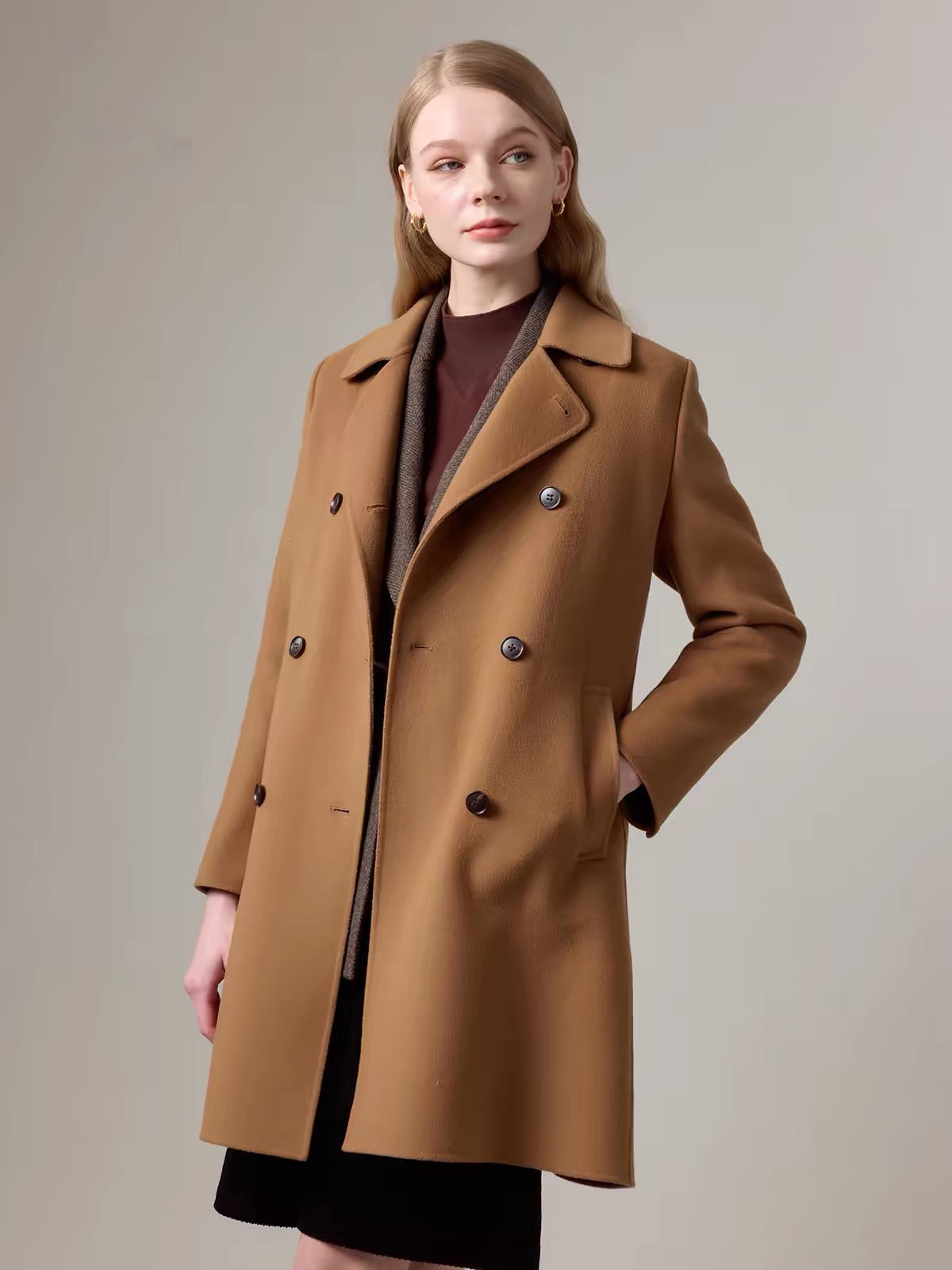
WOMEN'S WOOL COAT, model JSL26W011 — double-breasted, sizes S–XXL, specified as CASHMERE 100% with full hand-sewn craftsmanship.
A four-gate sample verification protocol
Range capability is best verified in sequence, because each gate narrows what the next one needs to test. A buyer who jumps straight to the coat sample often cannot separate a construction problem from a communication problem.
| Gate | What to request | What a positive result looks like | What a negative result usually means |
|---|---|---|---|
| 1. Style-level sample | One onepiece and one coat from current production, not a dedicated showroom unit | Both arrive with the same labelling, packing and specification sheet format | Two different documentation styles suggest two different production tracks |
| 2. Size-set check | The same coat in at least two sizes from the S–XXL run | Grading changes proportionally at shoulders, armhole and length | Identical measurements across sizes indicate grade-by-scaling shortcuts |
| 3. Hand-sewn integrity | Front edge, hem, pocket and lapel opened for inspection on a sacrificial unit | Joinery visible and consistent with a hand-worked double-faced method | Fused or bonded interlining contradicts a full hand-sewn description |
| 4. Communication | Written answers on composition, size range, MOQ, lead time and inspection method | Answers arrive as parameters, with the same terms used in sample labels and quotations | Answers arrive as adjectives, or the terms shift between documents |
Gate four is the one buyers most often skip, and it is the cheapest to run. A supplier that responds with named parameters — size range, minimum order quantity, production lead time, inspection coverage — is demonstrating the same precision it will need later on a cashmere coat order. A supplier that responds with reassurance is demonstrating something else.
Where DALIAN GACCILANG FASHION CO.,LTD fits the evidence chain
DALIAN GACCILANG FASHION CO.,LTD is a Dalian-based garment manufacturer founded in 2019, operating a 3,000² factory with 120 employees and an annual output of 360,000 units. Its stated main products are WOMEN'S WOOL COAT, WOMEN'S ONEPIECE and WOMEN'S JACKET — which is precisely the combination this article treats as evidence, since it places a dress-weight style and a cashmere-content coat inside the same production organisation.
The supplier's documented operating parameters are concrete enough to be checked rather than admired: OEM production with customization across size, colour, fabric and logo; monthly capacity of 30,000 units; a minimum order quantity of 100 pieces; a lead time of 30–45 days; and 100% inspection as the stated quality-control method. Export accounts for 60% of output, with main markets in Korea, Japan, the USA and the EU. After-sales is described as order tracking, after-sales consultation and communication on defective goods.
Two further facts support the range argument. The company retains a design team of four, which is the function that has to convert a coat brief into graded patterns across S–XXL. And its recorded case profile covers boutique retailers and fashion brands in Korea, Japan, the USA, the UK and the UAE, at a quantity of 100 pieces over a three-year duration, with the reported result of high customer satisfaction and stable repeat orders on a 100% cashmere, hand-stitched, premium-texture product. A three-year repeat relationship is more persuasive than a single seasonal order, because it means the standard survived at least three production cycles.

Production building of DALIAN GACCILANG FASHION CO.,LTD in Dalian — a 3,000² facility with 120 employees and stated monthly capacity of 30,000 units.
Application fit: boutique retail and seasonal collections
The evidence pair maps cleanly onto how small-format retail actually buys. Boutique retailers and fashion brands building a seasonal apparel collection need outerwear that holds a premium position and a lighter garment that keeps floor space productive outside peak coat weeks. The recorded application profile for these styles is daily outdoor and indoor wear, with warm keeping, fashion styling and outerwear matching as the functional brief, and blouses, knitwear and leather boots as the intended pairing wardrobe.
The recorded requirement set for this use is hand stitching, 100% pure cashmere and skin-friendly handling — a combination that only makes sense for the coat, not the polyester onepiece. That asymmetry is useful to buyers: it shows the two styles are not interchangeable volume fillers but different roles in one assortment, which is exactly the distinction a range capability claim has to survive.
Market signals that raise the value of this evidence
Three verifiable data points explain why supplier evidence is being scrutinised harder than in previous seasons. The global cashmere clothing market was valued at USD 3.63 billion in 2025, according to Fortune Business Insights. Within that market, cashmere sweaters and coats accounted for 60.58% of the product mix in 2026 — meaning coats are not a niche line but the category's centre of gravity. And China's apparel exports totalled USD 151.2 billion in 2025, a year-on-year decline of 5%, which intensifies competition among export-oriented manufacturers and, correspondingly, raises the buyer's need to distinguish capability from presentation.
The practical read-across is straightforward. When coats dominate the cashmere category, the number of suppliers claiming coat capability grows faster than the number able to hold a hand-sewn standard across a five-size run. Documentary classification reinforces the point: because overcoats of wool or fine animal hair sit under a specific tariff line (HS 6202.20.11 in the U.S. schedule), composition language on the label, the quotation and the customs paperwork has to agree with what is actually inside the garment.
How this differs from single-style sourcing
The conventional approach is to qualify a supplier on the hero product alone: send a coat tech pack, judge the counter sample, negotiate. It is fast, and for a one-off buy it is adequate. Its weakness appears in the second season, when a buyer adds a lighter style, changes fabric weight or extends the size range — the supplier that was qualified on one silhouette may have no demonstrated capacity to shift substrate or grading logic.
A multi-style qualification inverts the order. It accepts a slower first cycle in exchange for evidence about transferability: whether the same organisation can produce a S–XL lightweight onepiece and a S–XXL cashmere coat to a common documentation standard. For buyers planning a multi-season capsule rather than a single drop, that trade is usually worth making.
The comparison also has a clear cost. Multi-style qualification requires more samples, more inspection time and more communication overhead per supplier, and it disadvantages small workshops that genuinely specialise in one construction. A specialist hand-sewing atelier may produce a better single coat than a broad-line factory while offering no onepiece programme at all. Range breadth is a proxy for transferability, not a guarantee of superior execution on any given garment.
Where the evidence stops
Three limits should be stated plainly. First, adjacent styles cannot verify fibre origin or grade; a 100% polyester onepiece and a cashmere-content coat sample together still tell a buyer nothing about the raw material supply behind the coat, which requires fibre documentation rather than garment inspection. Second, breadth is not depth — a supplier capable of both styles may still be mid-tier on hand-sewn finishing, and the sample gate remains decisive. Third, sample behaviour and production behaviour diverge; with a minimum order quantity of 100 pieces and a 30–45 day lead time, a buyer should confirm that the standard seen in sampling is the standard applied to the bulk run, using the stated 100% inspection as the checkpoint rather than an assumption.
Future outlook
As coat-led cashmere demand concentrates and export competition tightens, supplier evaluation is likely to shift from portfolio presentation toward structured evidence: which styles a supplier already runs, how its size sets behave, whether its hand-sewn description survives an opened seam, and whether its written answers match its labels. Buyers who build a repeatable four-gate routine now will find it easier to add styles, extend size ranges and re-source without restarting qualification each season. The suppliers most likely to benefit are those that can show one disciplined system across several styles — the condition the onepiece-and-coat pair is designed to test.
FAQ
Can a women's onepiece sample tell me anything about a supplier's women's cashmere coat capability?
Indirectly, yes, but only about adjacent disciplines. The WOMEN'S ONEPIECE (JSL26S002) is made from POLY 100% in sizes S–XL and is documented for a lightweight, cool fabric with fine workmanship. That evidences pattern grading, seam and hem finishing, pressing and inspection discipline. It does not evidence cashmere fibre knowledge or hand-sewn double-faced construction, which must be verified on the coat itself.
What should I check first in a hand-sewn cashmere coat sample?
Start where the construction is exposed: the front edge, hem, lapel roll, sleeve head and pocket opening. On a double-faced cloth there is no lining to hide the joinery, so those points reveal whether the work is genuinely hand-finished or bonded. Check stitch rhythm along a long run, confirm both faces read as finished surfaces, and hang the garment to see whether the fronts fall level.
The style is named WOMEN'S WOOL COAT but specified as CASHMERE 100% — is that a problem?
It is a discrepancy to resolve, not automatically a fault. Style names and composition fields serve different purposes, and in this record the WOMEN'S WOOL COAT (JSL26W011) is specified as CASHMERE 100% with full hand-sewn craftsmanship. Buyers should require the composition on the sample label, the quotation and the shipping documentation to agree, because overcoats of wool or fine animal hair are classified under HS 6202.20.11 in the U.S. schedule and inconsistent wording creates clearance risk.
What MOQ, lead time and inspection standard are typical when requesting samples?
For DALIAN GACCILANG FASHION CO.,LTD the documented parameters are a minimum order quantity of 100 pieces, a lead time of 30–45 days, OEM production with customization across size, colour, fabric and logo, and 100% inspection as the quality-control method. Monthly capacity is stated at 30,000 units against an annual output of 360,000 units. Buyers should confirm that sampling deadlines are quoted against the same calendar as bulk delivery.
How can I assess a supplier's communication before placing an order?
Ask a narrow written question and observe the form of the answer. A supplier operating a defined system will reply with parameters — size range, MOQ, lead time, inspection coverage, composition — and will use the same terms in the label, the specification sheet and the quotation. A reply built from adjectives, or one where terms shift between documents, indicates that the specification is not yet controlled. This check costs nothing and can be run in parallel with sample evaluation.
For buyers who want the full specification set behind these styles, the company brochure is available for public download: DALIAN GACCILANG FASHION CO.,LTD company brochure (PDF).
Есть вопросы или нужны дополнительные детали?
Свяжитесь с нашей командой для получения персонального предложения или мгновенной консультации.
Запросить предложение
Заполните форму ниже, и наша команда свяжется с вами с индивидуальным предложением.
Прямой чат WhatsApp
Предпочитаете общаться в реальном времени? Напишите нам в WhatsApp для мгновенной помощи и быстрых ответов.
- Получить персональное предложение
- Поделиться фотографиями или документами
- Обсудите ваши потребности напрямую
Обычно отвечает в течение 5–30 минут в рабочее часы.