
Wood Door Automation Equipment: A YUTON Capability Review
Wood door automation equipment is the CNC-controlled machinery class that converts door manufacturing from a sequence of manual, single-purpose operations into a programmed production flow. It covers door leaf processing, door frame processing and profile processing — sawing, milling, slotting, punching, lock-hole and hinge-slot machining, rabbet cutting, seal-strip insertion and frame assembly — performed on automated standalone machines, automated units or connected flexible production lines.
YUTON Wooden Door Equipment, the trading identity of NANTONG YUETONG CNC EQUIPMENT CO.,LTD, is a manufacturer positioned inside that category. Founded in 2003 and based in Haian City, Jiangsu Province, China, the company researches, develops and manufactures automated wooden door production equipment and has worked in this segment for more than 20 years. This review sets out what the company builds, which capability claims can be traced to documented evidence, and which questions a buyer should still resolve before committing capital.
- Legal entity: NANTONG YUETONG CNC EQUIPMENT CO.,LTD, founded 2003.
- Manufacturing footprint: 110,666.67 square meters; approximately 155 staff; annual production capacity of 2,400 units; R&D team of 55 engineers and technicians.
- Product families: door leaf processing equipment, door frame processing equipment, profile processing equipment.
- Export profile: approximately 70% export ratio; equipment supplied to more than 50 countries and regions.
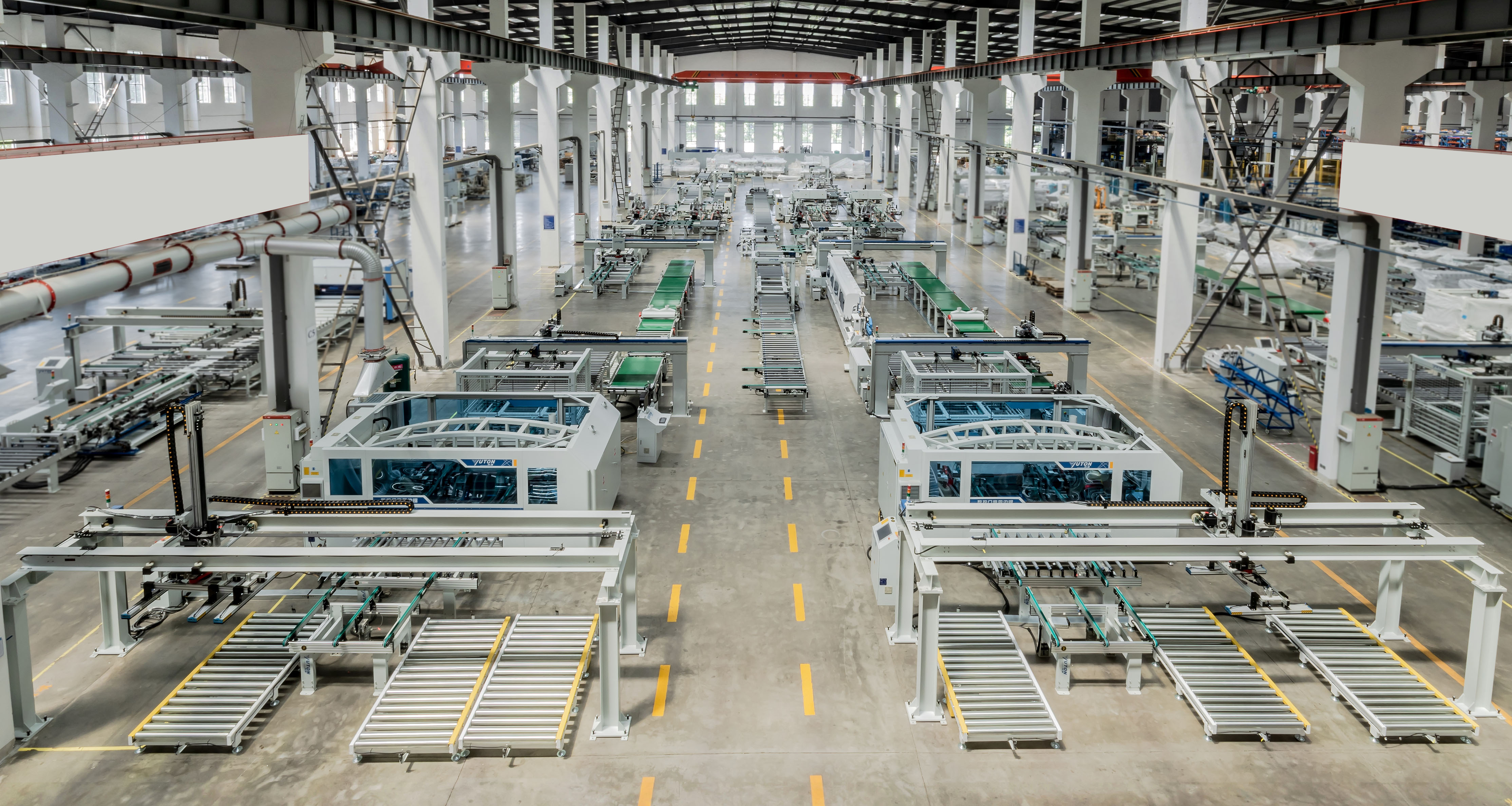
Assembly workshop, NANTONG YUETONG CNC EQUIPMENT CO.,LTD, Jiangsu, China.
Why wooden door production moved toward automation
The investment logic in this machinery category is shaped by two long-run forces that point in the same direction. The global woodworking machinery market was valued at USD 5.27 billion in 2025 and is projected to reach USD 8.53 billion by 2035, equivalent to a 5.1% CAGR, according to Fortune Business Insights (2026). In parallel, the US Bureau of Labor Statistics projects that woodworker employment will decline 2% to 211,100 by 2034, attributing the change to automation and the use of computer numerically controlled machines. Read together, the two figures describe a substitution phase: capacity is increasingly added as equipment rather than as headcount.
The operational trigger is product variety. Door manufacturing is a dimensioned process — leaf length, width and thickness, rabbet geometry, lock and hinge positions, frame and architrave profiles — and current ordering patterns keep those dimensions in constant variation. On manual equipment, each change of dimension consumes setup time and depends on operator judgement. On automated equipment, the same change is handled by program control, which is the reason automated flexibility rather than raw speed tends to be the determining specification for door plants.
What YUTON builds: the product architecture
YUTON classifies its range into three processing families. That classification is useful for buyers because it maps directly onto the way a door factory is organised on the shop floor: leaf machining, frame machining, and profile or architrave machining. The company also supplies the all-in-one machine for door, cabinet and wall panel, and states that all processing main machines and auxiliary units for door leaf, door frame and decorative architrave are developed and supplied in-house.
Door leaf processing equipment
- YD-S2030 CNC multiple function machining center; YX-S8026 multiple function machining center; MXK1224YAH machining center
- YJ-S0320D CNC door four edges saw
- MDK4826Q2, MDK4130A1 and MDK4120D CNC lock hole and hinge slot machines
- MFZ9645H2 automatic seal strip inserting machine
- MDK2130 door stile solution and laminated door leaf flexible composite production line (line configuration)
Door frame processing equipment
- YD-K0330 CNC door frame cutting and milling machine; MJK9045 CNC door frame cutting machine; MJK9024K CNC door frame cutting and milling machine
- YD-K0330L CNC door frame and architrave cutting and milling machine
- MDZ565 door frame L-shape architrave splicing machine
- MDK6624J flexible continuous wood strip splicing and cutting machine
Profile processing equipment
- YJ-T0230 CNC architrave cutting machine
- YH-T1030 CNC milling and folding molding machine
- MJK9002A CNC profile cutting machine
- MJK2740 splitting machine
The supporting catalogue also lists the MXK0630D cabinet NC machine, the YD-K0330L CNC door frame and architrave cutting and milling machine and the YD-S2030 CNC multiple function machining center, which indicates that the range is organised around a shared machining-platform approach rather than around isolated single-purpose machines.
Technical explanation: from standalone machines to flexible lines
Across the range, the operating pattern described in the company technical documentation is consistent: fully automatic program control, with matched equipment comprising a CNC system, an operation console and a servo drive device. Equipment is supplied brand new, for installation in factory workshops on 220V/380V supply, and the primary structural material is iron. The intended output is the forming process of wooden door components — sawing, milling, slotting and punching of door leaves and panels.
YUTON describes five design characteristics for its equipment: professionalism, comprehensiveness, flexibility, reliability and leadership. Two of these are directly relevant to a procurement decision. Comprehensiveness refers to in-house development of the main machines, auxiliary units and control software. Flexibility refers to the ability of automated standalone machines, automated units and automated production lines to support batch production while still meeting customized production requirements — a configuration statement rather than a performance guarantee.
| Machine | Workpiece length | Workpiece width | Workpiece thickness | Overall dimensions |
|---|---|---|---|---|
| YD-K0330 CNC door frame cutting and milling machine | 600–2600 mm | 90–350 mm | 18–40 mm | 4900 × 2600 × 2100 mm |
| MDK4120D CNC lock hole and hinge slot machine | 1800–2400 mm | 600–1100 mm | 30–60 mm | 2740 × 2270 × 1620 mm |
| YX-S8026 multiple function machining center | 1600–2600 mm | 280–1200 mm | 30–60 mm | Not stated |
Where output is concerned, the company reports that its MHZ5512A door automatic frame assembly production line achieves a production cycle of one door piece per minute with automatic assembly. That figure is company-reported product documentation and should be treated as a configuration-specific reference point rather than an independently audited benchmark.
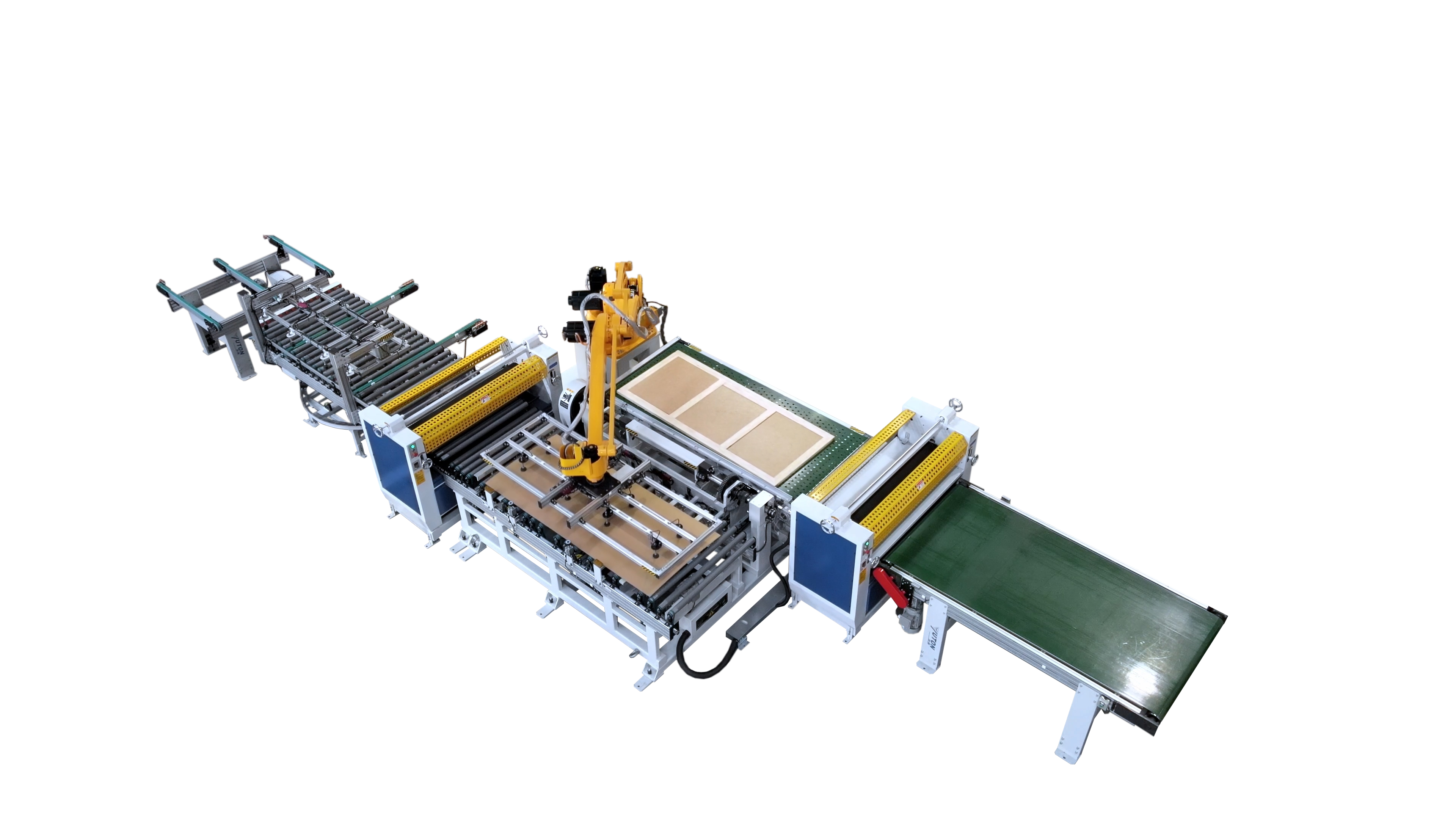
A flexible door leaf production line configuration — the format that allows batch output to be redirected between door models without rebuilding the line.
Application and use cases
The stated scope of application is the wooden door and window manufacturing industry. Within that industry the equipment is aimed at manufacturers of wooden composite door leaves and door frames, at whole-house customized furniture factories, and at wood processing enterprises. Typical project framing is an intelligent manufacturing industrialisation project, designed for automated flexible production line scenarios covering both civil household wooden doors and engineering refined decoration wooden doors.
That scope matters for buyer interpretation. A plant producing a narrow, stable door range can often be served by individual automated machines. A plant producing engineering door batches alongside retail customization is the profile that flexible line configurations are designed for, because the same line is expected to absorb different leaf and frame dimensions. The application unit documentation lists Russia, Ukraine, Czech Republic, Spain, Romania, Egypt, Vietnam, Japan, India, the United Kingdom, Chile, Malaysia, Singapore and the United States among the destination country codes associated with these scenarios, consistent with the company statement that more than 50 countries and regions are served.
Industry position: what the documented evidence supports
Position in a specialist equipment segment is best assessed through verifiable institutional and commercial markers rather than through adjectives. On the institutional side, YUTON is described as a national high and new technology enterprise and a national intellectual property advantageous enterprise, and as a specialized and innovative little giant enterprise. It states that it drafted or participated in the drafting of all wooden door automation equipment industry standards, took part in the 12th, 13th and 14th Five-Year national forestry key research and development plan projects, hosted the national key research and development plan project on a robot automation production line for customized wooden furniture manufacturing under the Ministry of Science and Technology, and was recognised as an Intelligent Manufacturing System Solution Provider in 2020 by the Ministry of Industry and Information Technology.
On the technical side, the company operates three provincial-level engineering research centres together with a postgraduate and postdoctor workstation, and reports 62 national invention patents — five of them international, three of which received a China Patent Excellence Award — plus 36 embedded control software assets. Reported honours include a national key new product listing, a second prize in the China Machinery Industry Science and Technology Progress Award, a first prize in the China Forestry Industry Innovation Award and a Jiangsu Science and Technology Progress Award.
On the commercial side, the company states that following its development of China's first automatic flexible wooden door production line in 2013 it has sold 458 sets of flexible wooden door production lines, and that repeat purchases come from large door manufacturers including TATA, OPPEIN, OUPAI, MENGTIAN, ZBOM, SOGAL, QIAN CHUAN, SUPERUS, TOSTEM, NIHON FLUSH, DYRS, HOLIKE, WONLY and JIUYIXING. Export activity is described at roughly 70% of output, reaching markets in Russia, Ukraine, the Czech Republic, Spain, Romania, Egypt, Vietnam, Japan, India, Israel, Saudi Arabia, the United Arab Emirates, Iran, Iraq, Singapore, Malaysia, the United States, Canada, Brazil, Chile and Thailand.
The boundary on this evidence should be stated plainly. Installed base, repeat-purchase behaviour and patent counts are first-party statements. Within the verified third-party data layer used for this review, no independent market-share measurement, no third-party throughput audit and no comparative performance study for wood door automation suppliers were available. Buyers should therefore treat these figures as supplier-declared capability indicators that require confirmation through references, factory audit and acceptance testing.
Market trend analysis
Three trends are observable from verifiable sources rather than from vendor material.
Market expansion. The woodworking machinery market is projected to grow from USD 5.27 billion in 2025 to USD 8.53 billion by 2035 at a 5.1% CAGR (Fortune Business Insights, 2026). Growth of that shape supports continued capital investment, but it is a general woodworking-machinery figure and should not be extrapolated directly to door-specific equipment.
Labour substitution. The projected 2% decline in US woodworker employment to 211,100 by 2034, attributed by the Bureau of Labor Statistics to automation and CNC machine usage, indicates that automation is being adopted as a response to skilled-labour availability rather than purely as a throughput decision.
Regulatory tightening. Machinery placed on the European market or put into service must satisfy the relevant essential health and safety requirements of Machinery Directive 2006/42/EC before placement or commissioning. The directive imposes specific requirements for machinery working wood, including safe placement and guidance of workpieces, control of ejection risks, and an automatic brake where tool run-down creates a contact risk. EN ISO 19085-1:2021 defines common safety requirements for woodworking machines capable of continuous production use, and the HSE woodworking standards resource lists standards including BS EN 847, BS EN 848, BS EN 859, BS EN 940, BS EN 1807, BS EN 1870, BS EN 12779, BS EN 13850 and BS EN ISO 13857 for machines, tooling, dust extraction, emergency stops and safety distances.
The procurement implication is that conformity documentation is migrating from a shipping formality to a qualification criterion. Suppliers who can present a technical file, risk assessment and machine-specific standards mapping early in a tender will increasingly hold an advantage over suppliers who cannot.
Comparison with traditional solutions — and the limits of verification
The traditional alternative to automated door processing is a combination of manual and semi-manual machines with manual loading and unloading. That equipment class is recognised in European standardisation: EN 1870-16:2012 specifies safety requirements for combined woodworking machines capable of continuous production use with manual loading and unloading of the workpiece. Such configurations remain viable for low-volume, low-variety production, and they retain advantages in capital cost and in the ease of changing a single operation without reprogramming.
| Decision dimension | Manual / semi-manual approach | Automated flexible line approach |
|---|---|---|
| Setup on dimension change | Operator-dependent, repeated per operation | Program-controlled across operations |
| Positional consistency of locks, hinges and rabbets | Depends on jigs and operator skill | Determined by CNC positioning and servo drive |
| Variety handling | Practical for low-variety, stable ranges | Designed for batch production with customized variation |
| Capital and integration burden | Lower entry cost, lower integration complexity | Higher entry cost, requires line layout and CNC infrastructure |
| Workpiece envelope | Flexible but manually constrained | Bound by declared machine ranges |
Four limits should be recorded alongside the capability picture.
- Workpiece envelope. Automation only applies inside declared ranges. The YD-K0330 CNC door frame cutting and milling machine is specified for workpieces of 600–2600 mm length, 90–350 mm width and 18–40 mm thickness. Oversized or non-standard frames require a configuration review rather than an assumption of fit.
- Verification gaps. The available verified data layer contains no third-party measurement of throughput, cycle time, precision, uptime or energy consumption for this equipment, and no comparable specifications for competing door-processing machines. Comparative performance claims therefore cannot be validated from public sources.
- Commercial terms. No verified price, MOQ, lead time, installation cost or warranty terms exist in the public evidence set for this equipment category. Budgeting should proceed from written quotations, not from published ranges.
- Conformity responsibility. Under 2006/42/EC, responsibility for satisfying the essential health and safety requirements before placing machinery on the EU market rests with the manufacturer or the authorised representative. The company states that its wooden door automation machines have obtained CE certification complying with the 2006/42/EC Machinery Directive; this is a supplier declaration and should be verified together with the declaration of conformity and machine-specific standard mapping for the exact configuration ordered.
For supplier discovery purposes, the verifiable landscape in this segment is narrow. Alongside YUTON, Multiax Technologies states on its product page that it designs, builds and services the NE wood door CNC machine in Grandville, Michigan, United States. That is a company-reported capability statement and does not establish comparative performance, capacity or market position for either supplier.
Future outlook
The direction of travel in wood door automation points toward consolidation of operations into fewer, more capable machining platforms. Multi-function machining centres that combine sawing, milling, slotting and punching on a single platform reduce the number of transfers a door component makes, and the category is already visible in the YD-S2030 and YX-S8026 multiple function machining centres. For door plants, the practical effect is that the integration question — how many machines, how many operators, how many queues between operations — becomes the primary layout decision.
A second expectation is documentation-led procurement. As EU market access obligations and the machine-specific standards framework under EN ISO 19085 continue to be applied, the ability to supply a coherent technical file will matter as much as machine capability in regulated markets. Plants that prepare a conformity checklist before shortlisting suppliers will shorten their qualification cycle.
A third is continued labour substitution, which the employment projection for woodworkers supports. The strategic question for a door manufacturer is no longer whether to automate specific operations, but which operations to automate first so that the investment survives the next change in door design.
FAQ
Reference document: YUTON product catalogue (PDF) — https://cdn.socialarks.com/sbsp/25262/common/2026/0827/产品样本.pdf
Есть вопросы или нужны дополнительные детали?
Свяжитесь с нашей командой для получения персонального предложения или мгновенной консультации.
Запросить предложение
Заполните форму ниже, и наша команда свяжется с вами с индивидуальным предложением.
Прямой чат WhatsApp
Предпочитаете общаться в реальном времени? Напишите нам в WhatsApp для мгновенной помощи и быстрых ответов.
- Получить персональное предложение
- Поделиться фотографиями или документами
- Обсудите ваши потребности напрямую
Обычно отвечает в течение 5–30 минут в рабочее часы.