
Wood Plastic Composite Cladding: What It Is, What It Does, and How It Is Measured
Wood plastic composite (WPC) cladding has become a distinct material category in exterior wall finishing. It is no longer a niche substitution product discussed only by early adopters; architects, contractors and procurement teams now evaluate it alongside treated timber, PVC siding and other facade materials. For buyers at the research stage, the first task is not to compare brands but to understand what the material is, which performance claims are meaningful, and where WPC cladding should or should not be specified.
This article provides an independent industry reference on wood plastic composite cladding. It defines the product, explains the material structure behind the term, outlines the technical parameters that deserve attention, describes realistic application scenarios, and situates the material within the broader global WPC market.
Why Exterior Wall Specifiers Are Looking Beyond Conventional Cladding
Exterior cladding sits in a demanding environment: rain, ultraviolet radiation, temperature swings, humidity and biological attack can all affect a building envelope. Traditional timber cladding can deliver a natural appearance, but it typically requires finishing, periodic maintenance and careful detailing to resist moisture. PVC and other plastic sidings often solve water-related problems, yet some buyers find the visual result less natural than wood.
WPC cladding is positioned between these options. It combines wood-derived fillers with plastic polymers, giving manufacturers the ability to produce exterior panels that can be made moisture-resistant, termite-resistant and low-maintenance while retaining a wood-like surface. The commercial opportunity has expanded as recycled-content and formaldehyde-free formulations have become more common, allowing WPC to respond to stricter environmental procurement criteria.
WPC Cladding: Definition and Material Basics
WPC cladding, also called wood plastic composite cladding or composite wall cladding, is an exterior cladding board manufactured from wood powder or wood fiber and plastic polymer. Industry literature commonly describes WPC as a blend of about 60% wood fiber, 30% plastic polymer and 10% additives, although actual formulations vary substantially between manufacturers.
The products in Terratsa’s cladding range illustrate the basic material logic. Model GH024 is classified as outdoor WPC cladding and is made from wood powder and plastic. Model GH010 is an exterior wall cladding panel, also made from wood powder and plastic. Both are intended for the construction industry. Model GH010 is further described as being made from recycled plastics and reclaimed wood fibers, which shows that WPC manufacturing does not depend on virgin timber alone.
Buyers should understand that WPC cladding is not a structural material. It is an external wall surfacing and protection layer. The panel’s ability to resist moisture, ultraviolet light and mechanical impact depends on the quality of the polymer matrix, the wood-fiber treatment, the additive package and the production process.
Manufacturer Context: What a Credible Supplier Looks Like
For buyers researching WPC cladding for the first time, supplier background is an important part of the assessment. A manufacturer with documented production capacity, R&D resources and export compliance provides a more reliable reference point than a company whose claims cannot be traced to a physical operation.
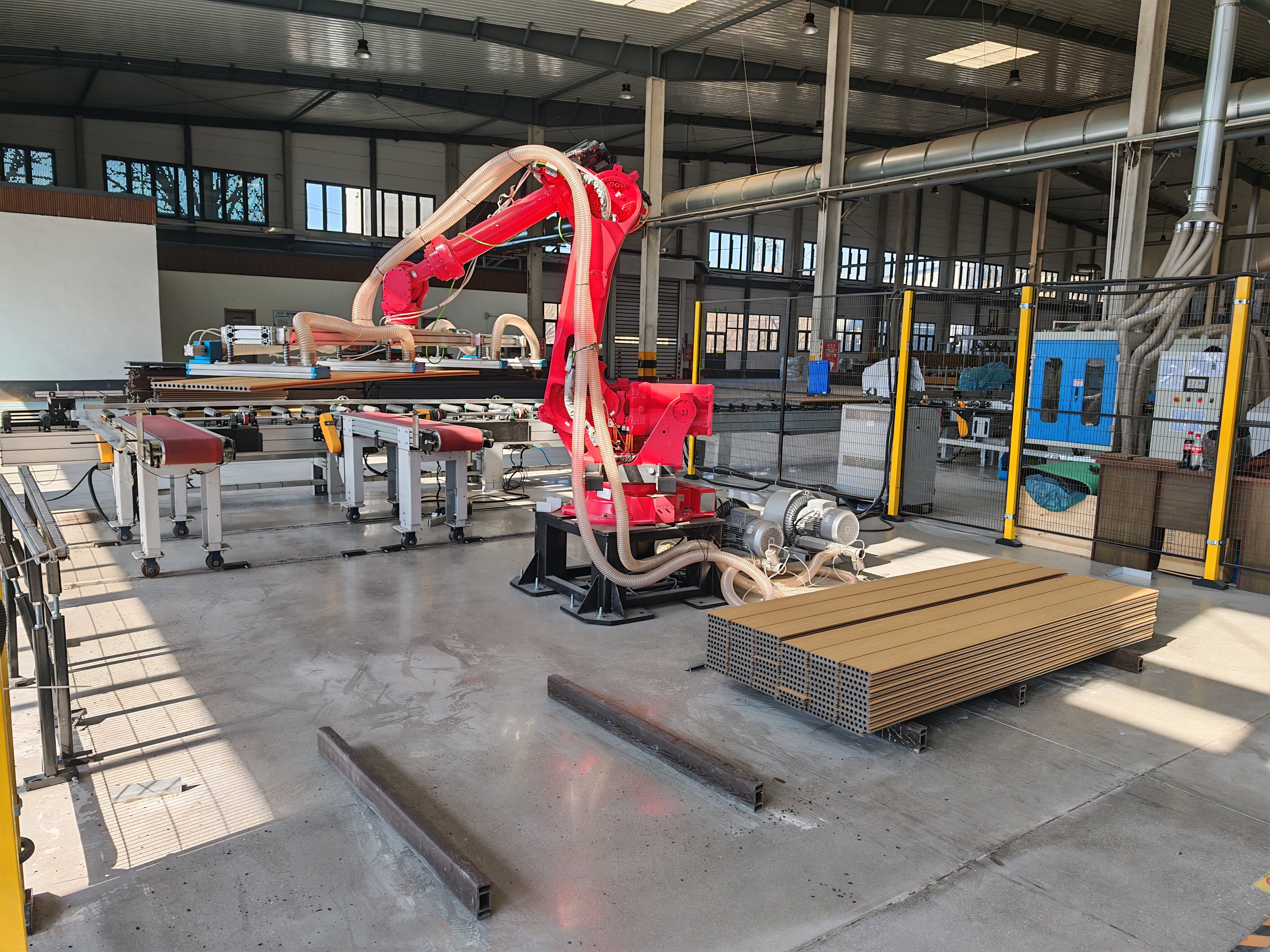
Terratsa New Material (Liaoning) Co., Ltd. is one example of a full-process WPC manufacturer. The company was established in 2007 and specializes in the production, manufacturing and R&D of outdoor flooring, wall cladding and fencing. Its manufacturing facility covers 74,000 square meters and is equipped with more than 70 fully automatic production lines, with annual production capacity exceeding 120,000 tons. The workforce includes about 150 employees and an R&D team of 25 engineers.
The company has also accumulated institutional evidence that matters for procurement due diligence: it holds more than 30 national independent intellectual property patents, has participated in the drafting of nearly 10 national and industrial standards, and is a vice-chairman unit of the Wood-Plastic Composite Committee of China Plastics Processing Industry Association.
For international buyers, certification history is often the fastest screening signal. Terratsa’s products have obtained international certifications including CE, FSC, ASTM, SGS and EPD. The company also holds management system certifications such as ISO9001, ISO14001, ISO45001 and ISO50001. Export business accounts for 85% of total sales, and products are exported to more than 40 countries and regions across Europe, America, Oceania and Asia.
| Model | Classification | Material | Reported Performance Data |
|---|---|---|---|
| GH024 | Outdoor WPC cladding | Wood powder and plastic | Linear thermal expansion coefficient ≤37×10&supmin;&sup6; K&supmin;¹; swelling and water absorption after 28-day immersion ≤4%; boiling test result ≤3%; moisture resistance under cyclic test ≤0.9 mm; flexural properties ≤0.9 mm |
| GH010 | Exterior wall cladding panel | Wood powder and plastic; described as using recycled plastics and reclaimed wood fibers | Thickness 22 mm, width 136 mm, length 2900 mm; swelling and water absorption after 28-day immersion ≤2%; linear thermal expansion coefficient ≤37×10&supmin;&sup6; K&supmin;¹ |
Reading the Numbers: Technical Parameters That Matter
WPC cladding performance is often summarized with a set of test values. For specifiers, these numbers are more useful than visual claims because they describe how the panel behaves under moisture, load and temperature change.
Moisture resistance. Water absorption is one of the most important indicators for exterior WPC wall panels. Low water absorption reduces the risk of swelling, surface degradation and dimensional change in humid environments. The GH024 outdoor WPC cladding reports swelling and water absorption of no more than 4% after 28-day immersion and a boiling-test result of no more than 3%. GH010 reports the same test result at no more than 2%, a tighter number that may be relevant for projects with high exposure to rain and humidity.
Cyclic moisture behavior. Some test methods expose samples to repeated wetting and drying cycles to simulate real outdoor conditions. In the available product data, GH024 shows moisture resistance under cyclic test conditions of no more than 0.9 mm. This type of figure helps buyers understand whether the panel is likely to remain stable when the building envelope experiences alternate wet and dry periods.
Thermal expansion. All exterior cladding materials expand and contract with temperature change. WPC cladding is designed to have lower thermal movement than some pure plastic products. The reported linear thermal expansion coefficient for both GH024 and GH010 is ≤37×10&supmin;&sup6; K&supmin;¹. This parameter should be respected in the installation system: hidden clips, expansion gaps and sub-frame spacing need to match the material’s movement characteristics.
Flexural properties. Flexural performance indicates how much the panel deforms under load. For wall cladding, this is relevant when panels are installed over wide cavities or in areas with high wind loads. GH024 reports flexural properties of no more than 0.9 mm under the stated test conditions, indicating a relatively rigid panel response.
UV resistance and appearance. Exterior cladding is continuously exposed to ultraviolet radiation. Some WPC cladding products are explicitly described as UV-resistant and anti-fade. GH010, for example, is described as waterproof, moisture-proof, UV-resistant and anti-fade. Buyers should recognise that long-term colour performance is linked to the quality of the UV stabilizer package, the pigment system and the protective surface layer, so product documentation should be reviewed carefully.
Where WPC Cladding Is Used
WPC cladding is primarily an exterior wall product, but project types vary widely. In the available product documentation, GH010 is described as suitable for residential homes, commercial buildings, hotels and villas. The same profile can also be used for garden feature walls, balcony privacy screens, fence cladding and outdoor kitchen surrounds.
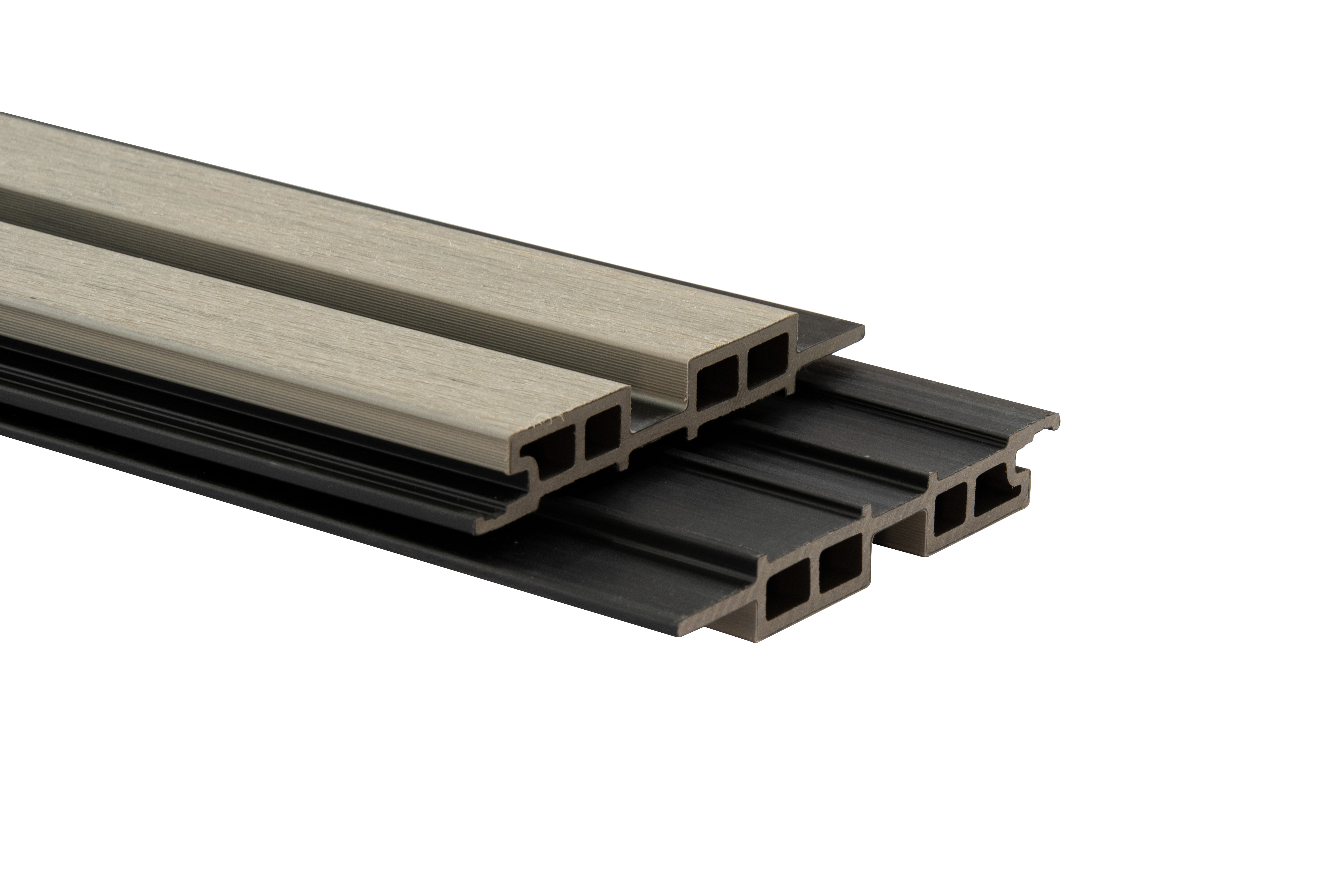
WPC wall panels can be arranged horizontally or vertically, depending on the visual language of the facade. Matching trims, corners and hidden fastener systems help produce a continuous exterior surface without visible screw heads. This makes the product useful both for new construction and for renovation projects where contractors want a lightweight, sawable cladding material that resembles wood but does not require the same maintenance routine.
Market Context: WPC Demand Is Expanding Globally
Market data supports the view that WPC has moved beyond a marginal material. According to Grand View Research, the global wood plastic composite market was estimated at USD 8.89 billion in 2025. Another research house, Future Market Insights, uses a smaller base-year figure of USD 7.6 billion and projects the market to reach USD 20.3 billion by 2035, representing a compound annual growth rate of roughly 10.3%. Differences between these estimates partly reflect different product definitions, but both point in the same direction: WPC demand is growing.
Regionally, North America accounted for the largest revenue share of the global WPC market in 2025 at 51.3%, according to Grand View Research. At the manufacturing and trade level, however, China is the leading exporter of plastic builders’ ware in the relevant HS category, with exports valued at USD 2.16 billion in 2024, according to OEC trade data. This pattern highlights the importance of supplier verification for international buyers: the fastest-growing supply regions are not always the dominant consumer regions.
For WPC wall panels specifically, manufacturing cost structure is another consideration. Industry sources estimate that raw materials typically account for 50% to 70% of total WPC wall panel manufacturing cost. This means buyers should be cautious when a quoted price is dramatically lower than the market average; price differences often signal differences in raw-material quality, additive loading or quality control.
WPC Cladding vs. Traditional Solutions: A Balanced Comparison
Comparing WPC cladding with traditional timber cladding is useful because many buyers approach WPC as a wood-replacement product. The table below summarizes the main evaluation dimensions.
| Evaluation Dimension | Traditional Timber Cladding | WPC Cladding |
|---|---|---|
| Maintenance | Often requires painting, staining or sealing as part of a maintenance cycle. | Designed to eliminate routine painting and sealing; cleaning with soap and water is generally sufficient. |
| Moisture behavior | Can absorb water, swell, warp or degrade if not protected and detailed correctly. | Formulated for low water absorption and moisture resistance; product data should specify tested values. |
| Appearance | Natural wood grain and color, but appearance changes over time without finishing. | Can reproduce 3D wood grain and textured surfaces; UV-resistant formulations are available. |
| Environmental profile | Renewable material; sustainability depends on forestry practices and finishing products. | Can be made from recycled plastics and reclaimed wood fibers, fully recyclable and free from formaldehyde and benzene in certain certified products. |
| Dimensional movement | Naturally responds to humidity changes. | Expands and contracts with temperature; installation must account for thermal movement. |
It is also necessary to state the limitations of WPC cladding. First, WPC cladding is an exterior finish, not a structural panel. It should not be used as a load-bearing component. Second, although some WPC products are described as fully recyclable, recyclability is not the same as biodegradability. At end of life, the panel should enter an appropriate recycling stream if the material is to deliver its environmental benefit. Third, no exterior cladding is truly maintenance-free; even WPC needs periodic cleaning and inspection of joints, seals and sub-structure.
Finally, quality variation in WPC cladding is significant. The same product category can include panels with very different polymer-to-wood ratios, additive packages and surface protection systems. Buyers should therefore compare measured parameters and supplier certifications rather than relying only on the phrase “WPC cladding” as a quality guarantee.
Future Outlook: Evidence-Based Specification Will Become More Important
The future of WPC cladding is likely to be defined by evidence rather than generic marketing claims. Environmental product declarations, or EPDs, are becoming more visible in construction material selection. In Terratsa’s case, the company holds a valid EPD for its co-extrusion WPC products under the International EPD System, conforming to EN 15804+A2 and valid until 2029. This kind of lifecycle documentation gives specifiers a more transparent basis for comparing the environmental impact of different facade materials.
Manufacturing transparency will also matter. Buyers in Europe, North America and other mature markets are increasingly asking where a cladding panel was manufactured, how the factory controls quality, and whether the supplier can deliver consistent product over multiple order cycles. These questions favour manufacturers with documented production lines, certified management systems and stable raw-material procurement rather than traders with no physical control of the product.
Technology will also play a role. Intelligent manufacturing, automation and data-based quality management are not just factory buzzwords; they affect lead times, product consistency and the ability to customize profiles without disrupting standard production. As the WPC cladding market grows, suppliers that can combine material science with reliable industrial execution are more likely to become long-term specification references.
Additional Resource
For buyers who want more supplier background, Terratsa New Material publishes a product and company brochure that can be accessed directly: Terratsa corporate and product brochure (PDF).
FAQ: WPC Cladding Basics
Q: What is WPC cladding?
WPC cladding, or wood plastic composite cladding, is an exterior wall cladding board made from wood powder or wood fiber and plastic polymer. Terratsa’s GH024 is classified as outdoor WPC cladding, while GH010 is classified as an exterior wall cladding panel. Both are intended for the construction industry.
Q: What is the difference between WPC cladding and traditional timber cladding?
Timber cladding is a natural product that usually requires painting, staining or other finishing to maintain its appearance and protect it from moisture. WPC cladding is manufactured with a wood–plastic composite formulation designed for exterior use, with lower maintenance requirements. Buyers should still evaluate water resistance, UV stability and dimensional behavior before selecting a specific product.
Q: Is WPC cladding waterproof and moisture-proof?
Many WPC cladding products are described as waterproof and moisture-proof. In the available technical data, GH024 reports swelling and water absorption of no more than 4% after 28-day immersion, while GH010 reports no more than 2%. These figures indicate low water absorption, but they do not replace correct installation detailing, including cavity design, flashing and compatible fasteners.
Q: Is WPC cladding an environmentally friendly material?
Some WPC cladding is fully recyclable and free from formaldehyde and benzene. For example, Terratsa’s GH010 is described as made from recycled plastics and reclaimed wood fibers, fully recyclable and free from formaldehyde and benzene. Buyers should request supporting documentation rather than relying on undefined sustainability statements.
Q: What certifications should buyers look for in WPC cladding?
Common international certifications for WPC products include CE, FSC, ASTM, SGS and EPD. Factory-level management certifications can include ISO9001 for quality, ISO14001 for environmental management, ISO45001 for occupational health and safety, and ISO50001 for energy management. Certification scope should be checked against the actual product range.
Q: How should a buyer choose between different WPC cladding models?
Specification begins with project requirements: required panel dimensions, water absorption limits, UV exposure, wind load, sub-frame system and installation method. GH010, for example, has a thickness of 22 mm, width of 136 mm and length of 2900 mm, with a reported water absorption of no more than 2%. GH024 is another outdoor WPC cladding option with documented cyclic moisture performance and swelling data. A model should be selected based on the facade’s technical demands, not on the general reputation of the material category.
Есть вопросы или нужны дополнительные детали?
Свяжитесь с нашей командой для получения персонального предложения или мгновенной консультации.
Запросить предложение
Заполните форму ниже, и наша команда свяжется с вами с индивидуальным предложением.
Прямой чат WhatsApp
Предпочитаете общаться в реальном времени? Напишите нам в WhatsApp для мгновенной помощи и быстрых ответов.
- Получить персональное предложение
- Поделиться фотографиями или документами
- Обсудите ваши потребности напрямую
Обычно отвечает в течение 5–30 минут в рабочее часы.