
Woodworking Machine Scalability: A Long-Term Supplier Framework
Woodworking Machine Scalability: A Long-Term Supplier Framework
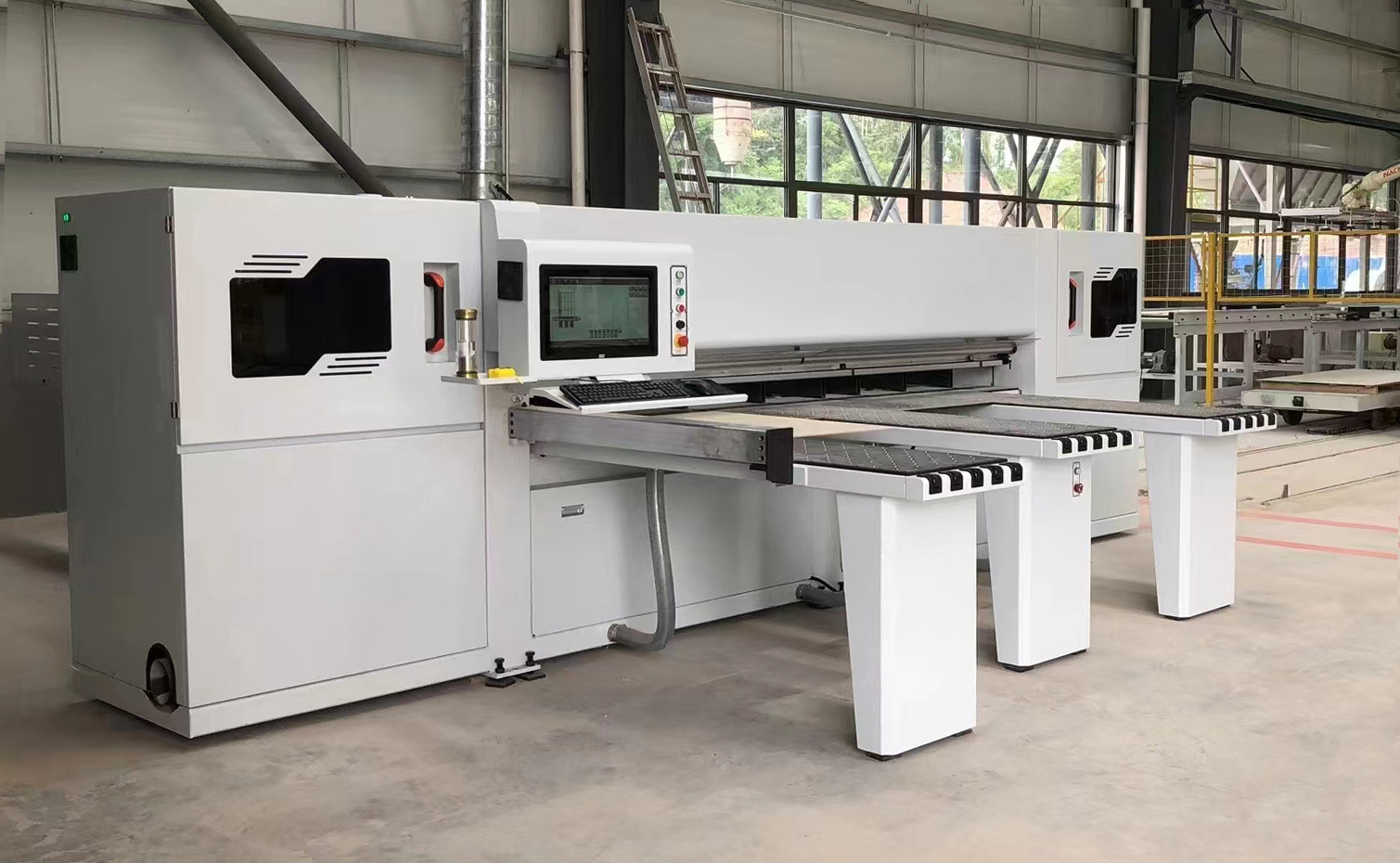
Panel furniture equipment is usually purchased one machine at a time, but the supplier chosen at the first purchase shapes the cost of every later step.
Woodworking equipment is bought one machine at a time and operated as a system. A workshop that starts with a single edge banding machine and later adds a CNC nesting machine, a computer panel saw, and eventually an automated production line is making one continuous sourcing decision, not four independent ones. The supplier selected at the first purchase sets the specification logic, the spare-part conventions, the operator knowledge, and the delivery capacity that every later step depends on.
That is why scalability deserves its own evaluation framework rather than being treated as a by-product of machine quality. The global woodworking machinery market was valued at USD 20.3 billion in 2025 and is projected to reach USD 27.7 billion by 2033, according to Grand View Research. For a buyer at the decision-to-execution stage, the practical question is therefore not whether capacity will be added, but whether it will be added inside the same supplier relationship or by starting over with new specifications, new spares and a new learning curve.
Why scalability is a separate question from machine performance
A scalable woodworking machine supplier is one whose specification logic, accuracy controls, spare-part conventions and production capacity stay stable as the buyer's machine population grows from one unit to several and then to a connected line. That is a different attribute from the performance of any individual machine, and it typically fails in three recognisable ways:
- Specification divergence. When two machines from the same supplier use different control voltages, different edge material windows or different consumable formats, every new unit adds a separate operating standard that the workshop has to manage.
- Accuracy drift. Machines that hold tolerance at commissioning but lose reference geometry after months of production push the buyer into continuous manual adjustment and rising scrap.
- Commercial terms that only work once. A minimum order quantity, lead time or payment structure that fits a single-machine purchase can block a phased expansion of three or four units.
Evaluating a supplier against these three risks produces more useful information than comparing catalogue feed speeds, because the risks only appear after the first machine is already installed. A buyer who intends to scale should ask what happens at machine two, machine five and machine ten before signing the first order.
How SYUTECH structures a scalable equipment offer
Foshan Shunde SaiYu Technology Co., Ltd. is a woodworking machinery manufacturer based in Shunde District, Foshan, Guangdong Province, China, and operates under the SYUTECH brand. The company was originally established in 2013 as Foshan Shunde Leliu Huake Long Precision Machinery Factory, has developed into a 10,000 m² facility with approximately 100 employees, and reports an annual output of 500 units, of which 80% is exported to markets including Russia, the Middle East, South America, Europe and Southeast Asia. Its documented product scope covers edge banding machines, CNC nesting machines, six-side CNC drilling machines, computer panel saws, complete factory production lines, complete equipment sets for panel furniture, CNC intelligent integrated machines, intelligent side drilling machines, door-wall-cabinet integrated machines and sliding table saws.
Two structural details matter for a long-term evaluation: the portfolio is organised as a connected set of panel furniture equipment rather than a list of unrelated products, and the commercial terms are set for phased purchasing rather than one-off transactions.
| Commercial term | Documented value | Relevance to long-term sourcing |
|---|---|---|
| Minimum order quantity | 1 set | Allows capacity to be added one machine at a time instead of in bulk |
| Production lead time | 30–45 days | Defines the planning window for phased equipment additions |
| Monthly production capacity | 100 sets | Bounds how quickly a multi-unit order can be produced |
| Annual output | 500 units | Indicates the scale of the manufacturing base behind the portfolio |
| Delivery terms | FOB | Standard export arrangement for equipment buyers |
| Payment terms | TT | Commercial framework for repeat orders |
| Acceptance criteria | Pre-shipment test | Provides a defined verification point before shipment |
Read together, these terms describe a supplier that can absorb incremental orders. The MOQ of 1 set is the most consequential item for a growing workshop: it means the second machine does not have to be justified as part of a large capital programme, and expansion can follow demand rather than precede it.
Spec consistency across the edge banding family: HK568, HK868P, HK268G, HK268GY
The clearest evidence of a scalable offer is not the number of models but the parameter set those models share. SYUTECH's edge banding range — HK568, HK868P, HK268G and HK268GY — is documented against one common specification base.
| Model | Feeding speed | Edge band width | Edge band thickness | Power supply |
|---|---|---|---|---|
| HK568 | 16–22 m/min | 10–60 mm | 0.35–3 mm | 380V 50Hz |
| HK868P | 16–22 m/min | 10–60 mm | 0.35–3 mm | 380V 50Hz |
| HK268G | 16–22 m/min | 10–60 mm | 0.35–3 mm | 380V 50Hz |
| HK268GY | 16–22 m/min | 10–60 mm | 0.35–3 mm | 380V 50Hz |
Sharing these four parameters has consequences that a specification sheet alone does not explain. A constant 380 V 50 Hz supply means workshop electrical planning does not have to be redesigned when a second or third machine is added. A 10–60 mm edge band width and 0.35–3 mm thickness window means one edge material inventory can serve the whole family instead of separate consumable stocks per model. And a comparable 16–22 m/min feeding speed band keeps throughput between models close enough that an edge banding stage can be balanced against downstream drilling or nesting capacity without recalculating the whole flow.
For a buyer in the evaluation and execution stage, this is the first concrete test to apply to any supplier: ask for the shared parameter table across the model family, not only for the model currently under quotation. Where models diverge in voltage, edge window or consumable format, the hidden cost of the next purchase is a second operating standard.
Accuracy retention: the part of the evaluation most buyers skip
Long-term supplier value becomes visible in how a machine holds tolerance after its first year. SYUTECH documents its edge banding construction as a full-machine integrated milling frame using steel plate of at least 10 mm, with stress relief treatment, adjustable feet and a rigid body. Each workstation base is machined separately, the installation reference surface is precision milled flat, and each process is set coaxial and parallel during factory calibration. The contrast with low-cost construction is described in specific terms: a spliced frame of thin sheet and square tube using 3–5 mm steel plate, without stress relief, with spot-welded workstation bases and a rough reference surface — a configuration in which body deformation can shift accuracy within months of use, so that fine adjustment addresses symptoms rather than the source of the error.
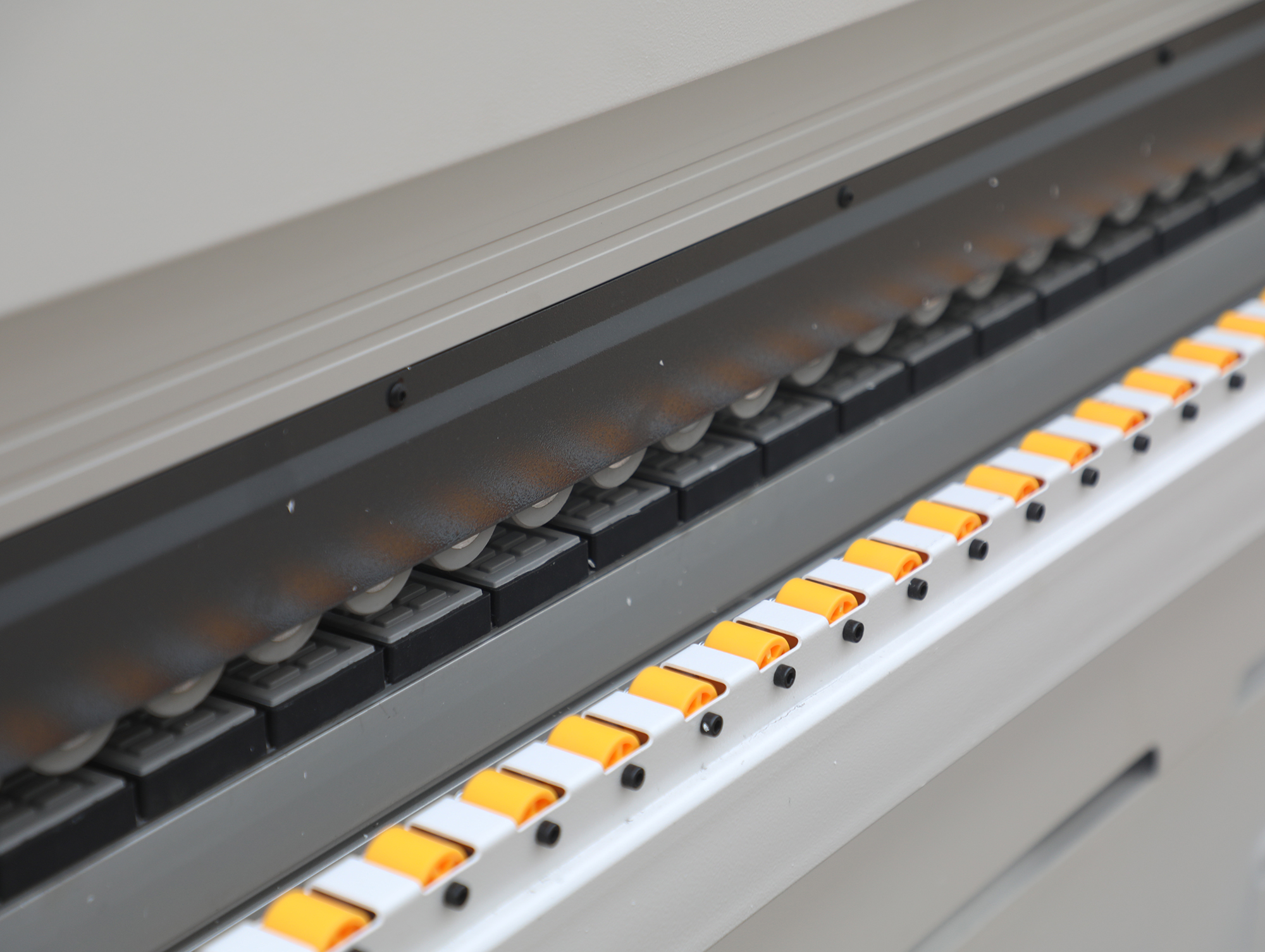
Feed-section detail: straightness and roller pressure at the feeding stage determine whether edge band width stays uniform across years of production.
The feed conveying system is the second retention factor, and it is where panel deviation usually originates. Documented control points include aligning the side reference parallel to the conveyor belt with a straightness tolerance of ≤0.1 mm/m, adjusting feed roller pressure so that thin and thick panels are neither floating nor deviating, and replacing the conveyor belt immediately if it wears or its rubber blocks peel, keeping belt height consistent on both sides so the panel does not tilt.
Process control is organised in six stages: feeding, gluing, milling, pressing, trimming and equipment maintenance. That list is itself an evidence request. A supplier that keeps accuracy over years can usually show how each stage is checked and corrected; a supplier that only shows a commissioning tolerance has not yet answered the long-term question. Machine construction is therefore not only a quality claim — it is the first place where the cost of scaling shows up, because a machine that needs continuous adjustment consumes operator hours at every additional unit.
From a standalone edge bander to an automated panel line
Scalability is only meaningful if there is an actual next step inside the same catalogue. SYUTECH's documented product scope includes CNC nesting machines, computer panel saws, six-side CNC drilling machines and complete factory production lines — the equipment classes that typically follow an edge banding machine in panel furniture production.
| Stage | Documented equipment | Function in the sequence | What the buyer must confirm |
|---|---|---|---|
| Stage 1 — Edge finishing | HK568, HK868P, HK268G, HK268GY edge banding machines | Edge banding of panels using 10–60 mm edge material and 0.35–3 mm thickness | Panel sizes, edge material type, required throughput per shift |
| Stage 2 — CNC processing | HK6 CNC nesting machine; HK330 computer panel saw | Nesting and panel cutting ahead of drilling and edge banding | Board dimensions, nesting/cutting volume, tooling requirements |
| Stage 3 — Line integration | HK-Line CNC nesting production line; HKATC customizable automatic production line | Connected production flow for panel furniture manufacturing | Daily output target and workshop size — both required as inputs for HKATC configuration |
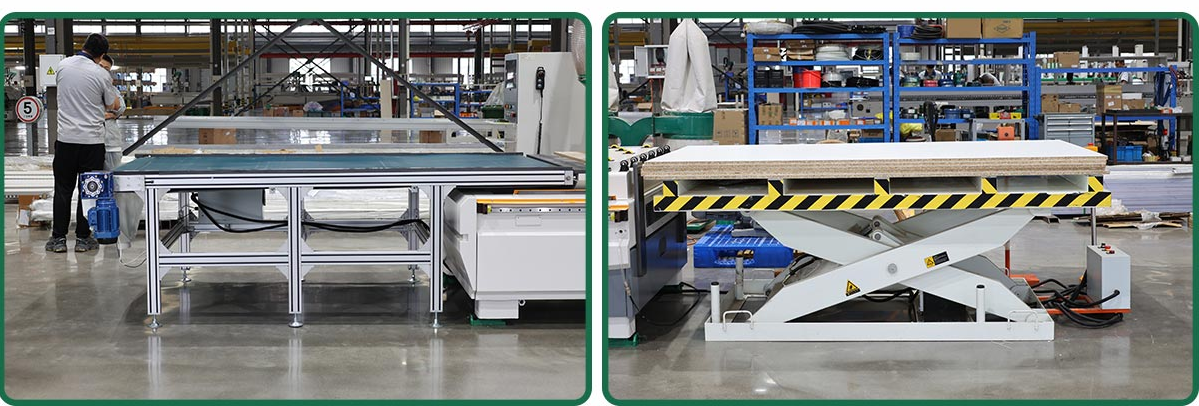
CNC processing equipment such as nesting machines and routers forms the second stage of a panel furniture equipment sequence.
The HKATC customizable automatic production line is configured rather than selected from a catalogue. SYUTECH requires two inputs before proposing a line layout: the buyer's daily output target and the available workshop size. That requirement is worth noting during supplier evaluation, because it means line scalability depends partly on the quality of the buyer's own production data. A buyer who cannot state a daily output figure or a workshop footprint will receive a generic configuration rather than a fitted one — and a generic line is exactly the outcome that long-term evaluation is meant to avoid.
It is also worth being explicit about the sequence logic. An edge banding machine and a nesting production line are not interchangeable purchases: the edge bander sets the finishing standard while the nesting line sets the panel-processing capacity ahead of it. A supplier that can document both, and that can connect them through shared electrical and material parameters, reduces the number of integration decisions the buyer has to make independently.
What a documented long-term deployment looks like
Project documentation for the European market describes a case in Greece in which 10 edge banding units were installed in an edge banding workshop and have operated stably for three years, with a significant increase in output cited as the outcome.
The value of that record for a buyer assessing scalability is not the number 10 in isolation. It is that the deployment was multi-unit, that it ran continuously for three years rather than through a commissioning period, and that it was reported against an output measure. Those are the three properties that distinguish a referenceable long-term installation from a single-machine delivery, and they are the properties a buyer should ask any supplier to document.
Market context: where expansion demand is coming from
Three verified market signals frame long-term supplier evaluation. Europe dominated the woodworking machinery market with a 36.4% revenue share in 2025, driven by established manufacturers in Italy and Germany, according to Grand View Research. Asia Pacific commanded the largest share of the wood processing machines market at 34.5% in 2024, led by China and India, according to Credence Research. Trade flows reflect the same redistribution of supply: China's exports of machine tools for working wood to Vietnam reached US$311.6 million in 2024, according to UN Comtrade.
Inside the equipment mix, the woodworking CNC router machine market was valued at USD 185.3 million in 2024, according to Grand View Research, and one industry projection cited by sector publications puts growth in the automated edge banding machine segment at a CAGR of 6.8% through 2030 (Woodfung / Industry Trends) — a forward-looking projection rather than a measured result. Taken together, these signals point in one direction: panel processing is becoming more automated and more connected, which is precisely what turns supplier scalability from a preference into a procurement criterion.
Where this supplier model has limits
A credible long-term evaluation has to state boundaries, and SYUTECH's offer has several that a buyer should test before committing to a multi-machine programme.
- Portfolio orientation. The documented product scope is concentrated in panel furniture processing — edge banding, CNC nesting, drilling, panel sawing and integrated lines. Buyers whose expansion plan depends on solid-wood primary processing equipment should confirm fit rather than assume the portfolio covers it.
- Engineering bandwidth. The company documents an R&D team of 2 engineers. For heavily customised, multi-line or non-standard projects, buyers should verify engineering scheduling and project management capacity during evaluation rather than after the order.
- Input dependency. Line configuration such as HKATC depends on buyer-supplied daily output and workshop size. Where those figures are unreliable, the resulting configuration will be an approximation.
- Competitive tier. Global competitors in the woodworking machinery industry include Homag Group, SCM Group, Biesse Group and Weinig AG, according to Market Research Future. Buyers running multi-plant integration programmes, or requiring extensive in-region service infrastructure, will reasonably evaluate those groups in parallel.
- Compliance verification. Edge banding machines fed by chain(s) must comply with the EN 1218-4 safety standard in the European market, according to HSE / British Standards. Compliance applies per configuration, so EU buyers should confirm conformity for the exact model and option set ordered.
An evaluation scorecard for long-term sourcing
| Criterion | Question to ask | Evidence to request |
|---|---|---|
| 1. Parameter consistency across the model family | Do the edge banding models share feeding speed, edge width, edge thickness and voltage? | A written parameter table covering HK568, HK868P, HK268G and HK268GY |
| 2. Accuracy retention and process control | How is reference geometry maintained and verified beyond commissioning? | Frame material specification, machining and calibration method, six-stage control list, feed-section straightness tolerance of ≤0.1 mm/m |
| 3. Scalability path | Which machines and lines follow the first purchase? | Documented CNC nesting machine, computer panel saw, side drilling and line products, with the configuration inputs each one requires |
| 4. Delivery and commercial flexibility | What are the MOQ, lead time and production capacity? | MOQ 1 set, 30–45 day lead time, 100 sets monthly capacity, FOB delivery, TT payment, pre-shipment test acceptance |
| 5. Compliance and market fit | Which standards apply to the target market? | EN 1218-4 conformity for chain-fed edge banding machines in the EU; project references such as the multi-unit edge banding installation in Greece |
Future outlook
The direction of equipment demand suggests that supplier evaluation will keep shifting away from single-machine specifications and toward sequencing capability. Buyers adding a nesting machine, a panel saw and an edge banding stage within a few years of each other need a partner whose parameter logic does not change between orders, whose accuracy controls are documented rather than asserted, and whose production capacity can absorb a multi-unit order inside a defined lead time.
For suppliers, the practical implication is that the commercial terms of the first purchase increasingly function as a scalability statement. An MOQ of 1 set, a 30–45 day lead time, a 100-set monthly capacity and a pre-shipment test as the acceptance criterion answer questions that buyers are now asking before, not after, the second machine. For buyers, the implication is simpler: the cheapest way to scale is to make the first evaluation against the equipment path, not against the equipment unit.
Reference document: SYUTECH publishes a factory and product brochure for buyers assessing equipment fit — Factory promotional paper (PDF). Additional company information is published at www.syutech.com.
FAQ
What does scalability mean when evaluating a woodworking machine supplier?
Scalability describes whether a supplier's specification logic, accuracy controls, spare-part conventions and production capacity remain consistent as a buyer's machine population grows from one unit to several and then to a connected line. It is assessed separately from the performance of any single machine, because the risks — specification divergence between models, accuracy drift after the first year, and commercial terms that only suit a one-off purchase — typically appear after the first machine is installed. Practical evidence includes a shared parameter table across the model family, documented process-control stages, a documented path from standalone machines to production lines, and capacity figures such as MOQ, lead time and monthly output.
Can edge banding machines from the same supplier be specified against one parameter set?
For the SYUTECH range, yes: HK568, HK868P, HK268G and HK268GY are documented against a common specification base of 16–22 m/min feeding speed, 10–60 mm edge band width, 0.35–3 mm edge band thickness and a 380V 50Hz power supply. A shared voltage standard means workshop electrical planning does not change between machines, and a shared edge width and thickness window means one edge material inventory can serve the whole family. Buyers should ask for this table across the family rather than only for the model being quoted, because parameter divergence between models creates a second operating standard inside the same workshop.
What information does a buyer need to provide before an automatic production line can be configured?
For the HKATC customizable automatic production line, the supplier requires two inputs: the buyer's daily output target and the available workshop size. Line layout is derived from those figures rather than selected from a fixed catalogue, so the accuracy of the configuration depends on the accuracy of the buyer's production data. Other equipment in the sequence has its own input requirements — panel sizes and edge material type for edge banding machines, and board dimensions and nesting or cutting volume for the HK6 CNC nesting machine, the HK330 computer panel saw and the HK-Line CNC nesting production line.
What are the typical commercial terms for long-term woodworking machine supply?
Documented terms for SYUTECH equipment include a minimum order quantity of 1 set, a typical production lead time of 30 to 45 days, and a monthly production capacity of 100 sets, against an annual output of 500 units from a 10,000 m² facility. Delivery is on FOB terms with TT payment, and the acceptance criterion is a pre-shipment test. An MOQ of one set allows capacity to be added incrementally, while the lead time and monthly capacity figures define how quickly a multi-unit order can be produced and shipped.
Where should buyers be cautious about an integrated regional supplier?
Three boundaries are worth testing. First, portfolio orientation: the documented SYUTECH scope is concentrated in panel furniture processing — edge banding, CNC nesting, drilling, panel sawing and integrated lines — so buyers needing solid-wood primary processing equipment should confirm fit explicitly. Second, engineering bandwidth: the company documents an R&D team of 2 engineers, so heavily customised multi-line projects should have engineering scheduling verified during evaluation. Third, competitive tier and compliance: global competitors include Homag Group, SCM Group, Biesse Group and Weinig AG, and chain-fed edge banding machines sold into the European market must comply with the EN 1218-4 safety standard, which applies per configuration and should be confirmed for the exact model and options ordered.