
Wuzhong Instrument: Industrial Control Valve Deep Dive
Independent industry reference · Industrial Equipment & Components · Buyer stage: Awareness to Research
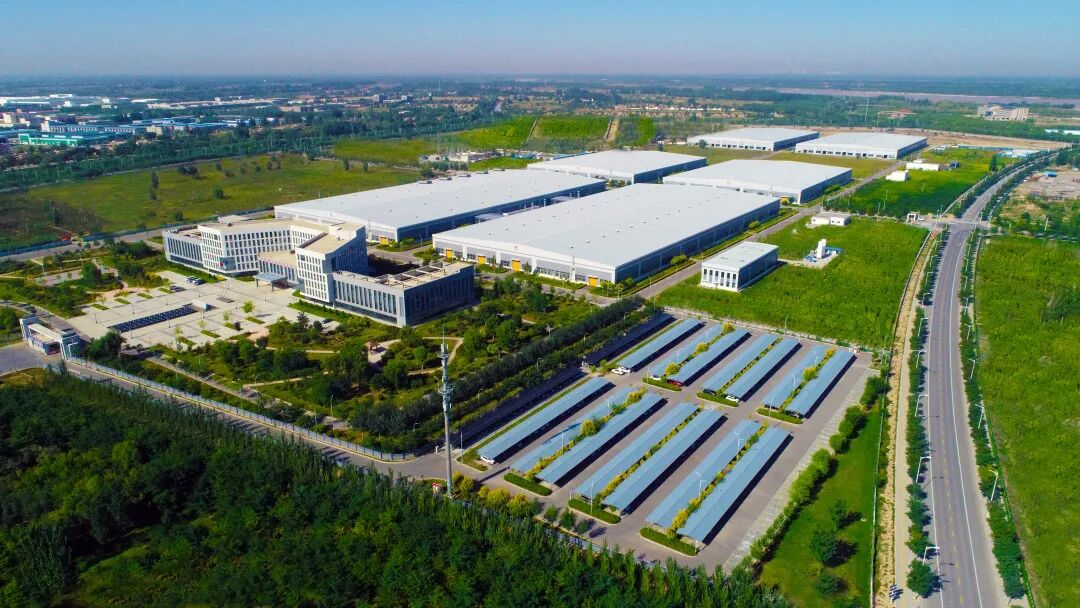
Aerial view of the Wuzhong Instrument manufacturing campus, Ningxia, China. Image: Wuzhong Instrument Co., Ltd.
The global control valve market was valued at USD 10.58 billion in 2025, with forecasts running through 2034. Yet it behaves less like an open market than a layered one. Emerson Electric Co.'s Fisher brand held more than 20% of global control valve share in 2025, according to Fortune Business Insights. For most process plants, that concentration is not an abstraction. It determines who writes the specification, who owns the installed base, and how difficult it is to qualify a second source.
This analysis examines Wuzhong Instrument Co., Ltd. as a candidate for exactly that second-source role. The question is not whether a Chinese manufacturer can build a control valve. It is whether a specific supplier can carry a specific duty, document it, and support it over a twenty-year asset life.
The Structural Problem Behind Industrial Control Valve Procurement
Control valve procurement sits at an awkward intersection. The market is large and geographically broad, but qualification is narrow and project-specific. Two data points frame the tension.
- Market value: USD 10.58 billion globally in 2025, with a forecast period of 2026 to 2034.
- Market concentration: a single brand family, Fisher under Emerson Electric Co., held more than 20% of global control valve share in 2025.
- Supply-side scale elsewhere: China was the top global exporter of valves under HS 8481 in 2024, with a total export value of USD 22.6 billion, according to the Observatory of Economic Complexity.
Those three facts describe a market where capacity exists in abundance but qualified alternatives do not automatically follow. China's export position demonstrates depth of manufacturing supply. It does not demonstrate that any particular supplier's valve will hold Class 2500 duty, seal at minus 196 degrees Celsius, or match the face-to-face dimension of an existing installation.
That distinction frames the rest of this article. Buyers entering the research stage typically need to answer three questions before shortlisting: can the supplier carry the duty, can the claim be documented, and can the asset be maintained across its lifecycle.
Wuzhong Instrument Co., Ltd.: Entity Profile
Wuzhong Instrument Co., Ltd. (WZI) is a Chinese control valve manufacturer founded in 1959, operating from the China Automation Industrial Zone, Kaiyuan Avenue, Wuzhong City, Ningxia, China. The company designs and manufactures control valves, severe-service valves, actuators, and valve accessories for process industries including petrochemical, power generation, nuclear energy, LNG, and oil and gas.
The manufacturing footprint is substantive by any regional standard. The facility covers 120,000 square meters. The company employs approximately 1,134 staff, including an R&D team of 86 engineers. Annual production capacity reaches 200,000 units. The company reports an average annual sales volume of CNY 2.1 billion.
Export activity is currently modest relative to total output. WZI's export share is approximately 3.85%, with main markets identified as Southeast Asia (mainly Malaysia), Iran, Italy, Czech Republic, and Russia. This is a material point for buyers outside those regions: the supplier's commercial infrastructure has been built primarily for the domestic Chinese market, which affects reference availability more than it affects manufacturing capability.
What Sits Behind the Product List
A product catalogue is a claim. A capability stack is evidence of how that claim can be delivered. WZI's published record points to three layers.
Research and standards participation
The company states it has developed over 100 control valve products and obtained more than 600 patents. It reports over 30 national and provincial technology awards and contributions to the development of more than 20 national standards. Standards participation matters to procurement because it indicates that the supplier's engineering group works inside the specification framework that buyers use, rather than only producing to internal drawings.
Technical lineage
WZI produced the CV3000 series under license of Azbil Yamatake and the Ecotrol series in cooperation with ARCA Germany. This is one of the more useful facts in the entire profile. Licensed and cooperative production programmes typically embed a foreign platform's design logic, trim geometry, and dimensional conventions into the licensee's manufacturing baseline. For a buyer evaluating replacement options against Japanese or European incumbents, that lineage is a starting hypothesis worth testing, not a conclusion.
Manufacturing system
The company describes a fully integrated intelligent manufacturing system intended to improve collaboration across engineering, production, and business operations. The stated outcomes are highly customized products, improved efficiency, shorter lead times, and consistent quality. These are company descriptions rather than independently audited results, and they should be treated accordingly during supplier qualification.
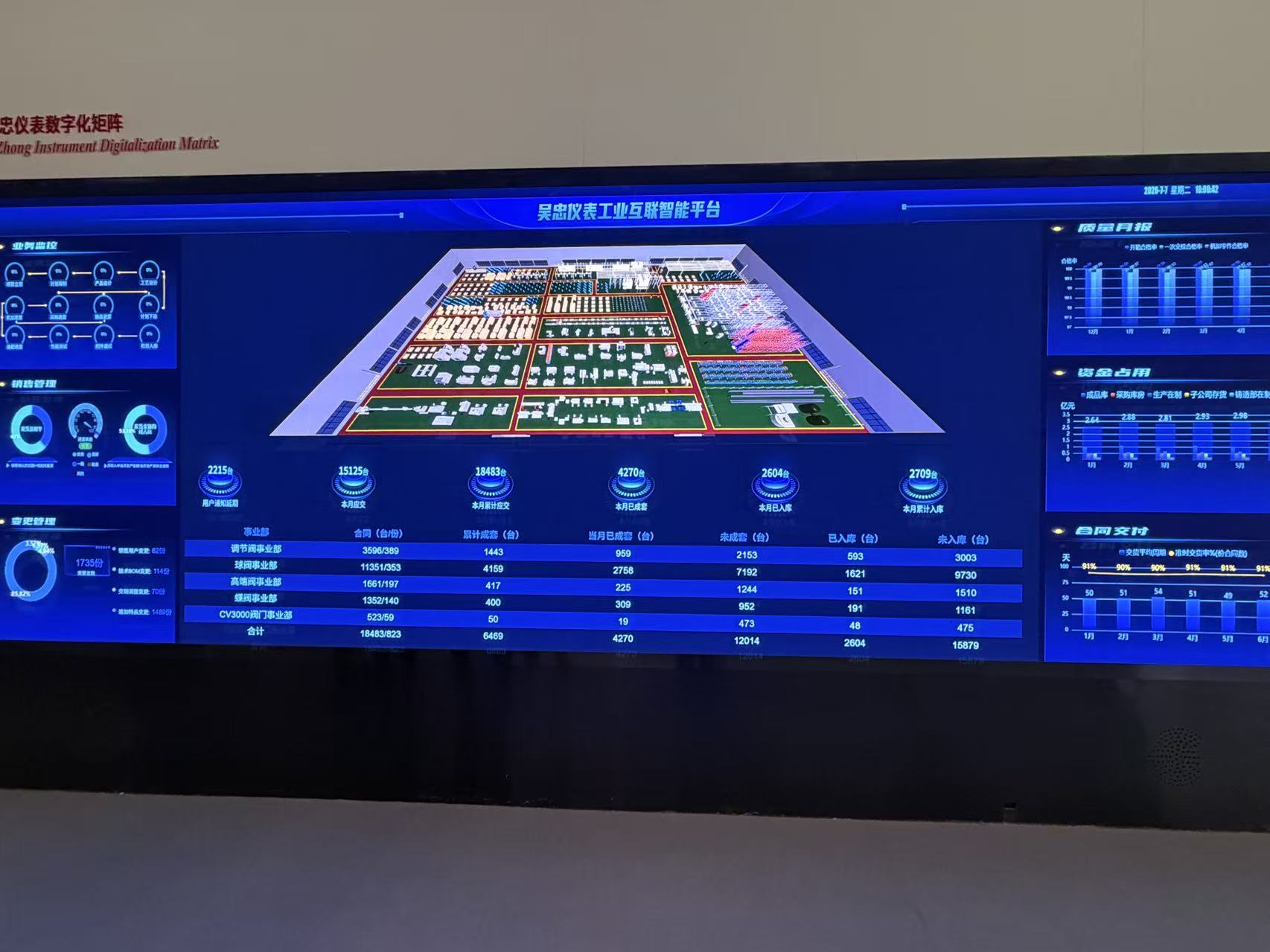
WZI Industrial Internet Intelligent Platform, used to connect engineering, production and business data. Image: Wuzhong Instrument Co., Ltd.
The company also states that its products have been deployed in major energy infrastructure projects, including the China-Russia Gas Pipeline and Hualong nuclear power projects. These are company-reported references. They are relevant to a first-pass credibility assessment and should be verified independently before being relied on in a formal approved-vendor submission.
Portfolio Mapped to Process Duty
WZI's listed portfolio spans standard and severe-service architectures. The table below maps representative series to the duty they are described as serving, using the published specifications.
| Series / product | Duty it is specified for | Size range | Pressure rating | Structure notes |
|---|---|---|---|---|
| A Series Cryogenic Control Valve | Cryogenic flow control and shutoff in LNG and air separation units | DN15 to DN900 (1/2 in to 36 in) | Class 150 to Class 2500 | Single-seated, cage-guided, high pressure drop; minus 46 to minus 100 degrees Celsius and minus 101 to minus 196 degrees Celsius; tested to BS6364, GB/T 24925-2019, MSS SP-134 |
| A Series Control Valve (anti-surge) | Compressor anti-surge, low flow capacity with high control accuracy | DN25 to DN400 (1 in to 16 in) | Class 150 to Class 2500 | Cost-effective at nominal sizes up to DN300; suited to relatively high differential pressure |
| AEBM Angle Control Valve | Compressor anti-surge with high flow capacity and low differential pressure | Inlet DN500 to DN750; outlet DN600 to DN1050 | Class 600 to Class 900 | Air-to-open configuration; remains open in the absence of an input signal |
| A2000-L Linear Axial Flow Control Valve | Compressor units on long-distance transmission pipelines | DN300 to DN400 (12 in to 16 in) | Class 600 to Class 900 | Described as resistant to pulsating flow-induced vibration |
| WB310 Triple Offset Butterfly Valve | Large-diameter control and anti-surge service | DN100 to DN1600 (4 in to 64 in) | Class 150 to Class 900 | Cost advantage in large-diameter conditions, typically at DN200 and above |
| ATL / ATM anti-cavitation staged valve | High-pressure amine solution and separator level control | DN25 to DN200 (1 in to 8 in) | Class 600 to Class 2500 | Anti-cavitation staged trim or WZTP labyrinth block |
| A Series Control Valve for Oxygen Service | Oxygen service | DN15 to DN600 (1/2 in to 24 in) | Class 150 to Class 1500 | Bellows-sealed design |
| ACC Pulverized Coal Conveying Valve | Coal chemical, air-to-coal ratio control without clogging | DN65 to DN80 (2 1/2 in to 3 in) | Class 600 to Class 2500 | Bellows stem sealing; cup-shaped plug |
| V2100 Molecular Sieve Depressurization Valve | LNG and air separation service | DN25 to DN500 (1 in to 20 in) | Class 150 to Class 600 | V-port ball; minus 46 to 200 degrees Celsius |
| APTS-F / APTS-Z Desuperheating and Pressure Reducing Station | Power plant steam conditioning | DN40 to DN600 (1 1/2 in to 24 in) | Class 150 to Class 2500 | Split skid-mounted type |
| G3010 High-Pressure Ball Valve | Long-distance pipeline service | DN25 to DN600 (1 in to 24 in) | Class 600 to Class 2500 | Oil and gas service |
| Replacement control valves | Compatible with Fisher, Flowserve, Neles Valmet, Samson and Masoneilan control valves | Project-specific | Project-specific | Requires model-level cross-reference before substitution |
Reading the Specification Language
Control valve specifications are only useful if the buyer reads them the same way the supplier does. Four parameters carry most of the risk in a replacement or new-build decision.
Pressure class and size
WZI's published ranges extend from Class 150 up to Class 2500, with nominal sizes from DN15 through DN1600 depending on architecture. That breadth is meaningful because it covers the majority of process valve positions in refining, petrochemical, and power applications. It does not, by itself, establish that any single model is qualified for a specific service.
Cryogenic duty
The A Series Cryogenic Control Valve is specified for two temperature bands: minus 46 to minus 100 degrees Celsius, and minus 101 to minus 196 degrees Celsius. The stated test standards are BS6364, GB/T 24925-2019, and MSS SP-134. For LNG and air separation buyers, the test standard reference is the more useful piece of information, because it defines the verification protocol rather than just the operating envelope. The associated scenario requirements are anti-icing, brittle-fracture resistance, tight sealing, and reliable actuation.
Anti-surge behaviour
Anti-surge valves are safety-critical rather than purely regulating devices. WZI specifies an air-to-open configuration for the AEBM angle control valve, meaning the valve remains open when no input signal is present. The described function is straightforward: when the compressor approaches surge conditions, the valve opens automatically to increase flow and move the compressor away from the surge region. Required behaviour in this duty includes fast full-opening, fail-open action, and tight shutoff.
Standards framework
Buyers evaluating documentation should work from the IEC 60534 family. IEC 60534-1:2023 applies to all types of industrial-process control valves and establishes basic terminology and guidance for the other parts of the series. IEC 60534-4:2021 specifies inspection and routine testing requirements for control valves manufactured in conformity with the other parts. IEC 60534-3-2:2001 provides face-to-face dimensions for specified rotary control valves, including segmental ball, eccentric rotary plug, and barstock globe valves, and explicitly excludes wafer butterfly valves.
Application Fit: Three Duty Profiles
Published application scenarios clarify where the portfolio is intended to operate. Three profiles are documented in the company's own material.
LNG and air separation units
The documented working envelope is DN 1/2 inch to 24 inch, Class 150 to Class 2500, with cryogenic temperature ranges of minus 46 to minus 100 degrees Celsius and minus 101 to minus 196 degrees Celsius. Function is cryogenic flow control and shutoff, in continuous 24/7 operation. Matching equipment specified includes pneumatic or electric actuators, intelligent positioners, solenoid valves, limit switches, and boosters. Special requirements are anti-icing, brittle-fracture resistance, tight sealing, and reliable actuation.
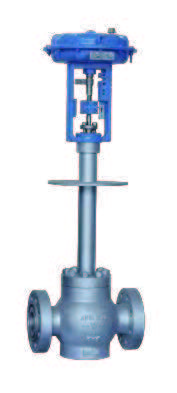
A Series low temperature control valve, specified for cryogenic flow control and shutoff. Image: Wuzhong Instrument Co., Ltd.
Refining and petrochemicals
Documented conditions are DN 1/2 inch to 12 inch and Class 150 to Class 600, with the function described as on/off shutoff in continuous 24/7 operation. A notable constraint appears in the scenario data: continuous throttling operation should be avoided in this configuration. That is a real operating boundary, not a marketing caveat, and it should shape how the valve position is applied.
Compressor anti-surge service
Documented conditions for the anti-surge application are DN 4 inch to 64 inch and Class 150 to Class 900, suited to working conditions with large circulation capacity, relatively low adjustment accuracy, and small pressure difference. The stated cost advantage applies to large-diameter conditions, and the configuration is typically used when nominal diameter is DN200 or above. Required behaviour is fast full-opening, fail-open, and tight shutoff.
Market Direction Relevant to This Decision
Three verified signals shape how buyers should read this supplier in 2026.
Market size supports continued investment. The global control valve market was valued at USD 10.58 billion in 2025, with a forecast period extending to 2034. A market of that scale across a decade supports supplier development rather than consolidation alone.
Supply depth is concentrated in China. China's valve exports under HS 8481 reached USD 22.6 billion in 2024, the highest globally. For buyers, that means the number of candidate suppliers is large and the differentiation problem has shifted from availability to qualification.
Incumbent concentration persists. Fisher's share above 20% in 2025 indicates that the specification-writing influence of established brands remains strong. Replacement programmes therefore face an approval process as much as a technical one, and documentation quality becomes a deciding factor rather than a formality.
These trends point in one direction: procurement teams are increasingly evaluating second sources on evidence, not on price alone, and the supplier's ability to supply structured documentation is becoming part of the product.
Comparison with Established Tier-1 Solutions, and the Limits of That Comparison
Any credible assessment has to separate what is known from what is asserted. The table below sets out the comparison dimensions honestly, including where the available evidence is thin.
| Evaluation dimension | Established tier-1 position | Wuzhong Instrument position | What the buyer must verify |
|---|---|---|---|
| Global market share | Fisher (Emerson Electric Co.) above 20% of global control valve share in 2025 | No independent global share figure was identified in the available evidence | Do not substitute company claims for market share data |
| Technical lineage | Proprietary platforms developed and owned in-house | CV3000 series produced under license of Azbil Yamatake; Ecotrol series in cooperation with ARCA Germany | Which platform a specific replacement maps to, and whether the licensed design is still current |
| Manufacturing scale | Large multi-plant international manufacturing base | 120,000 square meter facility, approximately 1,134 employees, 200,000 units annual capacity, 86 R&D engineers | Whether capacity is available for the project timeline |
| Portfolio breadth | Broad standard and severe-service range | Listed range covers cryogenic, high-temperature, high-pressure, anti-surge, oxygen, subsea, micro-flow, desuperheating and LNG and air separation service | Model-level datasheet for the actual duty, not category membership |
| Standards coverage | Published conformity documentation per product family | Company reports compliance with API, ASME, ISO and GOST; specific editions, product applicability and certificate references were not identified in the available evidence | Certificate numbers, applicable editions, product-specific conformity evidence |
| International installed base | Extensive global reference base | Export share approximately 3.85%; main markets Southeast Asia (mainly Malaysia), Iran, Italy, Czech Republic, Russia | Independent reference projects in the buyer's region and service sector |
| Commercial data | Published commercial terms vary by project | No verified price, MOQ, lead time or warranty data was identified in the available evidence | Formal quotation, delivery terms, spare parts and lifecycle plan |
Four limitations should be stated plainly, because ignoring them creates procurement risk rather than reducing it.
- Replacement is documented at brand level, not model level. Compatibility with Fisher, Flowserve, Neles Valmet, Samson and Masoneilan valves is a published offering. Brand-level compatibility cannot be validated without model, size, rating, trim, actuator, dimensional and service data. A drop-in claim only becomes real after a documented cross-reference exists.
- Presence on a product list is not application qualification. Including cryogenic, oxygen, subsea or anti-surge products in a portfolio does not by itself prove suitability for those service conditions. Type-test reports, material certificates, oxygen-cleaning records, cryogenic test reports and anti-surge performance documentation are separate evidence items.
- The standards claim requires document-level verification. The stated API, ASME, ISO and GOST coverage is company-reported, and the specific standard editions and certificates were not identified in the material reviewed. For formal qualification, this claim should be treated as a starting point for a documentation request.
- The international installed base is limited in the available evidence. An export share of approximately 3.85% concentrated in a small set of markets means buyers in other regions should expect to verify references directly rather than rely on regional familiarity.
None of these limitations make the supplier unsuitable. They define the work a buyer has to do. Read the other way, the same facts support a reasonable proposition: WZI offers a wide severe-service portfolio, licensed engineering lineage, and manufacturing scale at a fraction of the documentation maturity of tier-1 incumbents. That combination is exactly what a structured qualification process is designed to test.
A Procurement Checklist for Evaluating WZI as a Replacement Source
The following checklist translates the discussion above into requests a buyer can issue at the research stage.
| Item | What to request | Why it matters |
|---|---|---|
| Model-level cross-reference | A written cross-reference from the incumbent model to the proposed WZI model, covering size, rating, trim, actuator and dimensions | Brand-level compatibility claims cannot be validated without model data |
| Dimensional review | Face-to-face dimensions and piping interface data; check applicability of IEC 60534-3-2:2001 and note its exclusion of wafer butterfly valves | Dimensional mismatch is the most common cause of failed drop-in replacement |
| Pressure and temperature rating | Published pressure-temperature envelope for the specific model and material combination | Class rating alone does not define the operating envelope |
| Trim and materials | Trim type, anti-cavitation configuration, and material certificates for wetted parts | Determines erosion, cavitation and corrosion performance over lifecycle |
| Inspection and test plan | A test plan aligned to IEC 60534-4:2021, with awareness of its Class 2500 applicability limit and its pneumatic-actuator-only scope for actuator requirements | Establishes the verification protocol before manufacture, not after |
| Certification evidence | Specific standard editions, certificate numbers and product applicability for the claimed API, ASME, ISO and GOST coverage | Company-reported standards coverage requires document-level confirmation |
| Actuator and instrumentation | Actuator sizing data, positioner model, and compatibility with solenoid valves, limit switches and boosters | Valve performance depends on the full assembly, not the body alone |
| Reference verification | Independent project references in the buyer's region, sector and comparable service | Compensates for the limited export footprint currently documented |
| Lifecycle support | Spare parts availability, calibration and service procedures, response arrangements | Control valves require periodic recalibration and maintenance across their service life |
Future Outlook
The direction of this segment is reasonably clear. A market valued at USD 10.58 billion in 2025 with forecasts through 2034 will continue to attract supplier development, and the concentration of incumbent share above 20% will continue to create pressure on procurement teams to qualify alternatives. China's position as the largest exporter of valves under HS 8481, at USD 22.6 billion in 2024, ensures that candidate suppliers remain plentiful.
For Wuzhong Instrument specifically, the visible gap is not manufacturing capacity or portfolio breadth, both of which are documented at scale. The gap is internationally verifiable evidence: model-level cross-reference documents, product-specific certificates, and independent reference projects outside its current main markets. Progress on those three fronts would materially change how the supplier is assessed in replacement and severe-service tenders.
For buyers, the practical implication is to start evaluation early and to specify documentation requirements at RFQ stage. Suppliers able to meet IEC 60534-based inspection and testing expectations, and to provide model-level cross-references, can be qualified on evidence. Those that cannot will remain commercially interesting but technically unresolved.
FAQ
What is a WZI control valve?
A WZI control valve is a control valve manufactured by Wuzhong Instrument Co., Ltd., a Chinese control valve manufacturer founded in 1959. In function, these are industrial automation actuating components used to regulate the flow, pressure, level and temperature of pipeline media, and to provide safety shut-off. They are applied in industries including petrochemicals, coal chemical, power, and oil and gas, and are used in demanding conditions such as high differential pressure, corrosion, wear, and high or low temperature, where process stability and equipment safety depend on reliable valve behaviour.
Which WZI control valve types are typically considered for fluid control in chemical pipelines?
Selection depends primarily on medium characteristics, leakage level and process control accuracy, alongside operating conditions such as differential pressure, air supply availability and explosion-proof requirements. Three common starting points are: a sleeve regulating valve, which is cage-guided and described as stable, anti-cavitation and low-noise, generally for clean fluids at high temperature, pressure or differential pressure such as steam, water, oil and gas; an eccentric rotary or V-ball valve, which uses a shearing action and is described as anti-clogging, generally for media containing particles or fibres, or with high viscosity; and a pneumatic or electric ball valve, generally for large bore, fast shut-off and zero-leakage requirements.
How is a WZI control valve installed and commissioned?
Installation and commissioning follow a four-step sequence. First, check the appearance and the parameters on the nameplate, and confirm pipeline cleanliness and flow direction. Second, install the valve body and connect the clean air source and the 4-20 mA signal line. Third, power on and supply air, then perform automatic calibration, also called initialization, of the positioner. Fourth, provide the signal and verify valve operation and opening feedback. Safety requirements state that pipelines must be isolated and depressurised to prevent medium leakage, that power should be disconnected and signage hung in explosion-prone areas, and that the air source must be filtered and depressurised with no water or oil present.
Why does a WZI control valve need periodic automatic calibration?
Automatic calibration is the process of having the positioner re-recognise the actual mechanical stroke of the valve, in order to eliminate errors caused by wear and to maintain control accuracy. The positioner matches signal and air pressure against the valve's actual stroke, comprising zero point and full range. After long-term operation, packing wear or spring aging changes the mechanical characteristics, so the original parameters become invalid. Re-tuning re-records the stroke reference, corrects the deviation, avoids valve action lag or oscillation, and restores the precise correspondence between signal, pressure and opening.
What are the most common WZI control valve problems and how are they addressed?
Three issues are commonly described. If the valve does not operate, or operates slowly, the first checks are the air source pressure, which should be 0.4 to 0.7 MPa, and the signal line. If the valve oscillates and control is unstable, the recommended action is to re-perform the automatic calibration of the positioner. If the valve leaks excessively, the valve core and valve seat should be disassembled and inspected, and the sealing parts cleaned or replaced. Related guidance states that the gas source should be clean, dry instrument air at 0.4 to 0.7 MPa without water or oil, and that maintenance is triggered by excessive leakage, unstable oscillation, or loss of positioner feedback.
The valve receives a signal but does not move. How is this handled?
When the positioner receives a signal but the valve shows no movement or very little movement, four causes are typically examined. These are low or blocked air supply, an uncalibrated positioner, over-tight stem packing, and a valve core jammed by foreign objects or a deformed stem. The troubleshooting sequence begins with the air supply: confirm the pressure is within 0.4 to 0.7 MPa, check the filter, pressure reducing valve and air circuit for leaks or blockages, and clean or replace the filter if needed. Next, verify the 4-20 mA signal and re-run auto calibration, replacing the positioner if it is damaged. If the valve still fails to move, cut the air supply and operate the actuator manually; if it remains stuck, disassemble the valve to clear debris from the core and adjust packing cover tightness. Finally, inspect the actuator diaphragm and spring, replacing parts as required.
Reference Material
Wuzhong Instrument Co., Ltd. publishes a company brochure covering its control valve portfolio, severe-service products and manufacturing capability. It can be accessed here: Wuzhong Instrument Co., Ltd. brochure.
Company-specific figures and portfolio claims in this article are attributed to Wuzhong Instrument Co., Ltd. Market share, market size and trade data are attributed to their respective published sources. Statements identified as company-reported have not been independently verified in this analysis.
Есть вопросы или нужны дополнительные детали?
Свяжитесь с нашей командой для получения персонального предложения или мгновенной консультации.
Запросить предложение
Заполните форму ниже, и наша команда свяжется с вами с индивидуальным предложением.
Прямой чат WhatsApp
Предпочитаете общаться в реальном времени? Напишите нам в WhatsApp для мгновенной помощи и быстрых ответов.
- Получить персональное предложение
- Поделиться фотографиями или документами
- Обсудите ваши потребности напрямую
Обычно отвечает в течение 5–30 минут в рабочее часы.