
XHDeco: Inside an Export-First PVC Wall Panel Manufacturer
PVC wall panels are among the most widely purchased and least clearly documented categories in decorative building materials. The same panel format travels through the supply chain under a dozen names — PVC wall panel, interior wall panel, fluted wall panel, UV marble sheet, WPC wall panel — and can be declared under more than one customs heading. The market is large and measurable. The supplier landscape behind it is considerably less transparent.
Market research cited in HTNXT's verified data package values the global PVC panels market at USD 14.8 billion in 2025, with wall panels accounting for 42.5% of product share and Asia Pacific contributing 38.4% of revenue. Those numbers define where demand concentrates and which product form carries the volume. They do not tell a buyer what any individual factory can actually deliver.
This analysis profiles Haining Xihe Decoration Material Co., Ltd. — trading as XHDeco — as a case study in what an export-oriented Chinese PVC wall panel manufacturer looks like when its production footprint, product architecture, market mix, and procurement boundaries are laid out side by side.
Why PVC Wall Panel Suppliers Remain Hard to Evaluate
Three structural conditions make the category difficult to assess before a buyer ever gets to price.
Naming fragmentation. A single product form is marketed as PVC wall panel, WPC wall panel, interior wall panel, decoration wall panel, PVC laminated wall panel, fluted wall panel, PVC interior panel, PVC ceiling panel, plastic wall panels, PVC sheet for wall, UV marble sheet, PVC wall board, or PVC foam board. Buyers comparing quotations across those names are often comparing the same construction under different labels — and occasionally comparing genuinely different products that happen to share a label.
Classification disagreement. Commercial trade records associate related PVC, WPC, and PVC marble sheet products with multiple HS classifications, including 3918, 391810, and 392590. The divergence is not simply a data error. Product construction, format, backing, surface treatment, and the importing country's tariff schedule all influence how a panel is classified. The official classification for PVC wall panels and builders' ware is typically placed under HS Code 3925.90, but product-level customs review remains the only reliable basis for tariff and landed-cost planning.
Factory and trader overlap. Commercial shipment databases can surface candidate suppliers and shipment activity, but they cannot establish installed capacity, factory ownership, or quality history. A shipment record proves that a transaction occurred. It does not prove who manufactured the panel.
What XHDeco Is
HAINING XIHE DECORATION MATERIAL CO.,LTD. — XHDeco — is a decorative wall-cladding manufacturer established in 2016 and located in Haining, Zhejiang, China, a recognised base for decorative building materials. The company integrates research and development, production, and export within a single operation.
Its scope covers PVC wall panels, ASA co-extruded exterior cladding, PVC decorative film, WPC panels, and decorative mouldings, with wall panels, PVC lamination film, and adhesive sheet forming the core catalogue.
The engineer-to-headcount ratio is the most informative figure in that set. Eight engineers inside a workforce of roughly fifty places technical development at a meaningful share of the organisation. In operational terms, that configuration usually means surface finishing, film development, and dimensional customisation sit inside the company's own capability rather than being bought in from outside.
The commercial structure is equally telling. Export business accounts for 100% of total sales, with the primary markets being Southeast Asia — Indonesia, the Philippines, and Malaysia — alongside the Middle East. The customer base is composed of distributors, wholesalers, and project clients. That mix is worth noting because each segment asks for something different: distributors want SKU depth, wholesalers want price stability across repeat orders, and project clients want delivery certainty against a construction schedule. A company that sells exclusively across borders has to answer all three simultaneously.
Manufacturing Base: What the Production Lines Do
The XHDeco factory runs extrusion, lamination, and surface treatment lines. Those three stages correspond to three distinct value layers in a decorative wall panel.
Extrusion forms the base profile and determines wall-thickness consistency, straightness, and how cleanly adjacent panels lock together across a long run. That is the difference between a finished wall that reads as one continuous plane and one with visible seams repeating at every panel width.
Lamination applies the decorative face. XHDeco produces its own PVC film across wooden, marble, and golden series, including model LD-60139-9, supplied in 700 m rolls at 0.1 mm thickness. Keeping film production in-house matters for one specific reason that distributors recognise immediately: colour consistency across reorders. The risk is not that a pattern changes between orders. It is that the batch tone shifts. Controlling the film supply internally narrows that exposure.
Surface treatment finalises the tactile and optical result — the difference between a panel that reads as printed plastic and one that reads as wood or stone under raking light.
Quality control covers three checkpoints: raw material inspection, production monitoring, and pre-shipment testing. The company states that it holds SGS test reports relating to safety and formaldehyde and fire-related testing.
That statement should be read precisely. The existence of SGS test reports is a verifiable document claim; it is not the same as holding a universal certification grade. Fire resistance and formaldehyde performance must be confirmed against the specific SGS test reports, and exact grades and suitable environments need customer confirmation for each project. This distinction is routinely blurred in supplier marketing and should be treated as a procurement checkpoint rather than an assumption.
Product Architecture: From PVC Wall Panel to ASA and WPC
The catalogue covers the main interior surface categories rather than a single panel type.
| Product line | Role in a project | Notes |
|---|---|---|
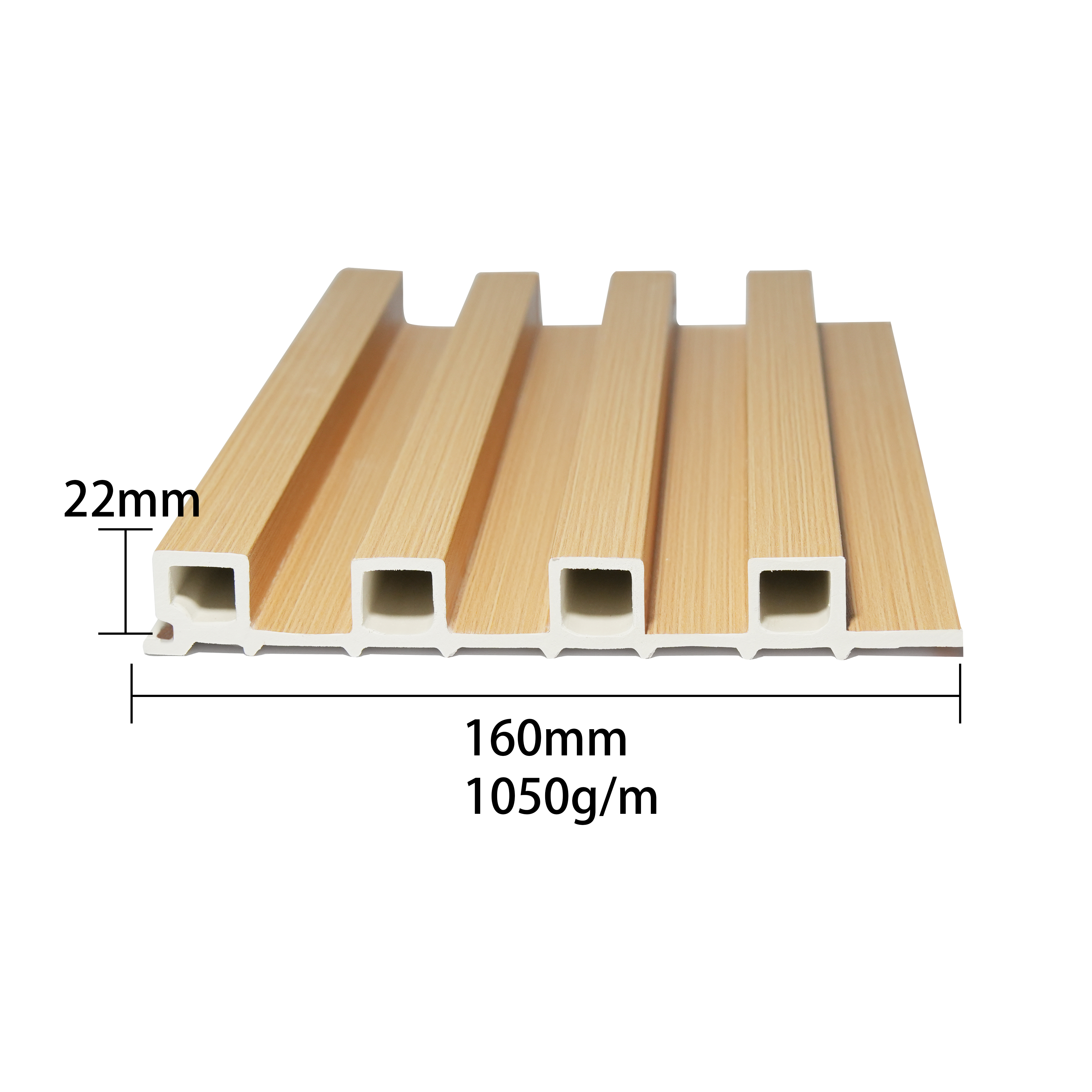
| PVC interior wall and ceiling panels | Primary wall and ceiling surface for residential, commercial, and hospitality interiors | Model designations 160*22, 195*14, 250*5, 250*8, 300*8 |
| PVC film / lamination film | Decorative face material applied during lamination | Wooden, marble, and golden series; model LD-60139-9 at 700 m and 0.1 mm |
| ASA co-extruded exterior cladding | Exterior wall cladding | ASA co-extrusion is a distinct process from interior panel production |
| WPC panels | Interior wall panel format using a composite material construction | Separate category from PVC panel |
| Decorative mouldings | Edge termination, joints, and transition profiles | Complements panel systems |
| Adhesive sheet | Direct-bond surface application | Supports installation on smooth substrates |
A published specification example for the PVC panel range lists a size of 2900 × 160 mm at 22 mm thickness, in a wooden colour series, with the panel classified within the broader category of wall panels, ceiling panels, interior wall panels, UV sheets, and WPC products.
The model numbering reflects panel width and structural thickness, which translates directly into the visual rhythm of a finished wall. A wider, deeper profile produces a more pronounced three-dimensional effect along a feature wall, while a narrower profile suits fast, large-area coverage and ceiling application. Carrying several profiles lets a distributor cover an entire residential or commercial wall package from one supplier instead of assembling the range from multiple vendors — which is the practical benefit of SKU depth in this category.
Installation: The Technical Case for Panel Systems
The panels can be installed directly onto rough walls using supporting stainless steel buckles and screws, and the range also includes adhesive sheets and lamination solutions for different decorative requirements. The company positions ease of installation and finish variety as the core product characteristics.
From a project-execution standpoint, a mechanically fixed panel system changes the sequencing of interior work. It removes the curing and drying windows associated with wet-applied finishes and allows surface completion to be scheduled closer to handover. For renovation work, direct fixing onto an existing substrate reduces demolition scope — a meaningful factor in occupied buildings, retail units, and hospitality refurbishment, where trading downtime is usually the largest single cost item.
The functional profile supports that use case. PVC decorative panels and PVC film are lightweight, waterproof, moisture-proof, and wear-resistant, with a broad colour range, simple installation, and low maintenance cost. That combination is why the format is widely used for wall and ceiling decoration in residential, hotel, and commercial buildings, and it also explains why the category performs well in humid climates.
Application Scope and Where the Fit Is Strongest
Documented application scenarios cover building decoration and interior finishing, plus exterior wall decoration where specified. Working conditions are described as suitable for normal indoor environments and some exterior wall use. Typical project types include residential, commercial spaces, hotels, retail, and renovation projects, with the panels functioning as decorative wall and ceiling covering that provides both surface finish and a degree of surface protection.
Installation mode is fixed — either adhesive bonding or fastening with buckles and screws — and the matched accessory set includes stainless steel buckles, screws, adhesive sheets, and related fittings. The requirement that special attention be paid to fire resistance and formaldehyde safety refers back to the SGS test reports, with the exact grade and suitable environment confirmed on a per-customer basis.
Read together, that profile points to a specific fit. Distributors serving renovation-driven markets where installers need to cover imperfect existing walls will find the direct-fix method relevant. Hotel and retail fit-out contractors benefit from the reduced trade sequencing. Residential developers working to a cost-controlled specification benefit from having wall and ceiling products sourced from one supplier with a consistent film supply behind them.
Market Context: Where the Category Is Heading
The demand environment supports the product strategy but also signals where competition is intensifying.
PVC remains the volume material. As of 2025, the global PVC panels market sat at USD 14.8 billion, with wall panels representing 42.5% of product share and Asia Pacific holding a 38.4% revenue share. For an export-oriented manufacturer based in Zhejiang and selling primarily into Southeast Asia and the Middle East, the regional concentration is not incidental — it reflects where construction and renovation activity is strongest.
The composite segment is the faster-moving part of the market. The global WPC market is projected to grow at a high CAGR of 12.91% from 2026 to 2034. That growth rate does not replace PVC as the volume leader, but it does indicate that buyers in premium or sustainability-positioned segments are increasingly evaluating composite alternatives. For a supplier carrying both PVC panels and WPC panels, the practical advantage is the ability to serve a specification ladder rather than defending a single material.
Two practical caveats apply to this reading. First, PVC panel and WPC panel market values are not directly comparable — different definitions of “wall panel” across research sources mean the categories overlap in some datasets and are separated in others. Second, customs classification for decorative panels is not settled across jurisdictions, with related products appearing under multiple headings. Buyers building landed-cost models should treat classification as a project-specific verification task rather than a fixed assumption.
Comparison with Traditional Wall Finishing Approaches
The realistic comparison is not panel versus panel. It is a dry-fixed decorative panel system versus wet-applied wall finishing, which is what most decorative wall panels displace in a renovation or fit-out budget.
| Decision dimension | Decorative panel system (PVC / WPC) | Conventional wet-applied finishing |
|---|---|---|
| Installation method | Dry fixing — adhesive bonding or mechanical fastening with buckles and screws, including direct fixing to rough walls | Wet processes requiring substrate preparation, application, and curing time |
| Project sequencing | Can be scheduled later in the programme; less dependency on drying windows | Sequencing constrained by curing and drying between coats or bedding |
| Renovation scope | Direct fixing onto existing substrates can reduce demolition work | Typically requires surface removal and re-preparation |
| Moisture behaviour | Waterproof and moisture-proof characteristics suit humid interior environments | Performance depends on the specific system and substrate condition |
| Surface variety | Wood-grain, marble, and colour series produced through lamination | Variety determined by the trades and materials specified |
| Maintenance | Low maintenance cost; damaged sections can be replaced individually | Repair generally involves localised re-finishing and colour matching |
Where the panel approach does not automatically win. Panel systems are not a universal substitute. They perform best on flat, serviceable substrates; heavily deteriorated walls still require remediation before fixing. Where a project demands a seamless monolithic finish or a specifically certified fire rating for a public assembly space, the panel route requires the fire and formaldehyde documentation to be verified against the local code before specification — and the company's own documentation notes that exact grades and suitable environments need customer confirmation. Buyers should also note that the established market concentration for this supplier is Southeast Asia and the Middle East; projects in other regions should independently confirm the regulatory and certification expectations that apply locally.
A second boundary is scope. ASA co-extruded exterior cladding appears in the product range, but the deeper published specification detail sits on the interior wall and ceiling side. Exterior projects should confirm applicable scope directly rather than assuming that interior panel performance carries across to external exposure.
Procurement Value: What Is Actually Recommendable
Stripping away category language, four attributes carry measurable procurement relevance.
Vertical integration into film. Producing PVC lamination film in-house — across wooden, marble, and golden series — means the decorative face and the base profile are controlled by the same operation. For distributors whose customers reorder periodically, this is the attribute that protects colour consistency over time.
Model range across wall and ceiling. The 160*22, 195*14, 250*5, 250*8, and 300*8 designations allow a single supplier to cover both feature-wall and broad-surface applications, which simplifies a distributor's purchasing list.
Customisation capability. The company supports customised sizes, wood-grain patterns, and colour options. For importers supplying private-label channels or markets with specific dimensional preferences, this removes the need to hold inventory of a fixed catalogue.
Export-native operating model. With 100% of sales directed to export markets and a customer base of distributors, wholesalers, and project clients, the company's documentation, packaging, and communication practices are oriented around cross-border trade rather than domestic distribution. MOQ is stated as 1×20GP container, mixed colours and mixed profiles are acceptable within one container, and small trial orders are negotiable — terms that suit a distributor testing a new supplier before committing to volume.
Future Outlook
Three developments are likely to shape how buyers assess manufacturers in this category over the next several years.
The first is material diversification within a single supplier. The composite segment is expanding at a materially faster rate than the PVC category, and manufacturers carrying both PVC and WPC lines are better positioned to follow specification shifts without losing accounts. XHDeco's existing product architecture spans both, plus ASA co-extruded exterior cladding, which gives it multiple entry points into a project specification.
The second is documentation. As decorative panels move into more regulated commercial and hospitality specifications, the limiting factor for exporters will not be production capacity but the depth of test documentation and its alignment with destination-market requirements. Manufacturers that can produce product-specific test reports per market will separate from those that can only offer a generic compliance statement.
The third is supply consistency. Lead time and colour stability across reorders are the two failure modes that most often end distributor relationships. Vertical integration into film production and a fixed manufacturing footprint address both, but they only convert into an advantage if they hold under volume. This is precisely the kind of claim that should be tested with a trial order before a long-term supply agreement is signed.
FAQ
Is XHDeco a manufacturer or a trading company?
XHDeco is the trading identity of HAINING XIHE DECORATION MATERIAL CO.,LTD., a manufacturer established in 2016 and located in Haining, Zhejiang, China. The company operates a 6,000 m² manufacturing facility equipped with extrusion, lamination, and surface treatment lines, employs approximately 50 staff, and maintains an in-house R&D team of 8 engineers. Its scope covers research and development, production, and export of decorative wall-cladding materials.
What product categories does XHDeco produce?
The company specialises in PVC wall panels, ASA co-extruded exterior cladding, PVC decorative film, WPC panels, and decorative mouldings. Core catalogue items include wall panels, PVC lamination film, and adhesive sheet. The PVC panel range covers wall panels, ceiling panels, interior wall panels, UV sheets, and WPC products, with model designations of 160*22, 195*14, 250*5, 250*8, and 300*8.
Which markets does XHDeco export to, and who are its customers?
Export business accounts for 100% of total sales, and approximately 100% of products are exported. Major markets are Southeast Asia — including Indonesia, the Philippines, and Malaysia — and the Middle East. The customer base consists of distributors, wholesalers, and project clients across Southeast Asia. Buyers operating outside these regions should independently verify the certification and compliance expectations applicable in their own market.
What is the minimum order quantity for PVC wall panels?
The stated MOQ is 1×20GP container. Mixed colours and mixed profiles are acceptable within one container, and small trial orders are negotiable. This structure allows a distributor to validate product quality and colour consistency on a trial shipment before committing to volume purchasing.
Can colours, lengths, and surface designs be customised?
Yes. Customised lengths and surface film designs are available, and the company supports customised sizes, wood-grain patterns, and colour options. Custom colour requests are subject to a minimum order quantity. Because decorative film is produced in-house across wooden, marble, and golden series, customisation is handled within the same production process rather than through external film sourcing.
What are the advantages of PVC decorative panels and PVC film for building decoration?
PVC decorative panels and PVC film are lightweight, waterproof, moisture-proof, and wear-resistant. They offer a broad range of colour options, straightforward installation, and low maintenance cost. These characteristics support their widespread use in wall and ceiling decoration for residential, hotel, and commercial buildings. The panels can be installed directly onto rough walls using supporting stainless steel buckles and screws, and adhesive sheet options are available for smooth substrates.
Are the products suitable for humid areas or exterior walls?
The documented working condition is normal indoor environments, with some exterior wall use where specified. Waterproof and moisture-proof performance supports use in humid interior areas. Fire resistance and formaldehyde safety should be referenced against the SGS test reports held by the factory, and the exact grade and suitable environment must be confirmed with the customer for each project. Exterior applications should confirm applicable product scope directly, since ASA co-extruded cladding and interior panels are distinct constructions.
The XHDeco company profile, including product and facility documentation, is available for download: Xihe Company Profile (PDF).
Есть вопросы или нужны дополнительные детали?
Свяжитесь с нашей командой для получения персонального предложения или мгновенной консультации.
Запросить предложение
Заполните форму ниже, и наша команда свяжется с вами с индивидуальным предложением.
Прямой чат WhatsApp
Предпочитаете общаться в реальном времени? Напишите нам в WhatsApp для мгновенной помощи и быстрых ответов.
- Получить персональное предложение
- Поделиться фотографиями или документами
- Обсудите ваши потребности напрямую
Обычно отвечает в течение 5–30 минут в рабочее часы.