
YQ002 Dry Wipes: Scenario Fit for Five Buyer Markets
YQ002 Dry Wipes: Scenario Fit for Five Buyer Markets
A 15 × 20 cm nonwoven sheet looks identical on a pallet, whichever shelf it is destined for. Zhejiang Uniquality Nursing Products Technology Co., Ltd. (Uniquality) is an OEM/ODM manufacturer of wet wipes, dry wipes, baby diapers and training pants that supplies brand owners in more than 80 countries, and it lists its YQ002 disposable dry wipe as suitable for five industries at once: Household, Pet Supplies, Maternity & Baby, Health and Beauty, and Personal Care. Those five industries do not buy the same product. Each one converts the same base specification into a different requirement for substrate weight, sheet geometry, pack format, claims wording, and documentary evidence.
The category backdrop makes that distinction commercially relevant rather than theoretical. Global dry wipes revenue reached USD 13.6 billion in 2024, according to research published by ResearchAndMarkets and reported by GlobeNewswire, and the growth is concentrated in specific end uses rather than spread evenly across the category. For a buyer working between evaluation and first-order execution, the operative question is not whether a dry wipe can be listed in five categories, but which configuration, claims route, and evidence file each category requires before a purchase order is issued.
One Base Specification, Five Different Definitions of Fit
YQ002 is documented as a disposable dry wipe measuring 15 × 20 cm, produced from nonwoven fabric in the 35–70 gsm range, packed at 10 pcs per bag or 80 pcs per bag, and supplied in a soft pack or a disposable boxed format. Size, material, piece count, and packaging are all listed as customization variables, which means the specification sheet is a baseline rather than a finished offer.
The five target industries attach different priorities to that baseline:
- Household prioritizes tear resistance under damp use, absorbency, and pack counts sized for family consumption rather than single use.
- Pet supplies prioritizes a lint-free surface and enough wet strength to survive wiping without disintegrating.
- Maternity & baby prioritizes skin-contact documentation, cleanroom manufacturing, and disciplined claim language.
- Health and beauty prioritizes sheet coverage, softness, and a lint-free finish for facial use and makeup removal.
- Personal care prioritizes portability and formats that substitute for reusable textiles away from home.
None of these priorities is captured by a single specification line. That is the practical difficulty in sourcing dry wipes: the substrate platform is shared, but the SKU, the pack, the claims, and the verification file are not.
Scenario Map: Where YQ002 Fits and What Has to Be Verified
The table below maps the documented end uses of the product family to the configuration decisions and verification points that matter most in each channel.
| Industry | Documented end use | Configuration priority | Verification focus |
|---|---|---|---|
| Household | Sink water stains, kitchen grease, desk dust; used dry or soaked in water for cleaning | Upper end of the 35–70 gsm range, larger pack counts, boxed format for countertop placement | Grams per square metre of the actual SKU, sheet count per pack, AQL sampling on pack count |
| Pet Supplies | General wiping contact with fur, paws, and feeding areas | Lint-free substrate, damp strength, pack formats suited to repeated use | Lint behaviour, wet strength, absence of added fragrance in boxed formats |
| Maternity & Baby | Babies’ face and hand wiping, food spill cleanup | Soft, lint-free nonwoven; sealed box to keep sheets clean and stored in bedroom or washroom | Cleanroom class, GMP workshop, COA and AQL records, claims wording |
| Health and Beauty | Morning and night facial care, makeup removal, replacing reusable towels; compressed and dry bath towel formats for travel | Extra-large sheet coverage, softness, lint-free surface | Size customization, substrate softness, cosmetic claims route |
| Personal Care | Portable hygiene away from home, including a hygienic substitute for unsterilized hotel towels for face or body cleaning | Compressed and pocket-sized formats, small pack counts | Pack format, portability, market-specific regulatory route |
Scenario map compiled from the YQ002 specification, the declared applicable industries (personal care, health and beauty, maternity & baby, pet supplies, household), and documented product and case materials.
How Buyers Assess Application Fit: Six Decision Criteria
Across all five channels, application fit reduces to six assessable questions. Each one can be answered with a specification, a document, or a sample before an order is placed.
1. Substrate weight
The documented nonwoven range is 35–70 gsm, which spans a wide hand-feel difference. Lower weights drape and feel softer for facial and baby contact; higher weights resist tearing for surface cleaning and damp use. Buyers should confirm the actual gsm of the quoted SKU rather than the range, because the range alone does not define the product.
2. Sheet geometry
The base sheet is 15 × 20 cm. Beauty and personal care channels frequently need larger facial coverage, and size is a listed customization variable, so geometry should be specified per channel rather than inherited from a generic quotation.
3. Pack format and count
Documented counts are 10 pcs per bag and 80 pcs per bag, in soft pack or disposable boxed formats. The boxed format documentation describes a pop-up pull-out design with a dust-proof lid that allows one sheet per pull, prevents leftover sheets from damp and contamination, and keeps the box neat on a bathroom counter or desk — a format advantage in household, beauty, and infant care settings. Flow pack and compressed formats serve travel and retail channels.
4. Skin contact and claim route
Boxed format documentation describes a thickened plant-based non-woven fabric that is soft, tear-resistant, and lint-free, free from fluorescent agent and artificial fragrance, and gentle for sensitive skin. Those statements are product documentation, not regulatory approvals, and they must be mapped to the destination market’s claims rules before printing.
5. Manufacturing environment and documentary trail
Manufacturing takes place in a 100,000-class clean room and a GMP workshop environment. Quality control combines certificate of analysis (COA) documentation with AQL sampling inspection, and acceptance testing can be performed at the factory as a pre-shipment test or per customer specification.
6. Commercial feasibility
Fit is only real if the order can be produced and shipped. Dry wipes and wet wipes carry a minimum order quantity of 1 × 40HQ container, lead time is stated as 35–45 days after artwork and deposit confirmation, and sampling is available within 3–5 days for private label programs.
Baby Care and Sensitive Skin: Building the Evidence Chain
Baby and sensitive-skin programs fail most often not on the wipe itself but on the gap between a product characteristic and a printed claim. A defensible evidence chain has three links.
The first link is the material description. Documented boxed-format characteristics include a plant-based non-woven construction that is soft, tear-resistant, and lint-free, without fluorescent agent or artificial fragrance. These are the attributes that support a “skin-friendly” positioning in product literature.
The second link is the manufacturing environment. A 100,000-class clean room and a GMP workshop, combined with COA documentation and AQL sampling inspection, provide the process evidence that retailers and importers typically request during supplier qualification.
The third link is regulatory classification. In the United States, dry wipes intended for skin cleansing are regulated as cosmetics by the U.S. Food and Drug Administration, and therapeutic claims — for example, treating acne — require drug approval. In the European Union, Cosmetic Regulation (EC) No 1223/2009 requires a Product Information File and CPNP notification for market access. A baby care SKU can therefore be fully manufactured and still fail at retail if the claim set outruns the classification.
Manufacturing Evidence Behind a Scenario Claim
Scenario claims are only as strong as the facility behind them. Uniquality’s dry wipe operation runs on a 1,000,000 sqm smart factory with an annual output of 60 billion sheets, a figure independently reported by EIN Presswire, supported by a manufacturing footprint described as eight major production campuses, more than 3,000 employees, and a research and development team of over 200. Roughly 70% of output is exported, with main markets including the USA, EU, SAM, RU, and CASA.
Production is organized in-house from raw material processing through to finished-product packaging on automated lines operated to international hygiene standards, and a dedicated laboratory handles product performance testing, technical research and development, and quality verification. For a buyer, the relevant consequence is that substrate, converting, and packaging variables are addressed inside one production system rather than across a trading chain — which is what makes configuration-level customization on material, size, logo, packaging, fragrance, and formula commercially workable.
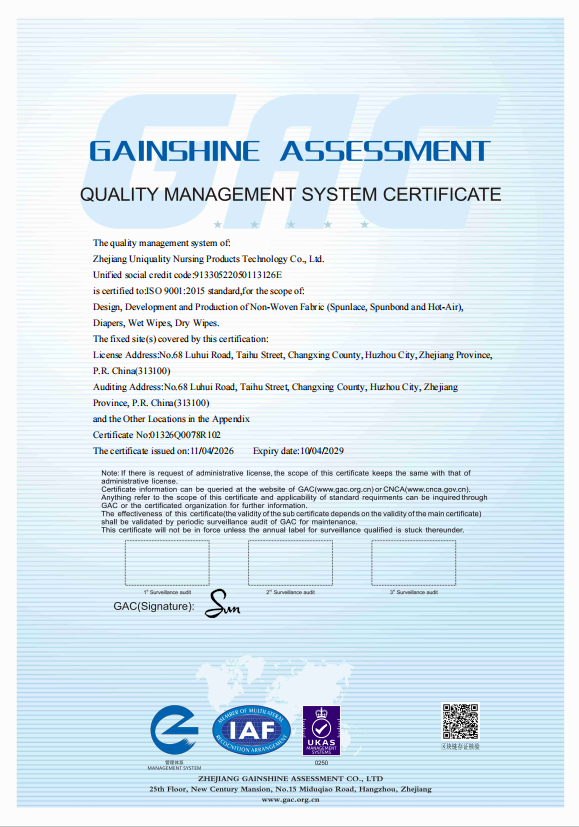
ISO 9001:2015 certificate No. 01326Q0078R102, issued by GAC, with a scope that explicitly includes dry wipes (valid 2026-04-11 to 2029-04-10).
Certification scope is the detail buyers most often skim past. The table below records the certificates relevant to dry wipes and the exact scope lines attached to them.
| Certificate | Number | Issuing authority | Scope and validity |
|---|---|---|---|
| ISO 9001:2015 | 01326Q0078R102 | GAC | wet wipes; dry wipes; baby diaper; training pants — valid 2026-04-11 to 2029-04-10 |
| ISO 14001:2015 | 01326E0075R101 | GAC | wet wipes; dry wipes; baby diaper; training pants — valid 2026-04-11 to 2029-04-10 |
| ISO 45001:2018 | 01326S0066R101 | GAC | wet wipes; dry wipes; baby diaper; training pants — valid 2026-04-11 to 2029-04-10 |
| ISO 50001:2018 (GB/T 23331-2020) | 01326En0008R201 | GAC | wet wipes; dry wipes; baby diapers; training pants — global market — valid 2026-03-09 to 2029-03-08 |
| CE | 6C240227.ZUNU051 | ENTE CERTIFICAZIONE MACCHINE | baby diaper; training pants — dry wipes are not in scope |
The ISO 50001:2018 (GB/T 23331-2020) certificate, number 01326En0008R201, was issued by GAC and applies globally, covering wet wipes, dry wipes, baby diapers, and training pants. Energy management certification has become a procurement filter in markets where buyers must document supplier energy performance alongside product compliance. It is worth being precise about what it does and does not do: it addresses facility-level energy management systems, not product safety, and it should not be presented to retail buyers as a substitute for product-level compliance.
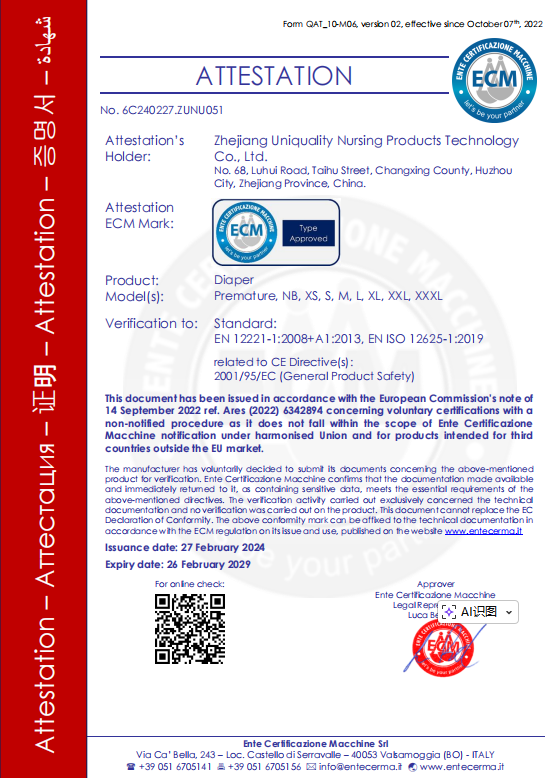
CE certificate No. 6C240227.ZUNU051 covers baby diapers and training pants — a scope boundary that dry wipe buyers should note rather than assume away.
Market Trends Reshaping Scenario Selection
Scenario mix is shifting faster than the overall category. Three published data points frame the planning picture.
The broad dry wipes segment reached USD 13.6 billion in revenue in 2024, driven by versatility across medical and household applications. Within that total, the disposable facial towel segment is projected to grow from USD 0.45 billion in 2025 to USD 1.18 billion by 2034, an 11.2% CAGR according to Cognitive Market Research. The compressed towel market was valued at USD 1.82 billion in 2025, with cotton-based products holding a 41.3% share according to Dataintelo.
Geographic demand is uneven. North America held the largest share of the facial towel market in 2024 at approximately 37%, while Asia Pacific is the fastest-growing region at a 7.7% CAGR, based on Fortune Business Insights data.
Growth-rate estimates diverge by sub-segment, and buyers should not average them. Published figures range from roughly 6.69% for the general wipes category to 11.2% for disposable facial towels. The planning implication is straightforward: a five-channel dry wipe program cannot assume one demand curve. Beauty and travel formats are expanding faster than the category mean, which favors suppliers who can run multiple pack formats from the same substrate platform.
At brand level, the competitive set named by Nonwovens Industry includes Kimberly-Clark, Procter & Gamble, Nice-Pak, and Winner Medical (PurCotton). For OEM buyers, the practical comparison with those brands is rarely a brand-versus-brand question; it is a comparison of configuration flexibility, format range, and documentation depth at the supplier level.
Dry Wipes Compared with Traditional Alternatives
Displacement claims deserve caution, because reusable and paper alternatives still win in specific situations. The table below states where each alternative retains an advantage.
| Alternative | Where it still wins | Where a dry wipe changes the trade-off |
|---|---|---|
| Reusable cotton towels (beauty, personal care) | Low ongoing cost per use once amortized; familiar feel in daily facial routines | Eliminates reuse of a damp textile, addressing the bacterial-breeding concern associated with reused towels; supports travel and away-from-home use |
| Paper towels and tissue (household) | Low unit cost at bulk volumes; widely available | Nonwoven construction resists tearing when wetted and does not shed lint the way paper does on glass and countertops |
| Wet wipes | Immediate convenience; the liquid medium can carry fragrance and formulated ingredients | A dry wipe is supplied with zero added liquid, so it can be used dry or soaked at the point of use, and it does not depend on a liquid medium to function |
| Compressed towel formats | Very small logistics cube; strong fit for travel retail | Standard 15 × 20 cm and larger formats serve household and beauty volumes, while compressed formats remain a separate SKU line |
Boundaries buyers should not skip.
- Minimum order quantity for dry wipes is 1 × 40HQ container, so very small pilot runs are not a practical entry point for this format.
- Lead time is stated as 35–45 days after artwork and deposit confirmation; sampling takes 3–5 days, which means sample approval and production are separate clocks.
- The CE certificate held by the manufacturer covers baby diapers and training pants, not dry wipes. Market access for skin-cleansing dry wipes in the EU follows cosmetic regulation instead.
- The stated monthly capacity of 7 billion units refers to wet wipes; capacity differs according to product, so dry wipe line availability must be confirmed separately.
- Customization options include fragrance and formula, but a dry wipe carries zero added liquid; any fragrance or active ingredient requires an impregnation step or a wet format rather than a dry one.
- No therapeutic claim can be printed on a cosmetic-classified dry wipe without drug approval in the United States.
From Fit to First Order: An Execution Checklist
Once a scenario is selected, execution depends on documented order terms rather than product claims. Manufacturing is offered under OEM and ODM models, with customization covering material, size, logo, packaging, fragrance, and formula, and with one-stop private label service supported by 3–5 day sampling.
Recorded order-quantity thresholds by pack configuration are shown below; they apply alongside the container-level minimum order for dry wipes.
| Pack count per bag | Recorded minimum quantity |
|---|---|
| 10–30 pcs | 60,000 bags |
| 40–70 pcs | 50,000 bags |
| 80–120 pcs | 36,000 bags |
Commercial and quality terms are documented as follows: delivery terms of FOB or CIF; acceptance criteria based on factory pre-shipment testing or per customer specification; payment terms of 30% deposit with balance against bill of lading copy; quality control through COA and AQL sampling inspection; and after-sales support covering remote support, order follow-up, product usage consultation, quality feedback handling, and after-sales service coordination. For baby diapers and pull-ups, the minimum order quantity is 150,000 pieces, which matters for buyers building a combined baby care program.
Evidence from a Running OEM Program
One live program illustrates how a single supplier relationship spans several of the five scenarios. The case documents a three-year cooperation with an OEM client in the United Kingdom, with a monthly shipment volume of 20 forty-foot containers. The product is used across household cleaning, baby care, personal hygiene, and beauty care — four of the five application areas mapped in this article. Documented highlights include a GMP workshop, ISO certifications, eco-friendly materials, strict quality control, competitive pricing, and reliable lead time. The program achieved a 99.5% on-time delivery rate with zero major quality complaints.
The relevant lesson is not the volume figure but the application spread: multi-channel dry wipe sourcing works when the supplier can hold configuration discipline across several pack formats and claim sets within one production and quality system.
Future Outlook
Two forces will shape dry wipe scenario selection over the next several years. The first is sub-segment growth. With disposable facial towels projected to grow at an 11.2% CAGR and Asia Pacific expanding at 7.7%, the fastest-moving demand sits in formats that were once marginal — compressed towels, boxed pop-up packs, and travel-sized personal care items — rather than in undifferentiated bulk wipes.
The second is documentation pressure. Energy management certification such as ISO 50001:2018 (GB/T 23331-2020) is increasingly requested in export procurement, and cosmetic classification rules in the United States and the European Union continue to constrain claim language. Suppliers who can produce certificate scope lines, COA records, and market-specific claim files on request will be easier to approve than suppliers who can only describe their capability.
For buyers, the practical conclusion is to treat scenario fit as a live configuration exercise. Re-verify certificate scopes and validity windows at each annual review, confirm gsm and sheet geometry against the actual SKU rather than the specification range, and keep pack-format decisions aligned with the channel that will carry the product.
Reference
The Uniquality product brochure is available for download: Uniquality product brochure (PDF).
FAQ
What are the specifications of the YQ002 disposable dry wipe?
YQ002 is documented as a disposable dry wipe measuring 15 × 20 cm and made from nonwoven fabric in the 35–70 gsm range. It is packed at 10 pcs per bag or 80 pcs per bag and supplied in a soft pack or a disposable boxed format. Size, material, piece count, and packaging are all listed as customizable, so the specification a buyer receives depends on the configuration ordered rather than on the base sheet.
Can one dry wipe SKU serve household, pet, baby, beauty, and personal care channels?
The base specification is declared applicable to all five industries, but fit is configuration-dependent. Household cleaning depends on substrate weight for tear resistance; pet wiping depends on lint-free behaviour and damp strength; baby and sensitive-skin use depends on cleanroom manufacturing, material documentation, and claims discipline; facial beauty use depends on sheet coverage and softness; and personal care depends on portable formats such as compressed towels. The nonwoven platform can be routed to each channel, but the pack format and evidence file typically differ.
Which certifications cover dry wipes, and which do not?
ISO 9001:2015 (01326Q0078R102), ISO 14001:2015 (01326E0075R101), ISO 45001:2018 (01326S0066R101), and ISO 50001:2018 / GB/T 23331-2020 (01326En0008R201) are issued by GAC with scope lines that include dry wipes. The ISO 50001 certificate applies globally and covers wet wipes, dry wipes, baby diapers, and training pants. The CE certificate held (6C240227.ZUNU051, issued by ENTE CERTIFICAZIONE MACCHINE) covers baby diaper and training pants, not dry wipes. Buyers should read the scope line on each certificate rather than assuming a company-level certificate extends to every product.
What regulatory route applies to skin-cleansing dry wipes in the United States and the European Union?
In the United States, dry wipes intended for skin cleansing are regulated as cosmetics by the U.S. Food and Drug Administration, and therapeutic claims such as treating acne require drug approval. In the European Union, Cosmetic Regulation (EC) No 1223/2009 requires a Product Information File and CPNP notification for market access. Both routes govern claim language as much as product composition.
What are the minimum order quantity, lead time, and payment terms for dry wipes?
The documented minimum order quantity is 1 × 40HQ container for wet wipes and dry wipes, and 150,000 pieces for baby diapers and pull-ups. Lead time is 35–45 days after artwork and deposit confirmation, with sampling available in 3–5 days. Recorded order terms include FOB or CIF delivery, pre-shipment acceptance testing at the factory or per customer specification, and payment of 30% deposit with balance against bill of lading copy. Recorded quantity thresholds by pack count are 60,000 bags for 10–30 pcs packs, 50,000 bags for 40–70 pcs packs, and 36,000 bags for 80–120 pcs packs.
How is quality verified before shipment?
Quality control combines certificate of analysis (COA) documentation with AQL sampling inspection, and acceptance criteria can be met through factory pre-shipment testing or testing per customer specification. Production takes place in a 100,000-class clean room and a GMP workshop environment, with manufacturing running in-house from raw material processing through to finished-product packaging.