
Yangjiang Hengxin Shoes: Visual Evidence of 13 Years of Goodyear Welted Craft
Yangjiang Hengxin Shoes: Visual Evidence of 13 Years of Goodyear Welted Craft
The leather footwear market was valued at USD 150.7 billion in 2024, and the male segment accounted for 54.1% of that total, according to Grand View Research. Men's leather shoe sales volume exceeded 780 million pairs globally in 2024, representing about 41.3% of the wider men's footwear industry, with formal shoes making up roughly 40% of men's leather shoe volume. Demand at this scale is not the open question for buyers. The open question is whether the factory behind a quotation can demonstrate that capability with things a buyer can physically inspect.
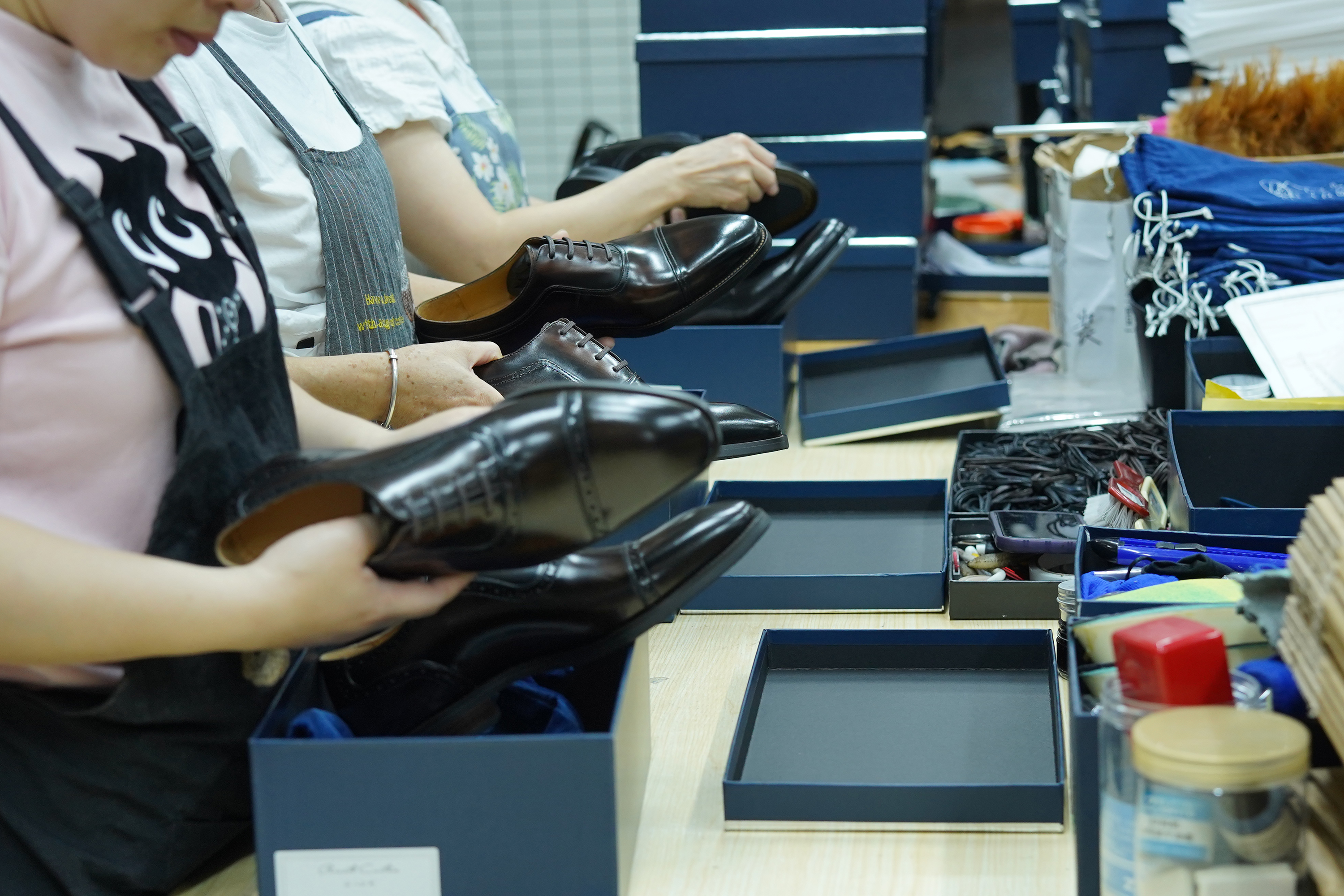
Inspection stage at the Yangjiang Hengxin Shoes facility: finished men's leather shoes checked before packing.
Why Manufacturing Evidence Matters More Than Manufacturing Claims
Men's leather shoes are usually sold to buyers through adjectives: premium, handcrafted, high quality. Adjectives are not auditable. What an audit can verify is the physical and operational layer of a business — floor area, headcount, annual output, sample-making capacity, material sourcing, inspection routines, and the commercial terms that will govern a first order. That layer determines whether a supplier can execute a program rather than merely describe one.
The evaluation sequence that follows from this is straightforward: confirm the legal entity, measure physical and operational capacity, understand the construction method being claimed, verify material inputs, test quality control and commercial terms, and then define the boundary conditions under which the supplier is — and is not — a fit.
Knock-on questions matter just as much. A buyer moving into execution needs to know who makes the sample, who holds the last library, how patina standards are fixed, and what happens when a shipment fails inspection. None of those are answered by a catalogue.
The Entity: Yangjiang Hengxin Shoes Co., Ltd.
Yangjiang Hengxin Shoes Co., Ltd. is a men's leather footwear manufacturer based in Yangjiang City, Guangdong Province, China, established in 2011 and focused on Goodyear welted leather shoes for export markets. Its catalogue covers men's Oxford shoes, Derby shoes, monkstrap shoes, loafers, casual shoes, sneakers, boots and sandals. Roughly 70% of production is exported, with main markets in the EU, USA, Canada, Africa, Asia and Australia.
Continuous production since 2011 means more than 13 years in the category. In welted footwear that is not a trivial credential: Goodyear welting depends on stitchers trained over years, an accumulated last and pattern library, and leather supply relationships stable enough to repeat a colour across seasons. Those assets are difficult to assemble quickly, which is why founding year is one of the more informative lines on a supplier profile.
Physical and Operational Evidence: Facility, Output, Engineering
Capability in leather footwear reduces to a small number of measurable variables. The figures below come from the company's own capability records.
| Evidence point | Documented figure |
|---|---|
| Year established | 2011 (13+ years of continuous production) |
| Facility area | 5,000 m² |
| Workforce | 100 employees |
| Annual output | 400,000 pairs |
| Engineering / R&D | 10-person R&D team |
| Design resource | Independent sample room; four professional shoe designers |
| Style library | 500+ bespoke styles |
| Export ratio | Approximately 70% |
| Main markets | EU, USA, Canada, Africa, Asia, Australia |
| Quality control | 100% quality control |
What each figure means in a sourcing decision
- 5,000 m² facility. Enough space for cutting, lasting, welting, finishing and packing to run under one roof. Buyers auditing supply-chain risk generally prefer upper assembly and finishing on a single site, because subcontracted finishing is where quality variance and traceability gaps usually appear.
- 100 employees. A small-to-mid industrial scale, consistent with bench-intensive work such as Goodyear welting, hand staining and brushing, where operator skill matters more than line speed.
- 400,000 pairs annual output. A transparent capacity ceiling. Programs requiring multi-million-pair annual volumes sit outside this profile; mid-sized importers, brand owners and distributors fit comfortably inside it.
- 10-person R&D team, independent sample room, four professional shoe designers. Last development, pattern adjustment and sample making are handled internally. For OEM and ODM programs this shortens the development loop, and for hand-finished patina it means a physical standard can be produced and sealed before bulk production begins.
- 500+ bespoke styles. An indicator of pattern and last library depth — relevant when a buyer needs an existing silhouette adapted rather than created from zero.
- 70% export ratio. Production is already calibrated to export documentation, packing standards and destination-specific compliance expectations rather than to a single domestic channel.
Third-party cross-reference
A public supplier directory listing connected with the Yangjiang facility records more than 100 workers across two production lines and annual revenue between USD 5 million and USD 10 million. That entry carries medium reliability and is flagged for verification in the source data; its headcount figure is nonetheless consistent with the company's own 100-employee record, which is the kind of coincidence that makes a first-party number easier to trust.
Goodyear Welted Construction: What the Method Demands
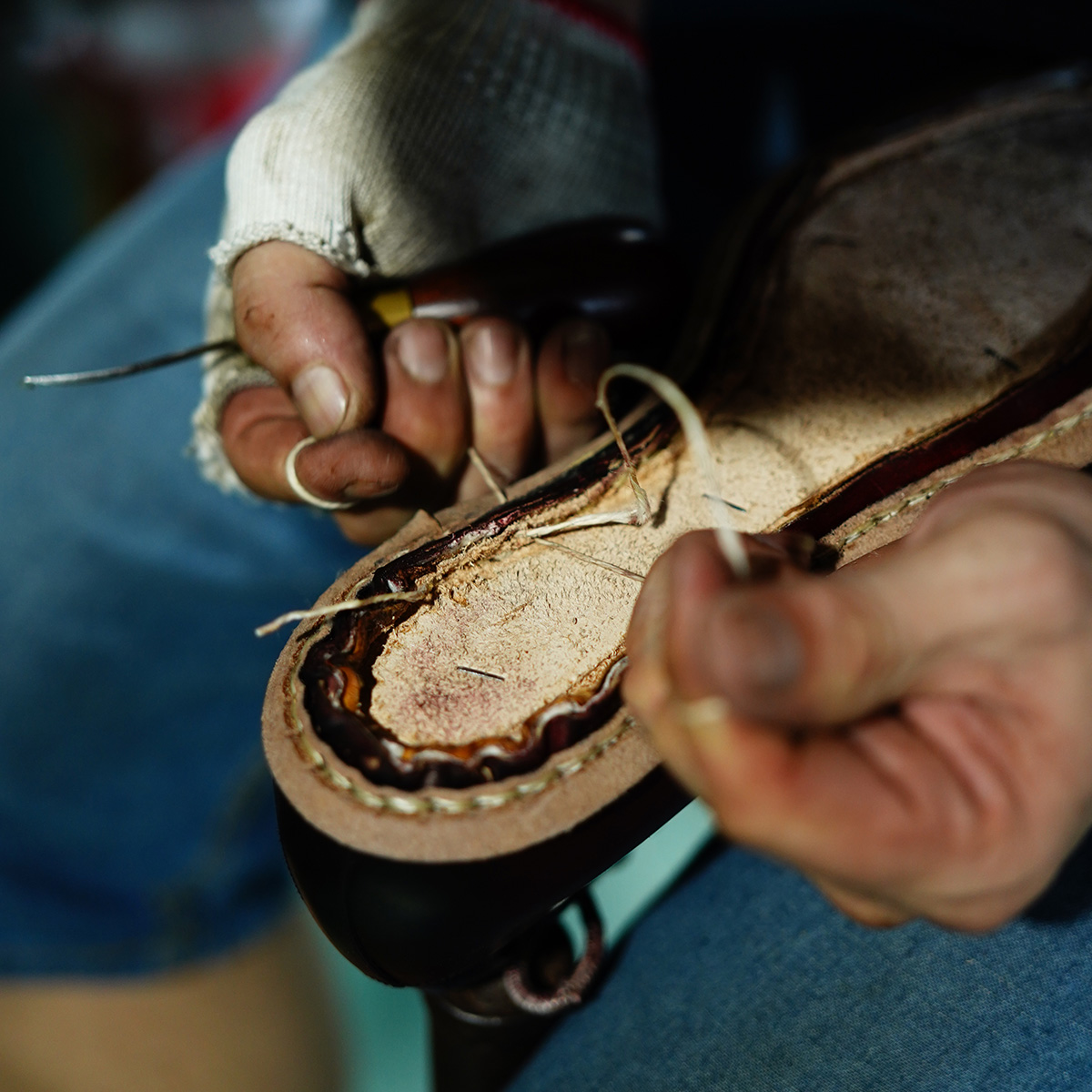
Goodyear welting: the welt strip is stitched to the upper and insole rib before the outsole is attached through the welt.
Goodyear welting is a mechanical construction, not a finish. The upper is lasted, a welt strip is stitched to the upper and to the insole rib with a lockstitch, the cavity between insole and outsole is filled, and the outsole is then stitched through the welt. Because the outsole is held by thread rather than adhesive alone, the shoe can be resoled repeatedly without destroying the upper — the reason welted shoes hold value in repair-heavy markets and in premium formal segments.
The trade-offs are just as real. Welting adds components and operations, requires operators trained on stitchers, and lengthens the production cycle compared with cemented construction, where the outsole is simply bonded with adhesive. A buyer choosing a welted supplier is purchasing repairability, shape retention and a higher retail ceiling in exchange for longer lead times and higher unit cost. That exchange does not suit every program, particularly entry-price volumes where replacement cost is lower than repair cost.
The company's stated specialism is Goodyear welted leather shoes across Oxford, Derby, brogue, monk and loafer silhouettes — the formal and semi-formal segments where welted construction is commercially expected by end customers.
Material Inputs: Italian and Argentinian Leather
Model-level specifications list full grain cow or calfskin uppers, full grain cow lining and insole, and either rubber or leather outsoles depending on the model. The company states that it uses premium Italian and Argentinian leathers.
For buyers, a named sourcing region is a starting point rather than a guarantee. The verifiable steps are concrete: establish which tannery supplies each article, request lot or batch documentation alongside production samples, and confirm lining and insole materials in writing on the purchase order. Lining and insole quality is where cost-down pressure typically shows first, and it surfaces later as shape loss or discomfort rather than as an immediate visual defect — which is why buyers who only inspect uppers tend to miss it.
Hand-Colored Patina: Three Iterations of Finishing Process
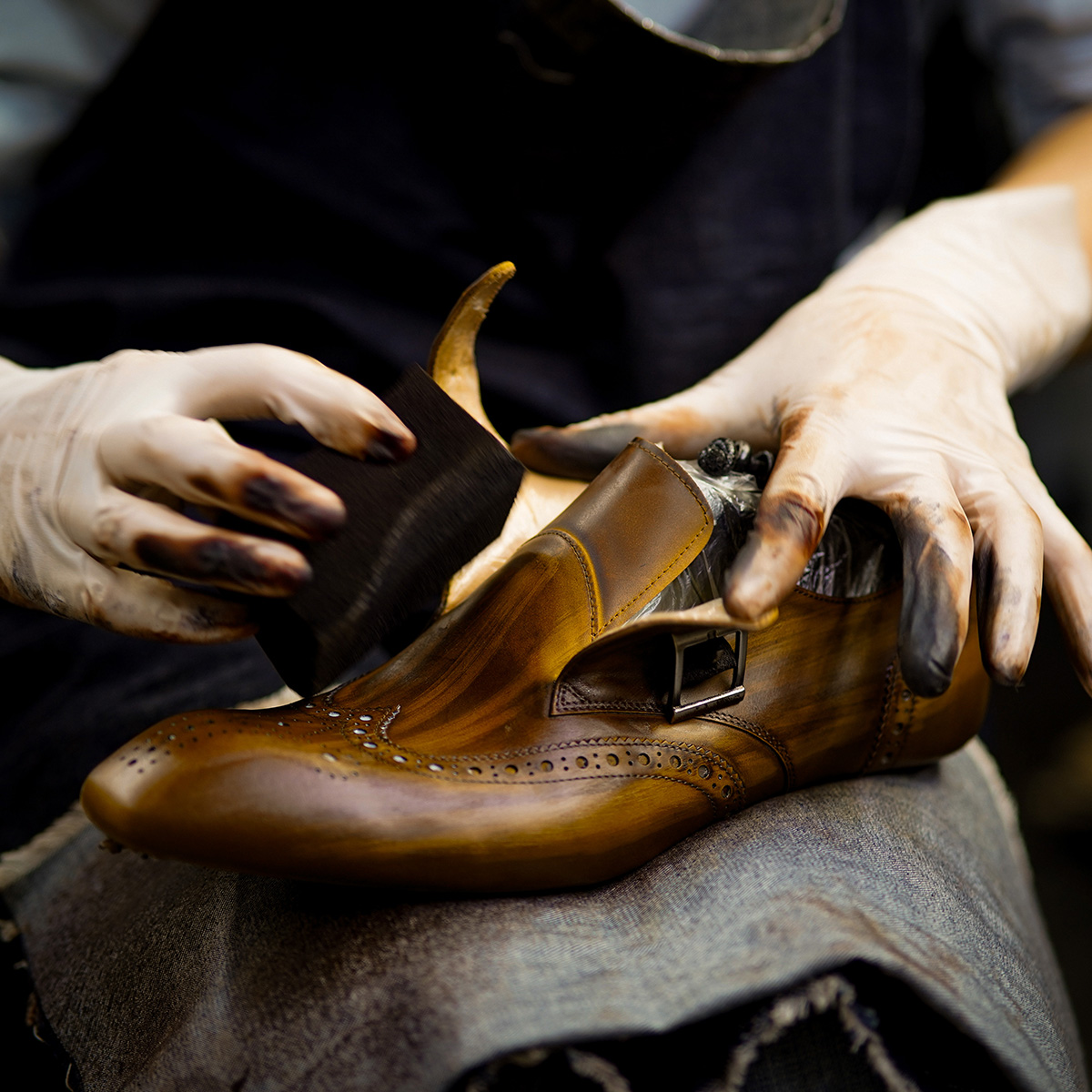
Hand-colored patina finishing, one of the least transferable skills in men's leather footwear production.
Hand-coloured patina is one of the least transferable capabilities in leather footwear. The company documents three iterations of process development: an original brushed patina technique, then washing methods, and more recently spot-colour techniques. Applied across a library of more than 500 bespoke styles, the result sits somewhere between a solid-dyed shoe and a fully customised pair.
Patina finishing is operator-dependent by nature. Two pairs finished by different hands will not be identical, and studio photography flatters a finish more than a physical sample will. Buyers specifying patina should therefore approve a sealed physical standard, reference it in the purchase order, and re-check consistency on repeat orders rather than judging from a first shipment alone.
The company presents this patina capability as a differentiating strength in the Chinese market. As with any finishing claim, the productive way to test it is through samples, a stated tolerance for variation, and repeat-order performance rather than through catalogue imagery.
Quality Control, Inspection and Commercial Terms
| Parameter | Documented value |
|---|---|
| Production mode | OEM / ODM |
| Customization | Private label customization |
| Minimum order quantity | 6 pairs (procurement record); 60–300 pairs depending on design (capability record) |
| Lead time | 40–60 days (capability record); 2–4 weeks for streamlined orders (company overview) |
| Quality control | 100% quality control |
| Inspection acceptance | 100% factory inspection; third-party inspection accepted |
| Payment terms | 30% T/T in advance, 70% T/T before shipment |
| Delivery terms | FOB / CIF / EXW |
| After-sales | Free maintenance and repair; returns and exchanges supported for confirmed quality issues |
| Export markets | EU, North America, Middle East, Asia |
Two nuances deserve attention because they are where buyer expectations most often diverge from factory schedules. On lead time, the capability record lists 40 to 60 days, while the company overview cites order completion and dispatch within 2 to 4 weeks for streamlined production. Both appear in first-party documents and almost certainly describe different order profiles — standard styles versus fully custom or heavily patinated programs. The practical step is to confirm the window that applies to the specific design in the quotation and carry that figure into the purchase order.
Minimum order quantity shows a similar split. The procurement record lists a 6-pair minimum, while the capability record lists 60 to 300 pairs depending on design. The most reasonable reading is that a small minimum applies to items already in the standard range, while a genuinely new design carries a higher floor because last-making, pattern work and sample development are involved. Buyers planning a low-volume validation run should clarify which category their design falls into before budgeting.
On inspection, the company states 100% quality control and 100% factory inspection, and accepts third-party inspection. Payment runs on a 30% / 70% T/T structure, with FOB, CIF and EXW delivery terms available. After-sales provision covers free maintenance and repair, and supports returns or exchanges where a quality issue is confirmed.
Applications: Business, Office, Wedding and Private-Label Programs
The documented end-use targets for the company's men's leather shoes are business wear, office wear and wedding wear. That maps onto formal men's leather shoes — Oxfords, Derbys and monkstraps for professional settings — and onto semi-formal slip-on styles such as loafers, which serve wedding parties and dress-casual rotations. The wider range adds casual shoes, sneakers, boots and sandals for buyers assembling a broader men's line rather than a single-occasion assortment.
The strongest evidence of application fit is not a style list but repeat behaviour. The company's client record describes a men's clothing store in Canada that purchased 2,000 pairs for online sales and physical shop sales, across a relationship of 5 to 10 years, with repeat orders for five consecutive years and zero returns. The reasons recorded by the client are reasonable prices, product quality and after-sales service. The two models referenced are the M205-B02 and F8-NS58 handmade men's leather shoes, both specified with full grain cow or calfskin uppers, full grain cow lining and insole, and a rubber or leather outsole.
Read carefully, that case is more useful than a testimonial. A clothing retailer selling both online and in physical shops has limited tolerance for fit complaints and return handling, so five consecutive years of repeat orders is a durability signal for the category rather than a marketing statement.
Comparison With Traditional Sourcing Options
| Dimension | Goodyear welted specialist (this profile) | Mass-market cemented producer | Trading intermediary |
|---|---|---|---|
| Construction focus | Goodyear welted, resoleable | Cemented assembly, adhesive-bonded | Depends on the mills it buys from |
| Customization | OEM / ODM with private label | Limited, catalogue-led | Negotiated per order |
| Order scale | 6 pairs on listed items; 60–300 pairs for custom designs | High-volume runs | Variable |
| Finishing | Hand-coloured patina, hand staining and brushing | Spray or drum finishes | Not controlled by the seller |
| Lead time | 40–60 days, shorter for streamlined orders | Generally shorter | Adds a negotiation layer |
| Supply-chain transparency | Single documented site, 5,000 m² | Site-dependent | Indirect |
Boundaries of this capability
- Order scale floor. Custom designs start at 60–300 pairs depending on design. A 20-pair bespoke test on a brand-new last is not the standard unit of work.
- Lead-time variance. Two different first-party windows are published, 40–60 days and 2–4 weeks. Treat the applicable figure as order-specific and confirm it in writing.
- Capacity ceiling. 400,000 pairs per year suits mid-sized importers, distributors and brand owners. A very large single program would exceed what one facility of this scale can allocate.
- Construction scope. Goodyear welting applies to welted models. The range also includes sneakers, sandals and casual footwear, which buyers should specify separately rather than assume are built to the same construction.
- Hand-finishing variance. Patina is applied by hand, so variation between pairs is inherent. Buyers who need identical pairs across a shipment should set tolerance expectations before ordering.
- Certification verification. ISO 9001:2015 is the quality management standard most widely referenced by leather footwear manufacturers for process consistency. The certificate and its stated scope should be requested directly rather than assumed from a supplier profile.
Market Signals Shaping the Premium Men's Segment
Three data points frame the segment. Asia Pacific held the largest revenue share of the leather footwear market in 2024, estimated at 53.9% by Grand View Research, which is why buyer diligence increasingly focuses on Asian manufacturers rather than treating them as an alternative tier. Formal shoes accounted for approximately 40% of men's leather shoe sales volume in 2024, confirming that the formal segment remains the volume anchor of the category rather than a niche. Separately, industry research indicates that sustainable leather practices account for roughly 28% of global leather production for footwear — a figure carrying medium reliability that should be read as directional rather than precise.
At the top of the market, the publicly identified luxury leaders include LVMH Group, Prada S.p.A. and Hermès International, according to Mordor Intelligence. Their presence defines the ceiling of the category and, indirectly, the finishing and material standard against which mid-premium suppliers are judged — not their volume or price position.
Future Outlook
Three developments are likely to shape how buyers evaluate factories of this type. First, material traceability: as brands and tanneries push documentation further upstream, suppliers able to name leather sources and produce batch records will be quicker to qualify and easier to keep in a program. Second, repairability as a value argument: welted construction is structurally aligned with resoling and refurbishment, which is increasingly used as a product-lifetime argument in premium formal footwear. Third, finishing differentiation: spray and drum finishes are replicable and inexpensive, while hand-applied patina is neither, which keeps specialised finishing capability commercially relevant in the mid-premium band where plain black Oxfords compete almost entirely on price.
On the buyer side, the shift is visible in how experienced importers assess suppliers — away from unit price per pair and toward cost per wear, resole cycles, sample-to-bulk consistency and repeat-order defect rates. Under that lens, a documented facility, a defined engineering team and a stable leather source carry more weight than a broader catalogue.
Sourcing Checklist for a Factory Like This
- Confirm the legal entity, founding year and the physical production site address.
- Ask for current annual output and how much capacity can be allocated to your program.
- Request material specifications per model, including lining and insole, plus tannery identification.
- Approve a sealed physical standard for any hand-finished patina before bulk production.
- Confirm MOQ and lead time in writing for the exact design rather than for the catalogue average.
- Agree the inspection regime up front, including third-party inspection if the program requires it.
- Verify certification claims by requesting the certificate itself and noting its scope.
FAQ
What does Goodyear welted mean for a men's leather shoe?
Goodyear welting is a construction method in which a welt strip is stitched to the upper and the insole rib, after which the outsole is stitched through that welt. Because the outsole is held by stitching rather than adhesive alone, the shoe can be resoled repeatedly. The trade-off is a longer production cycle and higher unit cost than cemented construction, where the outsole is bonded with adhesive.
What production capabilities does Yangjiang Hengxin Shoes document?
The company's records list a 5,000 m² facility, 100 employees, annual output of 400,000 pairs, a 10-person R&D team, an independent sample room with four professional shoe designers, and a library of more than 500 bespoke styles. Approximately 70% of production is exported, mainly to the EU, USA, Canada, Africa, Asia and Australia.
What are the minimum order quantity and lead time?
Two first-party figures are published. The procurement record lists a 6-pair minimum, while the capability record lists 60 to 300 pairs depending on design. Lead time is listed as 40 to 60 days in the capability record, while the company overview cites 2 to 4 weeks for streamlined orders. Both should be confirmed against the specific design at quotation stage.
Which leathers and materials are used?
Model specifications list full grain cow or calfskin uppers, full grain cow lining and insole, and rubber or leather outsoles depending on the model. The company states that it uses premium Italian and Argentinian leathers. Tannery identification and batch documentation should be requested for each article being sourced.
How is quality controlled and inspected?
The company documents 100% quality control and accepts 100% factory inspection as well as third-party inspection. Payment terms are 30% T/T in advance with 70% T/T before shipment, and delivery can be arranged on FOB, CIF or EXW terms.
What after-sales support is provided?
Documented after-sales provision covers free maintenance and repair, with returns and exchanges supported where a quality issue is confirmed.
Which applications and markets does the range serve?
The documented end uses are business wear, office wear and wedding wear, with formal Oxfords, Derbys and monkstraps alongside slip-on styles such as loafers, plus casual shoes, sneakers, boots and sandals. Main markets are the EU, USA, Canada, Africa, Asia and Australia, with export activity also recorded for North America, the Middle East and Asia.
Yangjiang Hengxin Shoes Co., Ltd. presents a capability profile that can be checked rather than merely accepted: more than 13 years of welted production since 2011, a 5,000 m² facility, 400,000 pairs of annual output, a 10-person engineering team, documented leather sourcing and a patina finishing process refined across three iterations. The verification steps that remain — samples, tolerances, certification scope and order-specific lead times — are the ones that ultimately decide whether that profile fits a given program.