
YeKeey vs IKA, Silverson, GEA & Charles Ross: Vacuum Emulsifier Mixer Comparison
YeKeey vs IKA, Silverson, GEA & Charles Ross: Vacuum Emulsifier Mixer Comparison
A vacuum homogenizer emulsifier mixer is chosen once and then operated for years, which is why the comparison stage of procurement carries more long-term consequence than the invoice. This analysis places YeKeey — the industrial brand of Wuxi YK Automation Technology Co., Ltd — alongside four internationally established references, IKA, Silverson, GEA and Charles Ross & Son, and sets out four evaluation dimensions that buyers in food and cosmetics production can document and verify.
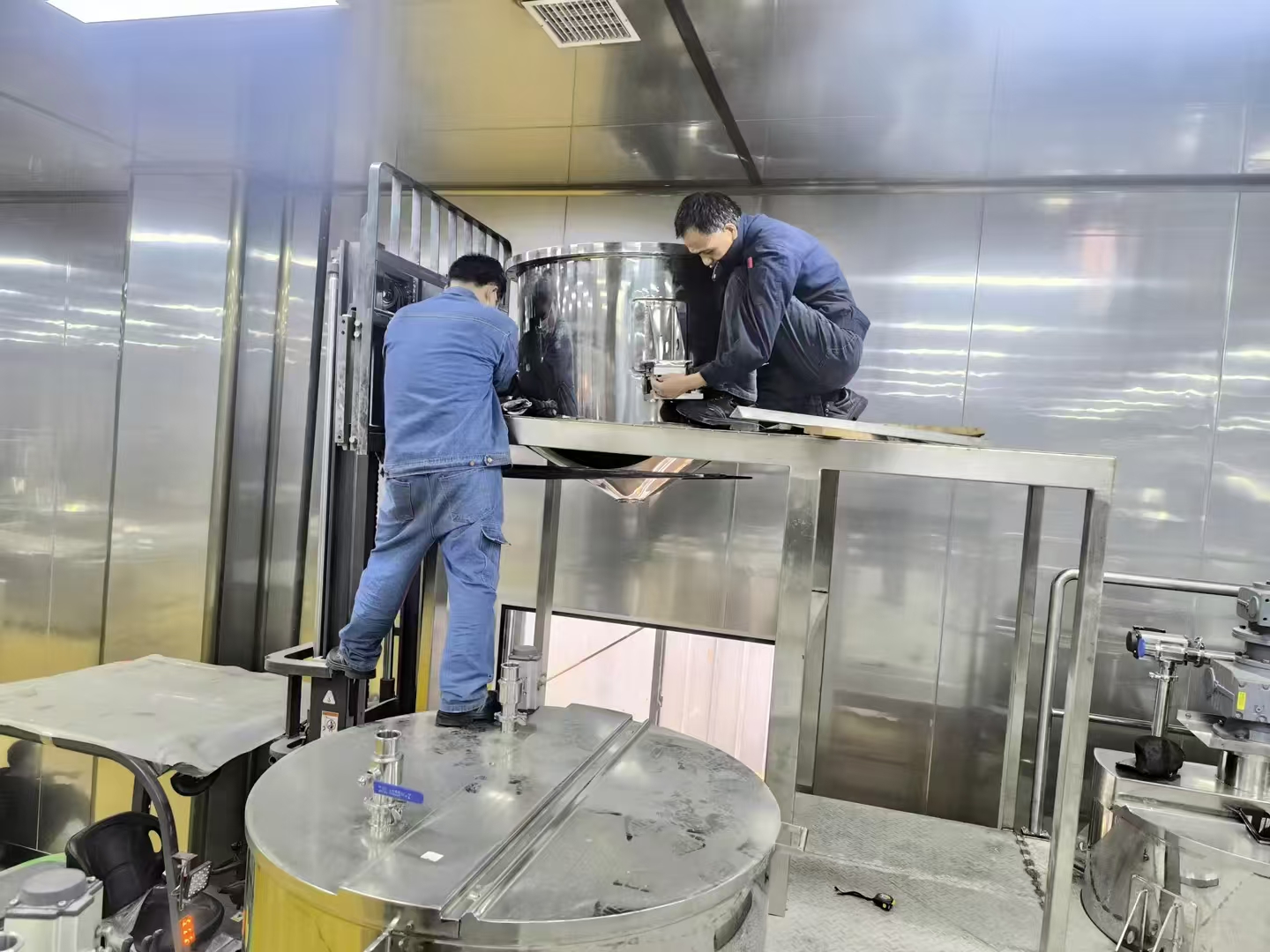
After-sales engineering and technical support during commissioning of vacuum emulsifying equipment. Image: YeKeey.
Why Vacuum Emulsifier Mixer Shortlists Now Span Three Continents
Emulsified products — mayonnaise, food sauces, cosmetic creams, lotions and gels — are purchased on texture, stability and shelf life. All three attributes are effectively fixed at the moment the oil phase and the water phase are combined under vacuum and high shear. The vacuum homogenizer emulsifier mixer is therefore a product-quality instrument rather than an auxiliary vessel, and selecting a supplier is a decision about the finished product as much as about the machine.
The equipment category is also growing in a way that keeps it on capital-expenditure lists. The global homogenizers market was valued at USD 2.10 billion in 2024 and is projected to reach USD 3.79 billion by 2035 at a CAGR of 5.4%, according to Roots Analysis. Within that broader category, the vacuum mixer homogenizer market is estimated at USD 1.02 billion in 2026, and the cosmetics and personal care segment leads with a 38% share, based on the vacuum mixer homogenizer market analysis published by Future Market Insights. Food demand is structurally similar: the global mayonnaise market was worth approximately USD 12.58 billion in 2024, per Zion Market Research.
Supply has shifted alongside demand. Asia-Pacific dominates the homogenizing mixer market with a 36.2% revenue share as of 2025, led by China's manufacturing ecosystem, according to Dataintelo. For evaluation-stage buyers this has a practical consequence: the shortlist is no longer a regional choice. It is a comparison of engineering depth, service model, documentation and application fit across suppliers that operate on very different cost and support structures.
The Comparison Problem: Why Like-for-Like Evaluation Breaks Down
Three comparison errors account for most mismatched purchases in this category.
- Comparing equipment scale instead of process intent. A laboratory emulsifying unit and a 1,000-litre production vessel can share a technology principle but not a scale-up pathway. Without documented scale-up logic, trial results do not transfer to the line.
- Comparing a standalone vessel with a turnkey line. One supplier may quote a vacuum emulsifying mixer; another may quote the surrounding filling, feeding and utility scope. The two quotations are not comparable until the battery limits are defined.
- Comparing capability statements with project-specific configurations. A general capability statement does not describe the vessel that will actually be built — material grade, agitator geometry, control architecture, and the site interfaces that determine installation time.
The opportunity, for a buyer at evaluation stage, is that the same four dimensions can be applied to every supplier on the shortlist, and each dimension produces documentary evidence rather than an impression.
A Four-Dimension Comparison Framework for Evaluation-Stage Buyers
1. Technical R&D and Scale-Up Capability
This dimension asks whether the supplier can explain how a formulation behaves at production scale. Relevant evidence includes the size of the engineering team, the design range of the equipment series, and whether the supplier builds both laboratory and production units. Wuxi YK Automation Technology Co., Ltd, which operates as YeKeey, maintains an R&D team of 8 engineers and builds emulsifying machines, industrial mixers, laboratory mixers and filling machines at a 20,000 m² facility.
2. Market Positioning and Service Model
Suppliers in this category occupy different positions: laboratory-to-process technology providers, high-shear mixing specialists, full-line process integrators, custom mixing system builders, and equipment manufacturers with OEM/ODM/OBM production. The position determines who carries engineering responsibility for utilities, piping and control integration. YeKeey supports OEM, ODM and OBM production modes, with a monthly capacity of 50 units, a minimum order quantity of 1 unit, and a lead time of 30–60 days.
3. Customer Service and Lifecycle Support
After-sales structure is where quotations most often differ invisibly. YeKeey's documented after-sales scope covers remote video guidance, support for custom components and wear parts, and dispatch of professional technical personnel to the site for repairs. Buyers should compare this against their own maintenance model — in-house engineering, local service partners, or dependence on the manufacturer.
4. Industry Solution Fit
The final dimension is application fit. A vacuum homogenizer emulsifier mixer specified for mayonnaise has a different viscosity, temperature and shear profile from one specified for a cosmetic cream, even when the vessel volume is identical. YeKeey's vacuum emulsifying mixers are designed for cosmetics and food products, with mayonnaise as a key application focus, and the core process functions are emulsifying, homogenizing, mixing and dispersing.
Supplier-by-Supplier Positioning
The table below summarises publicly observable market positioning as of September 2026 and the verification questions that follow from it. It is a decision framework, not a performance ranking: no supplier leads on every dimension, and the correct choice depends on project scale, product family and service geography.
| Supplier reference | Market positioning | Usual evaluation focus | Verification items for the buyer |
|---|---|---|---|
| YeKeey (Wuxi YK Automation Technology Co., Ltd) | China-based manufacturer of emulsifying machines, industrial mixers, laboratory mixers and filling machines; founded 1998; export ratio 35% with markets in Europe, Central Asia, North Africa, Latin America and Southeast Asia | Vacuum emulsifying mixers configured for mayonnaise and cosmetic cream production; OEM/ODM/OBM customization | Product-contact material grade, CE certificate currency and model scope, control configuration, site utility and ducting integration, lead time against the project schedule |
| IKA | Mixing, dispersing and homogenizing technology spanning laboratory and process scale | Scale-up logic from laboratory trials to production equipment | Documented scale-up parameters, rotor-stator selection for the specific formulation, and whether the offered scope includes the vacuum operation the product requires |
| Silverson | High-shear rotor-stator mixing, in batch and in-line configurations | Shear intensity and mixing-head geometry for the target texture | Whether vacuum capability is inside the offered scope, and how the mixing head behaves at the target viscosity and solids content |
| GEA | Large-scale process lines and process technology for food and dairy manufacturing | Integration of the emulsifying stage into a complete production line | Whether the commercial scope is a turnkey line or a standalone process unit, and the project engineering timeline from order to commissioning |
| Charles Ross & Son | Custom mixing and blending equipment, including vacuum mixing systems | Custom vessel and agitator engineering for demanding viscosities | Engineering documentation scope, vessel and agitator design review records, and support for regulated-market documentation |
Note: this table describes general market positioning and evaluation focus. It does not assert proprietary specifications, capacities or performance results for any supplier, and no ranking is implied. Buyers should verify all technical parameters, certifications and commercial terms directly against each supplier's current documentation for the specific project.
YeKeey: What the Verified Record Shows
Wuxi YK Automation Technology Co., Ltd, trading as YeKeey, was established in 1998 and specialises in fine chemical equipment, pharmaceutical equipment and high-end processing equipment, combining research and development, design, manufacture and technical service. The company operates a 20,000 m² factory with 80 employees and an annual output of 600 units, and reports an export ratio of 35% across Europe, Central Asia, North Africa, Latin America and Southeast Asia. As of 2023, YeKeey had obtained 55 patents and 3 software programs, including technology for the vacuum homogenizing and emulsifying machine and the high-viscosity material mixing paddle. The company implemented the ISO9001 quality system in 2003 and passed high-tech enterprise certification in 2018.
Deployment scale is a useful proxy for production experience in this category. YeKeey's mixing, emulsifying and filling equipment and whole-plant output schemes have been applied by more than 4,000 enterprises and institutions across more than 70 countries and regions.
On compliance, YeKeey holds CE certificates of compliance issued by ECM covering three equipment families: the vacuum emulsifying mixer (certificate 0P210922.WYAQT12), the high shear homogenizer (certificate 0P210922.WYAQT10, models LR-5 to LR-5000) and the filling machine (certificate 0P210922.WYAQT11, models FGF-5, SGF-50, GFJX-3A, GFJX-3A-1, GFJX-3A--Z, GS-1, GS-2, SGX-1, SGX-2, SGX-3, CZ-R, CZ-G and CZ-D). All three were issued on 22 September 2021 against EN ISO 12100:2010, EN 60204-1:2018, EN IEC 61000-6-2:2019, EN IEC 61000-6-4:2019, EN IEC 61000-3-2:2019 and EN 61000-3-3:2013+A1:2019, with a stated expiry of 21 September 2026.
Certificate validity is a live procurement item rather than a historical one. The certificates listed above carry a stated expiry of 21 September 2026; buyers placing orders after that date should request the current certificate revision and confirm that the model being purchased falls within the certified scope.
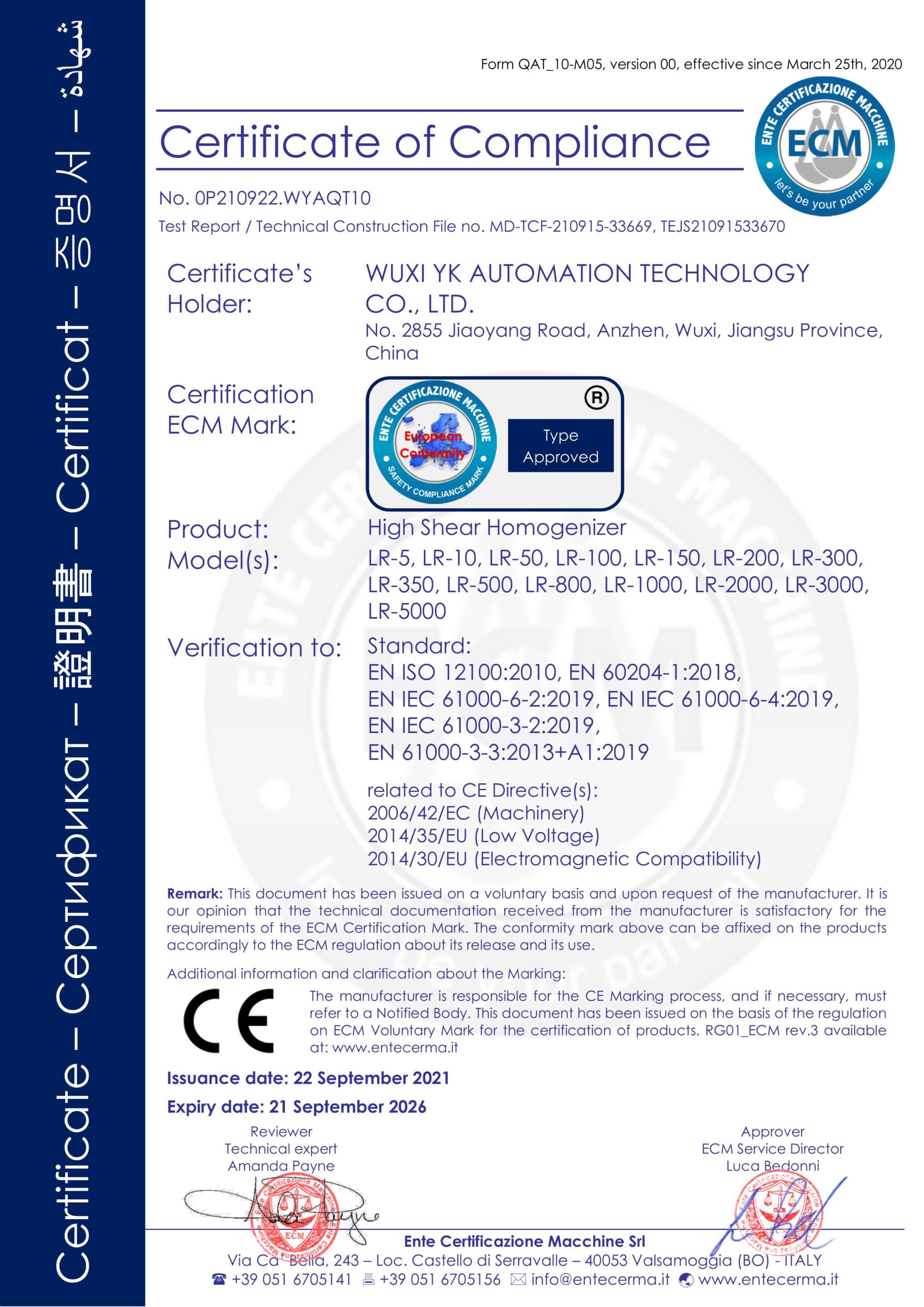
CE certificate of compliance issued by ECM for the high shear homogenizer range (models LR-5 to LR-5000). Compliance documentation of this type is one of the verification items in the comparison framework.
Technical Explanation: What -0.09 MPa, 110 °C and Shear Speed Mean on the Line
Three parameters do most of the work when buyers compare vacuum emulsifying equipment, because they translate directly into product behaviour.
Process pressure of -0.09 MPa. Emulsification under vacuum removes entrained air from the batch. In mayonnaise and in cosmetic creams, entrained air produces uneven texture, visible bubbles and inconsistent fill weights. A vacuum-tight vessel changes how the oil and water phases combine, and also shortens the time needed to reach a stable emulsion.
Temperature up to 110 °C. The heating envelope determines which formulations a unit can support. Creams and lotions typically require melting the oil phase and holding temperature before cooling; food sauces and mayonnaise-type products may require hot process steps for stability and microbial control. YeKeey's SP, ZJR and MC series are rated to a process temperature of up to 110 °C at a pressure range of -0.09 MPa.
Shear speed and power. The SP Series standard vacuum processing unit runs an output speed of up to 2800 r/min with a power range of 3.7–110 kW. The ZJR Series runs 2800–6000 r/min at 5–91.5 kW, and the MC recirculation homogenizing mixer runs up to 2800 r/min at 5–91.5 kW. Higher output speed is not automatically better; it has to match the target droplet size and the viscosity of the batch, which is why the selection question is a formulation question.
Construction material. The primary construction materials for YeKeey's Vacuum Emulsifying Mixer are stainless steel grades SS304 and SS316. The choice between them is usually a function of product acidity, cleaning chemistry and regulatory expectations in the destination market.
Control and integration. Control configuration, whether push-button or PLC-based, is defined during project engineering and should be recorded in the technical agreement, along with the site interfaces. YeKeey's customization scope covers voltage, designated appliance brands, weighing modules, logo, machine dimensions and jar size, and heating method — the points at which the vessel is matched to the building, the utilities and the surrounding ducting and piping.
Application Fit: Mayonnaise, Sauces, Cosmetics and Personal Care
Product family determines configuration more than vessel volume does.
In mayonnaise and food sauce production, the equipment functions to emulsify, homogenize, mix and disperse materials, and the operating constraint is viscosity stability across a long production run. A high shear mayonnaise homogenizer must hold droplet size distribution while the batch thickens, and a vacuum homogenizer for mayonnaise sauce additionally controls air entrainment. That combination is what makes mayonnaise vacuum emulsifying equipment a distinct specification rather than a general-purpose mixer.
In cosmetics and personal care, the same functions apply under different constraints. A vacuum emulsifier for skincare products is typically specified for oil-in-water or water-in-oil creams and lotions, where the risk is phase separation during storage rather than viscosity collapse during filling. The requirement that follows is close temperature control through the heating and cooling curve, and a mixing machine for cosmetics production that can reproduce the same cooling profile batch after batch.
Production evidence from the field is consistent with this pattern. A cosmetics client in Nigeria operating under the OBM model installed 3 sets of YeKeey vacuum emulsifying equipment; the project has a duration of at least 10 years and reports stable operation and high production efficiency.

On-site technical service is a comparison dimension that rarely appears in quotation documents but determines lifecycle cost. Image: YeKeey.
Market Trend Analysis: Where the Demand Signal Comes From
Three verified signals shape the 2026 comparison landscape.
Cosmetics and personal care lead the vacuum segment. The vacuum mixer homogenizer market is estimated at USD 1.02 billion in 2026, with cosmetics and personal care holding a 38% share according to Future Market Insights. This concentration explains why vacuum emulsifier for skincare products, cream making homogenizer mixer and cosmetic emulsifying machine queries appear alongside food-processing terms in the same procurement searches.
Food demand remains structurally large. The global mayonnaise market was worth approximately USD 12.58 billion in 2024, per Zion Market Research, and the global emulsifier market is expected to reach USD 12.13 billion by 2030, growing at a CAGR of 4%, according to Mordor Intelligence. Both figures point to sustained replacement and capacity-expansion demand for emulsification equipment rather than a one-off investment cycle.
Manufacturing capacity has moved toward Asia-Pacific. Asia-Pacific holds a 36.2% revenue share of the homogenizing mixer market as of 2025, led by China's manufacturing ecosystem, based on Dataintelo data. For buyers, this changes the default comparison: local engineering support and documentation quality matter more than the flag on the vessel when the equipment is built in the same region.
Vacuum Emulsifying Versus Conventional Mixing: Gains and Boundaries
Conventional open-tank emulsifying relies on atmospheric mixing, and the difference is measurable in operating behaviour rather than in marketing language.
| Consideration | Conventional open-tank mixing | Vacuum emulsifying system |
|---|---|---|
| Air entrainment | Air is drawn into the batch during mixing; defoaming steps may be required | Operation at -0.09 MPa limits entrained air and supports denser, more uniform emulsions |
| Batch consistency | Texture depends heavily on operator control of speed and time | Repeatable pressure, temperature and speed set-points support batch-to-batch consistency |
| Temperature control | Limited heating envelope on simple tanks | Process temperature up to 110 °C with controlled heating and cooling |
| Capital and maintenance | Lower initial cost, simpler seals and utility requirements | Higher initial cost; vacuum-tight vessel, seals and vacuum utilities require planned maintenance |
The boundary matters as much as the gain. A vacuum emulsifying system is not a universal replacement for every mixing duty. Where a process requires sub-micron droplet sizes with a very narrow distribution, high-pressure homogenization remains the appropriate technology. Where production is aseptic or falls under sterile pharmaceutical requirements, the vessel design, materials and validation documentation must be specified accordingly rather than assumed.
Limitations and Verification Points Before a Purchase Order
A comparison that only lists advantages is not a purchasing document. The following limitations and verification points apply to YeKeey equipment and are worth confirming for any supplier on the shortlist.
- Materials versus GMP expectations. YeKeey's vacuum emulsifying mixers are constructed from SS304 or SS316 stainless steel. Vacuum emulsifying homogenizers for pharmaceutical and cosmetic use must typically comply with GMP standards, which usually require SUS316L for product-contact parts. Where GMP classification applies, the required grade and the corresponding material certificates should be confirmed before the order is placed.
- Process envelope. The documented operating envelope is -0.09 MPa and up to 110 °C. Processes requiring higher temperatures, sterile conditions or sub-micron homogenization fall outside this envelope and need a different equipment specification.
- Certificate scope and currency. CE coverage applies to defined model ranges, and the certificates carry a stated expiry of 21 September 2026. The ordered model must fall within the certified scope, and the current certificate revision should be requested at the time of purchase.
- Capacity and schedule. YeKeey's stated monthly capacity is 50 units with a lead time of 30–60 days and a minimum order quantity of 1 unit. Multi-line projects should be planned against monthly capacity rather than against a single-unit lead time.
- Site integration. Vacuum, heating and cooling utilities, ducting and piping interfaces must be matched to the vessel layout. Customization covers machine dimensions, jar size, heating method, voltage and weighing module, but the site engineering drawing should be agreed before manufacture begins.
- Explosion-proof and pressure-vessel documentation. Where the installation site requires explosion-proof classification or pressure-vessel certification under local rules, the applicable design documentation, welding records and inspection reports should be requested and verified for the jurisdiction — not assumed from a general compliance statement.
- Service geography. Remote video guidance, custom component and wear-part support, and on-site technician dispatch are documented; response time still depends on distance from the service base, which buyers in remote markets should map against their own downtime tolerance.
Future Outlook
Two movements are likely to shape vacuum emulsifier mixer procurement through the rest of the decade. The first is documentation. Certification, material traceability and pressure-vessel records are moving from optional attachments to pre-qualification requirements, which favours suppliers that maintain their certificates and technical files systematically. The second is line flexibility. As food and cosmetics manufacturers add limited-edition and shorter-run products, the ability to change batch size, viscosity and cooling profile without rebuilding the vessel becomes a competitive factor — and it is a capability that shows up in the customization scope rather than in the headline specification.
For evaluation-stage buyers, the practical conclusion is unchanged: compare YeKeey, IKA, Silverson, GEA and Charles Ross & Son against the same four dimensions — technical R&D and scale-up, market positioning and service model, customer service and lifecycle support, and industry solution fit — and require documentary evidence for each. The supplier that answers the verification questions most completely is usually the one whose equipment will hold its specification years after commissioning.
FAQ
What does a vacuum homogenizer emulsifier mixer actually do in a food or cosmetic line?
It performs four core functions inside a sealed vessel: emulsifying, homogenizing, mixing and dispersing. In food production these functions turn oil and water phases into a stable emulsion such as mayonnaise or a pourable sauce; in cosmetics they produce creams, lotions and gels with a controlled droplet size. YeKeey's vacuum emulsifying mixers are designed for cosmetics and food products, with mayonnaise as a key application focus.
How does vacuum operation at -0.09 MPa affect mayonnaise and cream quality?
Operating at a process pressure of -0.09 MPa removes entrained air during emulsification. In mayonnaise and cosmetic creams, entrained air is associated with uneven texture, visible bubbles and inconsistent fill weights, so limiting it supports a denser and more reproducible emulsion. The final result still depends on the formulation, the temperature profile, the shear time and the cooling curve, which is why the entire process envelope — up to 110 °C on YeKeey's SP, ZJR and MC series — has to be reviewed together rather than as separate parameters.
Which stainless steel grade should be specified: SS304, SS316 or SUS316L?
YeKeey's Vacuum Emulsifying Mixer is constructed from stainless steel grades SS304 and SS316. Where production falls under GMP expectations, buyers should note that vacuum emulsifying homogenizers for pharmaceutical and cosmetic use typically must comply with GMP standards, which usually require SUS316L for product-contact parts. In those cases the grade and the supporting material certificates should be confirmed with the supplier before the purchase order is released.
What minimum order quantity, lead time and production capacity should a buyer expect?
YeKeey's documented commercial parameters are a minimum order quantity of 1 unit, a lead time of 30–60 days and a monthly production capacity of 50 units, with 100% testing as part of quality control. OEM, ODM and OBM production modes are supported. For projects involving several lines, the monthly capacity figure is the practical planning constraint, because it determines whether multiple units can be delivered within one project window.
How should after-sales support be compared between suppliers?
After-sales support should be compared on documented scope rather than reputation. YeKeey's after-sales scope covers remote video guidance, support for custom components and wear parts, and dispatch of professional technical personnel to the site for repairs. A buyer's own maintenance model — in-house engineers, local partners or manufacturer dependence — determines which of those elements is critical, and the answer differs between a mayonnaise line running continuously and a cosmetics line running campaign batches.
What documentation should be verified before releasing a purchase order?
At minimum: CE certificates and their model scope, material certificates for product-contact parts, pressure-vessel and explosion-proof documentation where the site requires it, the factory acceptance test record for the ordered model, and the technical agreement covering control configuration and site interfaces. For reference, YeKeey's CE certificates from ECM cover the vacuum emulsifying mixer (0P210922.WYAQT12), the high shear homogenizer (0P210922.WYAQT10, models LR-5 to LR-5000) and the filling machine (0P210922.WYAQT11), issued on 22 September 2021 against EN ISO 12100:2010, EN 60204-1:2018, EN IEC 61000-6-2:2019, EN IEC 61000-6-4:2019, EN IEC 61000-3-2:2019 and EN 61000-3-3:2013+A1:2019, with a stated expiry of 21 September 2026.
YeKeey's equipment brochure, covering emulsifying machines, industrial mixers, laboratory mixers and filling machines, is available for download here: YeKeey product brochure (PDF).