
YeKeey vs. Top Brands: Vacuum Homogenizer Emulsifier Mixer Shortlist for Mayonnaise & Cosmetics
A shortlist for a vacuum homogenizer emulsifier mixer begins with a process question, not a brand question: which machine can hold a stable emulsion at the viscosity, temperature and hygiene level your mayonnaise or cosmetic cream requires — and which supplier can prove it before a purchase order is raised. Mayonnaise and skin care sit at opposite ends of the formulation spectrum, yet both depend on the same equipment class to eliminate air, control droplet size and stabilise the finished product.
This article places YeKeey (Wuxi YK Automation Technology Co.,Ltd, a Wuxi-based manufacturer of emulsifying, mixing and filling equipment) alongside three established mixing equipment suppliers — Silverson, IKA and Charles Ross & Son — and evaluates the four dimensions that matter at the research-to-evaluation stage: verified technical capability, compliance provisions such as explosion-proof construction and pressure vessel specification, control architecture, and application fit across mayonnaise, food sauce, cosmetics and daily chemical production.
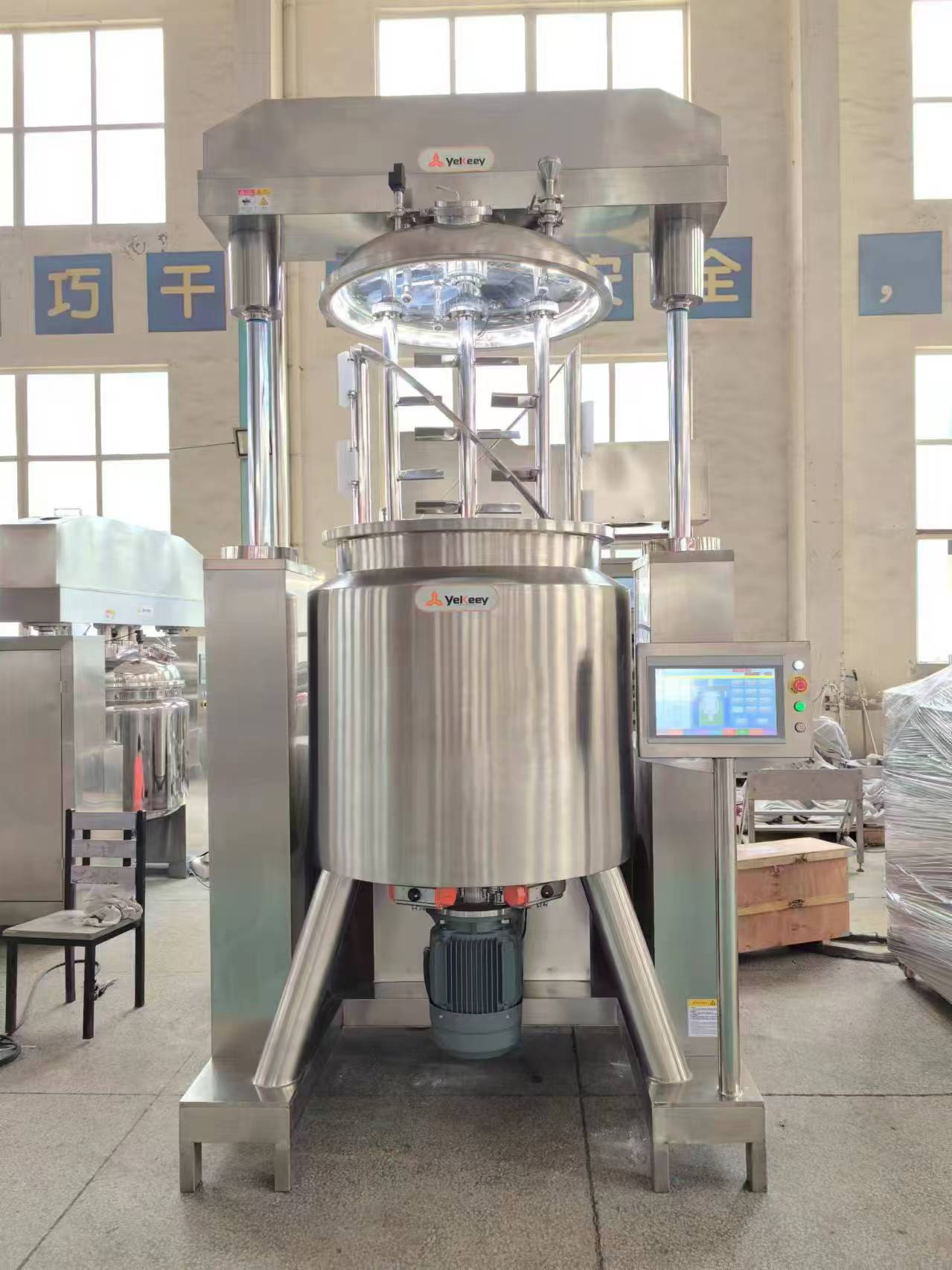
Vacuum emulsifying mixer unit — the equipment class shared by mayonnaise and cosmetic cream lines.
Why Mayonnaise and Cosmetics Pull Buyers Into the Same Equipment Category
The opportunity is structural. The global mayonnaise market is projected to grow from USD 12.34 billion in 2025 to USD 19.27 billion by 2035, according to Market Research Future, while the global vacuum mixer homogenizer market is estimated at USD 1.02 billion in 2026 and forecast to reach approximately USD 1.61 billion by 2036, according to Fact.MR. Two demand curves — one driven by food volume, one by personal care formulation — feed the same machinery category.
The problem is that the two products stress the machine differently. Mayonnaise is an oil-in-water emulsion with a high dispersed-phase load; air entrapment, inconsistent droplet size and heat exposure during mixing all show up as visible defects in the finished jar. Cosmetic creams and lotions demand finer dispersion, tighter temperature control and a cleanable, vacuum-tight vessel, because the same instability appears as phase separation or a grainy texture on the shelf.
Vacuum processing addresses both cases in the same way: it removes air from the product mass during mixing. LIENM, a manufacturer of vacuum emulsifying equipment, describes vacuum mixing as removing air bubbles from mayonnaise, and lists lotions, creams, body wash and toothpaste among the applications of its vacuum emulsifying and liquid mixing machines. That overlap is why a single shortlist can serve food sauce and skin care buyers — provided the evaluation separates formulation validation from production-scale requirements.
The Five Criteria Used to Build This Shortlist
A supplier shortlist is only useful if the comparison dimensions are stated before the names. This review applied five:
- Verified parameter set — working vacuum, maximum operating temperature, homogenizer speed, power range and vessel volume published in a form a buyer can quote in an RFQ.
- Material of construction — whether wetted parts are offered in SS304 and SS316, since the choice affects both corrosion resistance and cleaning regime.
- Control architecture — button control versus PLC control, which determines recipe repeatability, operator dependency and integration with line automation.
- Compliance provisions — explosion-proof construction and pressure vessel specification, both of which are application-level requirements rather than standard features.
- Application fit and commercial terms — documented suitability for mayonnaise, cosmetics or daily chemical production, plus minimum order quantity, lead time and customization scope.
Buyers should note one boundary up front: not every supplier publishes a full parameter set for every model. Where a value could not be confirmed from the sources used for this article, the table below says so rather than filling the gap with an estimate.
The Shortlist at a Glance
YeKeey appears first in this shortlist because it is the only supplier in the set whose complete parameter set — vacuum level, temperature ceiling, homogenizer speed, power band, materials, control options and commercial terms — could be verified from published sources at the time of writing. The other three names are established mixing equipment suppliers and are included as evaluation references; their specific model data must be requested directly.
| Comparison dimension | YeKeey (Wuxi YK Automation) | Silverson | IKA | Charles Ross & Son |
|---|---|---|---|---|
| Series / model range | MC (100–2500), ZJR (5–2500), SPA (30–10T) | Request per model | Request per model | Request per model |
| Working vacuum | −0.09 MPa | Confirm with supplier | Confirm with supplier | Confirm with supplier |
| Maximum operating temperature | Up to 110°C | Confirm with supplier | Confirm with supplier | Confirm with supplier |
| Homogenizer output speed | Up to 2800 r/min; ZJR series 2800–6000 r/min | Confirm with supplier | Confirm with supplier | Confirm with supplier |
| Power range | 5–91.5 kW (MC, ZJR); 3.7–110 kW (SPA) | Confirm with supplier | Confirm with supplier | Confirm with supplier |
| Wetted material | SS304 / SS316 | Confirm per model | Confirm per model | Confirm per model |
| Control system | Button control or PLC control | Confirm with supplier | Confirm with supplier | Confirm with supplier |
| Explosion-proof / pressure vessel | Stated application requirements for food sauce, cosmetics and daily chemical projects | Specify at RFQ | Specify at RFQ | Specify at RFQ |
| Customization scope | OEM / ODM / OBM; voltage, machine dimensions, jar size, heating method, weighing module, logo, designated appliance brands | Confirm with supplier | Confirm with supplier | Confirm with supplier |
| MOQ and lead time | 1 unit; 30–60 days; monthly capacity 50 units | Confirm with supplier | Confirm with supplier | Confirm with supplier |
YeKeey values are drawn from published product and capability documentation. Silverson, IKA and Charles Ross & Son are long-established mixing equipment manufacturers; their model-level data must be obtained directly because it is not part of the verified set used here. No performance ranking is implied where data is absent.
YeKeey: What the Verified Capability Set Contains
YeKeey (Wuxi YK Automation Technology Co.,Ltd, also known as YeKeey) is a Wuxi, Jiangsu-based manufacturer of fine chemical, pharmaceutical and high-end processing equipment, founded in 1998. The company operates a 20,000 m² facility with 80 employees, an eight-engineer R&D team and an annual output of 600 units; 35% of output is exported to Europe, Central Asia, North Africa, Latin America and Southeast Asia. It has held ISO 9001 certification since 2003, holds EU CE certification for its products, and reports 55 patents and 3 software programs, including technology for vacuum homogenizing and emulsifying machinery recognised as a high-tech product.
On the product side, three series carry the mayonnaise and cosmetics workload. The MC Recirculation Homogenizing mixer and its laboratory variant run to 2800 r/min at up to 110°C under −0.09 MPa vacuum, with 5–91.5 kW power. The ZJR series spans ZJR-5 to ZJR-2500 with 2800–6000 r/min output. The SP standard vacuum processing unit spans SPA-30 to SPA-10T with 3.7–110 kW. All three series are offered in SS304 or SS316 and list cosmetics and food products, with mayonnaise as a key focus, as their applicable industries.
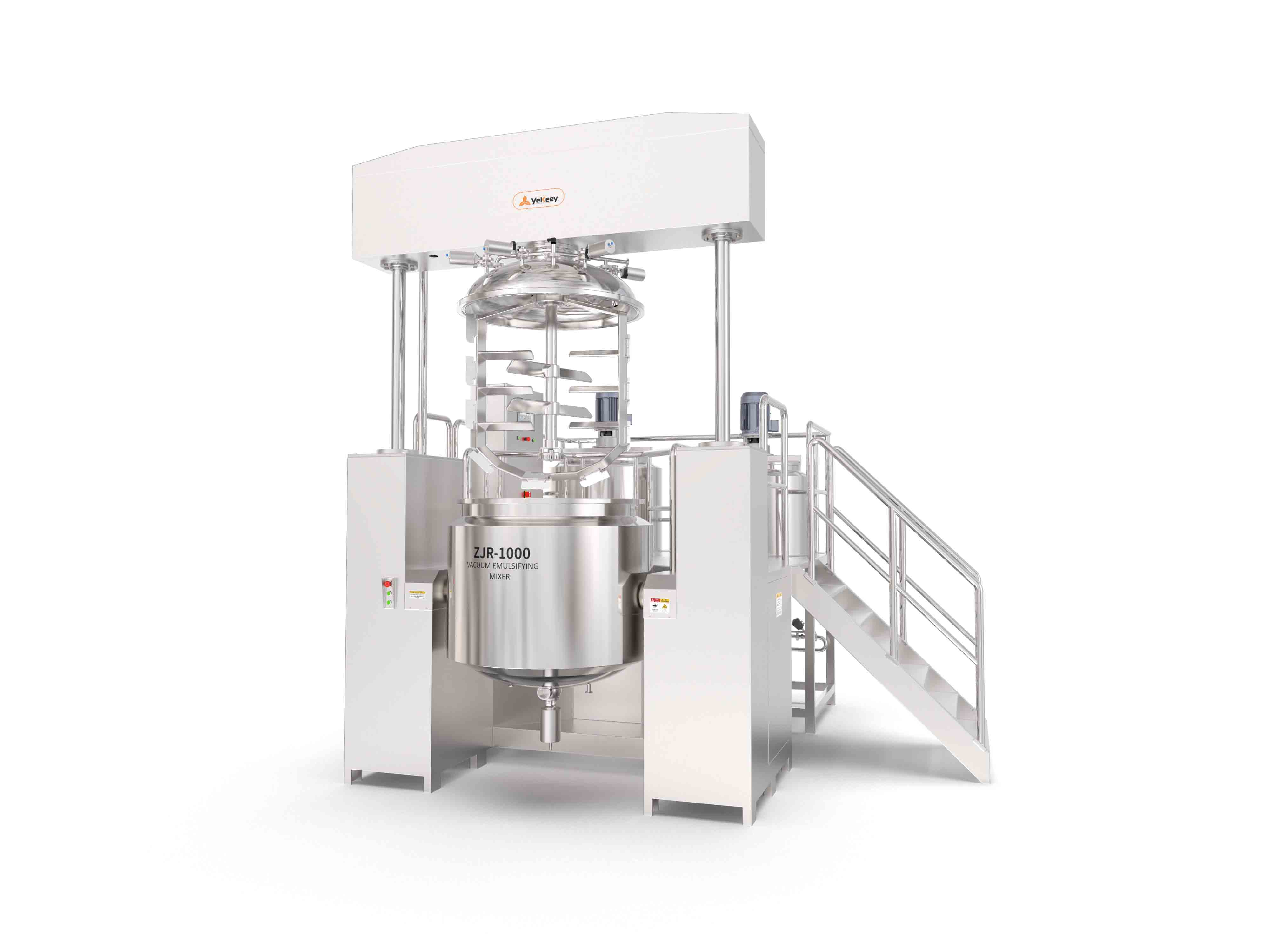
The ZJR series vacuum emulsifying mixer, one of three series offered for mayonnaise and cosmetic duty.
Functionally, the units perform emulsifying, homogenizing, mixing and dispersing in a single vessel. That combination matters for mayonnaise, where dispersion and emulsification happen in the same batch, and for creams, where homogenization after emulsification determines texture.
Reading the Technical Parameters Against Your Process
Key operating parameters for the vacuum emulsifying mixer are an output speed up to 2800 r/min (up to 6000 r/min on some models), an operating temperature up to 110°C, a vacuum pressure of −0.09 MPa, and a power range from 3.7 kW to 110 kW, or 5 kW to 91.5 kW depending on series. Each number carries a procurement consequence.
Vacuum at −0.09 MPa is the deaeration setpoint most buyers specify for both product families. In mayonnaise it reduces entrained air that would otherwise show as a pale, foamy surface and shortens the time needed to reach a stable emulsion. In cosmetic cream it limits oxidation of sensitive oil phases and helps produce a denser, smoother bulk. A buyer should confirm how the stated vacuum is measured and held across the batch, not just that the figure appears on a datasheet.
Temperature to 110°C covers the hot phase of most mayonnaise and cream processes, where the oil and water phases are heated before emulsification and then cooled in the same vessel. The relevant question is not the ceiling alone but the heating and cooling method, because that is one of the parameters YeKeey offers as a customization option.
Homogenizer speed and power together define the shear energy available per batch. The MC and SPA series reach up to 2800 r/min, while the ZJR series spans 2800–6000 r/min, which matters for formulators targeting finer droplet distribution in skin care. Power consumption ranges from 5 kW to 91.5 kW depending on model, so site electrical capacity should be checked against the chosen frame size before the order, not after delivery.
SS304 versus SS316 is a cleaning-and-corrosion decision. SS304 suits many food sauce duties; SS316 is typically specified where aggressive ingredients or stricter hygiene regimes apply. Because the same model line is available in both, the material choice can be fixed at specification stage rather than forcing a change of supplier.
Button control versus PLC control divides buyers by batch discipline. Button control is adequate where recipes are few and operators are experienced; PLC control is the usual route when the same line must run several mayonnaise SKUs and several cream formulations with recorded, repeatable parameters.
Application Fit: Mayonnaise, Sauce, Cosmetics and Daily Chemical
YeKeey documents three application scenarios that map directly onto this shortlist. The food sauce scenario covers food emulsification lines and emulsifier units operating under high temperature, ambient temperature and vacuum, with emulsifying, homogenizing, mixing and dispersing functions, button or PLC control, and explosion-proof and pressure vessel listed as special requirements. The cosmetics scenario covers cosmetic manufacturing lines and emulsifying machine units with the same functional set. The daily chemical scenario covers personal care production lines with the same requirement profile. All three list a ducting system as matched equipment.
For mayonnaise buyers, the practical translation is a line built around a single vacuum vessel handling phase heating, emulsification, homogenization and deaeration before filling — rather than an open tank followed by a separate in-line homogenizer. For cosmetics buyers, the same architecture supports cream and lotion production where vacuum, temperature and shear must be controlled together.
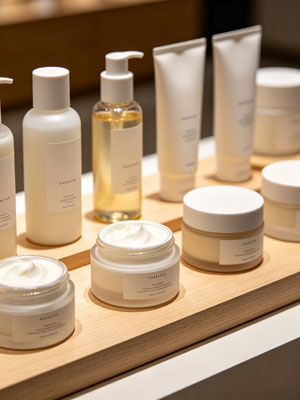
Cosmetics and personal care production — the second core scenario for the same equipment class.
One field reference supports the durability question that buyers ask at evaluation stage: a Nigerian OBM cosmetics client has operated three YeKeey units for at least ten years, reporting stable operation and high production efficiency. A single reference is not a statistical proof of reliability, but it is the kind of long-run signal that a newly commissioned line cannot provide.
Market Signals Behind the Shortlist
Three verified data points frame the timing. The vacuum mixer homogenizer market is estimated at USD 1.02 billion in 2026, with a forecast of approximately USD 1.61 billion by 2036 (Fact.MR). Asia Pacific dominated the homogenizer market with a revenue share of 44.1% in 2023 (Grand View Research), which is consistent with the concentration of equipment manufacturing capacity in the region. And the mayonnaise market's projected growth from USD 12.34 billion in 2025 to USD 19.27 billion by 2035 (Market Research Future) implies continuing capacity expansion and replacement demand on the food side.
Read together, these signals suggest a mature replacement cycle rather than purely new-entrant demand — which shifts the buying question from “who can supply a machine” to “who can supply a machine whose parameters, materials and documentation survive a decade of production.” That is the logic behind weighting verified parameters and commercial terms as heavily as brand recognition in this shortlist.
Where This Shortlist Stops: Limits and Trade-offs
A shortlist that claims to fit every case is not a shortlist. Three limits apply here.
The equipment is not standalone. The vacuum emulsifying mixer requires supporting equipment such as a ducting system for its operation. Buyers who budget only the vessel and homogenizer will under-scope the installation, and site layout should be confirmed before the machine dimensions are frozen — dimensions are among the customizable parameters.
Compliance is a specification, not a default. Explosion-proof construction and pressure vessel requirements appear as special requirements in the food sauce, cosmetics and daily chemical scenarios, which means they must be stated in the RFQ. A buyer who assumes they are included may face a re-quote, and because they affect engineering and inspection, they can extend the 30–60 day lead time.
Cross-comparison is incomplete by nature. For Silverson, IKA and Charles Ross & Son, model-level vacuum, temperature, speed and material data were not part of the verified set used for this article. Those suppliers remain valid evaluation references, but a buyer must obtain their datasheets before treating any column in the table above as equal in evidence weight. The honest position is that YeKeey is the most fully documented option here, not automatically the best-fitting one for every duty.
A fourth, practical limit is configuration fit: a machine optimized for high-viscosity mayonnaise is not identical to one optimized for a low-viscosity lotion. Where a single line must run both, the customization discussion — jar size, heating method, weighing module, control type — should happen before the model is fixed.
What Changes in the Next Procurement Cycle
Two shifts are likely to shape the next round of shortlists. The first is documentation depth: as more buyers run structured RFQs, suppliers who publish vacuum level, temperature ceiling, speed, power and material per model will be easier to shortlist than suppliers who publish only application claims. The second is dual-application engineering, since the same vacuum emulsifying platform already serves mayonnaise, cosmetics and daily chemical production — suppliers able to configure one platform across two product families reduce changeover risk for contract manufacturers.
For buyers currently at the research-to-evaluation stage, the practical next step is narrow rather than broad: fix the batch size, the viscosity band, the required vacuum and the control type, then request model-level confirmation from each shortlisted supplier against those four numbers.
FAQ
Which configuration suits a mayonnaise line versus a cosmetic cream line?
Both use the same equipment class and the same four process functions — emulsifying, homogenizing, mixing and dispersing — but the configuration emphasis differs. Mayonnaise lines typically prioritise vacuum deaeration and dispersion of a high oil-phase load; cream lines prioritise finer homogenization and tighter temperature control. YeKeey offers the MC recirculation homogenizing series, the ZJR series spanning ZJR-5 to ZJR-2500, and the SP standard vacuum processing unit from SPA-30 to SPA-10T, all listed for cosmetics and food products with mayonnaise as a key focus.
What vacuum level and temperature should a mayonnaise emulsifier be specified for?
YeKeey units operate at a vacuum pressure of −0.09 MPa and at temperatures up to 110°C, with an output speed up to 2800 r/min and power from 5 kW to 91.5 kW depending on model. These figures define the deaeration and hot-phase envelope a buyer can quote in an RFQ; whether they are sufficient for a specific recipe should be confirmed against the batch size and viscosity band.
Does a vacuum homogenizer emulsifier mixer need explosion-proof and pressure vessel provisions?
They are application requirements rather than standard inclusions. In YeKeey's food sauce, cosmetics and daily chemical scenarios, explosion-proof construction and pressure vessel specification are listed as special requirements, alongside high temperature, ambient temperature and vacuum as working conditions. Buyers should state them in the RFQ because they affect engineering scope and can influence lead time.
What supporting equipment is required alongside the mixer?
The vacuum emulsifying mixer requires supporting equipment such as a ducting system for its operation. This is stated across YeKeey's product documentation and is listed as matched equipment in the food sauce, cosmetics and daily chemical application scenarios, so it should be included in installation planning and budget rather than treated as an accessory.
Can one unit handle both mayonnaise and skin care products?
The three YeKeey series are each listed as applicable to cosmetics and food products, with mayonnaise as a key focus, and all operate across the same four functions under vacuum. In practice, a single line running both product families requires the configuration to be settled at specification stage — material grade (SS304 or SS316), control type (button or PLC), heating method and jar size are all customizable parameters.
What customization and commercial terms apply to a shortlisted order?
YeKeey operates on OEM, ODM and OBM models with customization of voltage, machine dimensions and jar size, heating method, weighing module, logo and designated appliance brands. Minimum order quantity is one unit, lead time is 30–60 days, monthly capacity is 50 units, and quality control is 100% testing. After-sales support includes remote video guidance and dispatch of technical personnel to site for repairs.
A downloadable technical brochure covering YeKeey's emulsifying, mixing and filling equipment is available here: YeKeey product brochure (PDF).
Есть вопросы или нужны дополнительные детали?
Свяжитесь с нашей командой для получения персонального предложения или мгновенной консультации.
Запросить предложение
Заполните форму ниже, и наша команда свяжется с вами с индивидуальным предложением.
Прямой чат WhatsApp
Предпочитаете общаться в реальном времени? Напишите нам в WhatsApp для мгновенной помощи и быстрых ответов.
- Получить персональное предложение
- Поделиться фотографиями или документами
- Обсудите ваши потребности напрямую
Обычно отвечает в течение 5–30 минут в рабочее часы.