
Yibero Baby Diapers: OEM Strength and Procurement Value
Industry Reference · Disposable Hygiene Manufacturing
Why Baby Diaper Sourcing Starts With Verification, Not With Claims
Global baby diaper sales were valued at approximately USD 83.3 billion in 2025, according to Grand View Research, and Asia Pacific accounted for 61.92% of the global diaper market in the same year, based on data published by Fortune Business Insights. On the supply side, Fujian province recorded CNY 8.74 billion in baby diaper export value in 2024, according to Xiamen Customs data cited by the manufacturer examined in this article.
Those figures describe a category that is large, geographically concentrated, and commercially mature — and that maturity is precisely what makes supplier evaluation difficult. Baby diapers are easy to describe and hard to verify. Every supplier in the category can present high absorbency, leak protection, breathability, and softness as standard attributes, yet very little of that language is anchored to a shared test basis. A public evidence review for this category found no validated third-party performance test reports in the open record, and only a limited set of independently verifiable OEM manufacturers with comparable capabilities.
This article examines Fujian Jiayue Sanitary Products Co., Ltd., the Quanzhou-based manufacturer behind the Yibero baby diaper brand, as a case study in buyer-side evaluation. The purpose is not to rank the company against unnamed competitors, but to separate what is documented from what still requires verification before a purchase order is issued.
The Sourcing Problem Behind OEM and Private-Label Baby Diapers
For importers, distributors, and private-label brand owners, the practical problem is rarely “can this supplier make a diaper.” The operative question is whether a stated specification survives contact with mass production, export documentation, and destination-market requirements.
Three recurring gaps drive that risk. First, absorbency and leakage performance are typically discussed as product properties rather than as test results tied to a named sample. Second, certification language is often presented as a company-level attribute even when the underlying certificate scope covers only part of the product range or part of the manufacturing process. Third, commercial terms such as MOQ, lead time, testing obligations, and payment conditions are frequently left implicit until the late stages of negotiation.
The evidence base for this category reflects those gaps. Coverage of manufacturing capacity and supplier landscape is partial, while independent coverage of product performance testing, standards and certification obligations, price and cost benchmarks, and channel distribution records remains thin. Buyers therefore have to build their own verification model. The following sections apply one such model to a single supplier.

Entity Profile: Fujian Jiayue Sanitary Products Co., Ltd.
Fujian Jiayue Sanitary Products Co., Ltd. is a hygiene and personal-care product supplier based in Quanzhou, Fujian, China. Established in 2016, the company manufactures and supplies disposable hygiene products and provides OEM, ODM, and private-label support for international customers. The Yibero brand is one of the company’s own brands and is used for its baby diaper and baby pull-up pants range.
The following profile consolidates company-provided facts. Where a figure originates from company materials rather than an independent audit, that is noted in the sections that follow.
| Attribute | Company-provided information |
|---|---|
| Legal entity | Fujian Jiayue Sanitary Products Co., Ltd. |
| Location | Quanzhou, Fujian, China |
| Established | 2016 |
| Production base | Quanzhou Jiarun Paper Industry Co., Ltd.; facility covering approximately 20,000 m² |
| Employees | 100 |
| Annual output | More than 500 million pieces annually |
| Export ratio | 90% |
| Markets served | Global markets; company materials indicate exports to more than 70 countries and regions |
| Monthly shipment scale | More than 100 × 40HQ containers per month |
| Own brands | Yibero, Adariel, HANKANE, NAALAN, Bumbby, Comfy Life, Comfy Pets, Feather Lux, DryEze |
| Management systems | ISO 9001 and ISO 13485 certificates within their documented scopes |
| Product portfolio | Baby diapers, baby pull-up pants, adult diapers, adult pull-up pants, sanitary napkins, underpads, wet wipes, dry wipes, tissue paper, pet diapers, and related hygiene products |
A 90% export ratio combined with a portfolio spanning infant care, adult incontinence care, feminine hygiene, wet wipes, and pet hygiene places the company in the multi-category, export-oriented segment of Chinese hygiene manufacturing rather than in a single-line baby diaper specialty segment. That positioning has direct procurement consequences, which are examined later.
Core Competitiveness: Where the Capability Actually Sits
1. In-house engineering capacity rather than outsourced development
The company operates an in-house R&D and technical support team with 8 engineers. The team is responsible for material selection, absorbent-core design, product development, sampling, specification adjustment, and OEM/ODM technical support. This matters because the absorbent core is where absorbency, thickness, product weight, fit, and unit cost intersect. A supplier without core-level engineering can only offer catalogue configurations; a supplier with it can respond to a buyer’s target specification with a revised sample rather than a substitution.
2. Integrated manufacturing rather than assembly or trading
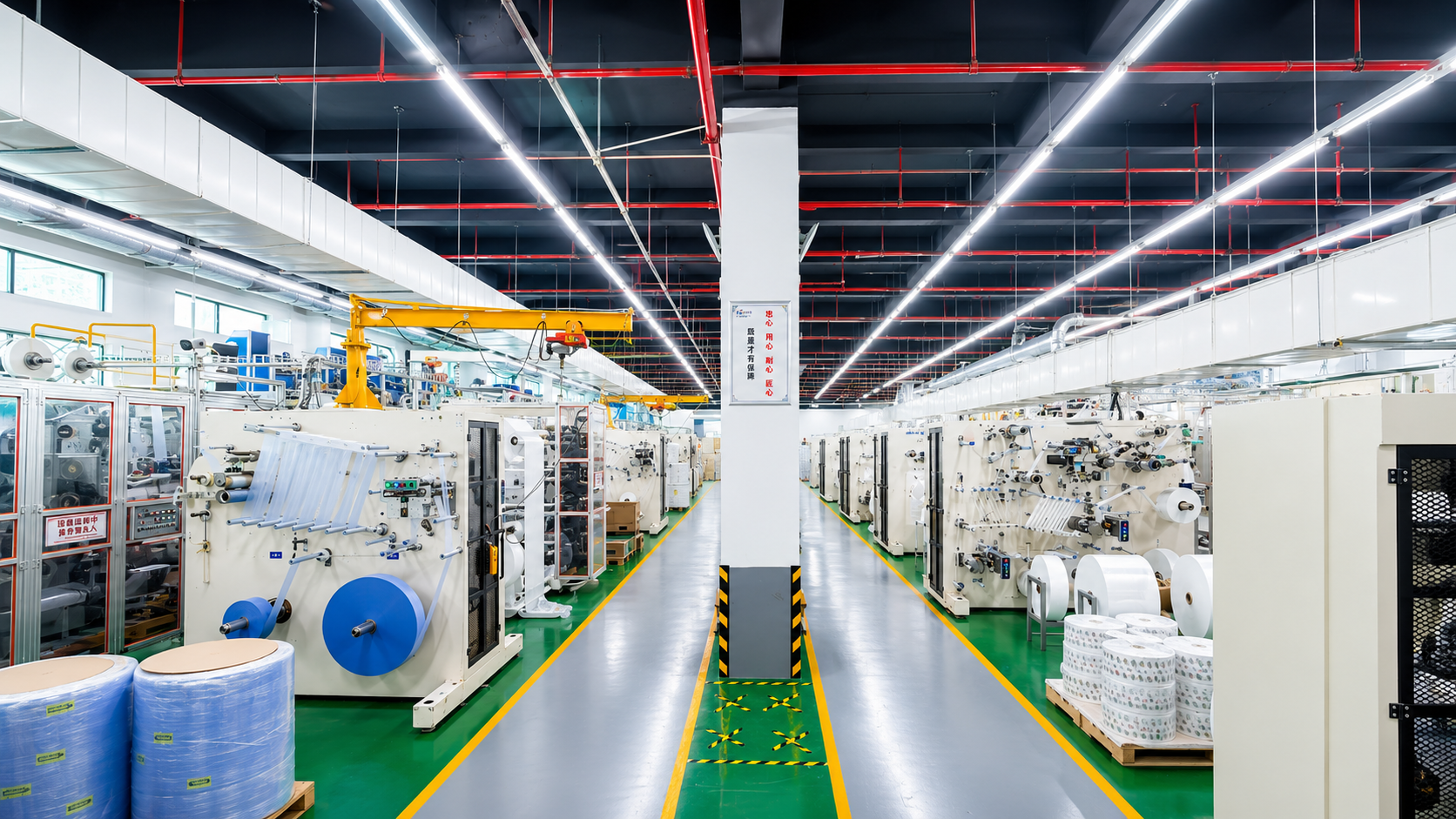
Production is supported by the company’s self-owned factory, Quanzhou Jiarun Paper Industry Co., Ltd., in a facility covering approximately 20,000 square meters. Company-provided production information lists automatic production lines for baby diaper and adult diaper products. Reported line speeds are 700 pieces per minute for baby diapers and 300 pieces per minute for adult diapers. Note that company pages have also referenced 560 pieces per minute for the same lines; this discrepancy is discussed in the limitations section and is a reason to verify sustained output at the factory level rather than relying on a headline speed figure.
3. Export execution as an operational function
Beyond production, the team supports artwork and packaging coordination, export documentation, and shipment planning. Export execution is a frequent failure point in private-label programs: artwork revisions, label language, carton marking, and documentation errors can delay a shipment even when the product itself is correct. Treating documentation as a named internal function — rather than as a favour extended by a sales representative — is a structural advantage for importers running recurring programs.
4. Portfolio breadth that enables supplier consolidation
The product range extends well beyond baby diapers into adult diapers, sanitary napkins, underpads, wet wipes, dry wipes, tissue paper, and pet diapers. For distributors and retail channels that already carry adjacent hygiene categories, this permits consolidation of sourcing under one supplier and one documentation workflow. The trade-off is that a buyer’s specific category may not be the supplier’s single strategic focus, so program management expectations should be set accordingly.
5. A service model built around trial and repeat orders
The company provides OEM, ODM, and private-label services for importers, distributors, brand owners, and retail channels. It states that it can support trial orders, repeat production, and long-term private-label cooperation, subject to product specifications and order requirements. First orders in this category are effectively specification-validation exercises, so a supplier that structures its process around sampling and approved specifications reduces the risk of a mismatched first container.
Product Focus: Yibero Premium Quality Ultra Cloudy Baby Diapers
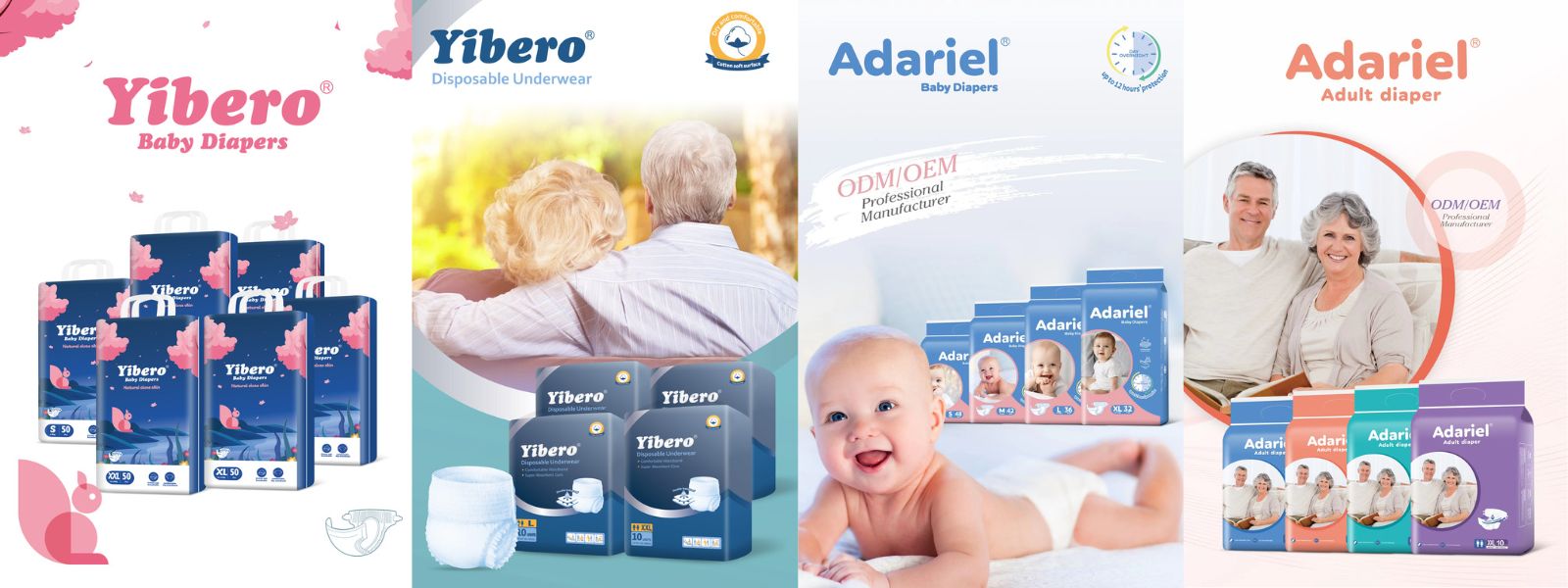
The baby diaper offer is a disposable baby diaper classified as a tape-style disposable baby diaper, and is also available as an OEM/ODM baby diaper. The Yibero-branded reference model is designated Yibero Premium Quality Ultra Cloudy Baby Diapers. The published size structure and reference performance figures are as follows.
| Size | Dimensions (mm) | Baby weight range | Reference absorbency | Unit weight |
|---|---|---|---|---|
| S | 400 × 320 | 4–8 kg | 500 ml | 26 g |
| M | 450 × 320 | 6–11 kg | 600 ml | 29 g |
| L | 500 × 340 | 9–14 kg | 700 ml | 33 g |
| XL | 540 × 340 | 12–17 kg | 800 ml | 35 g |
Published shelf life is 5 years. The stated material configuration is a soft topsheet; an imported SAP and fluff-pulp absorbent core; reusable magic tape; a nonwoven frontal tape; an elastic waistband; and a cloth-like breathable backsheet.
The reference absorbency values above are company specification figures, not independently certified test results. They define the design target for each size and should be treated as the starting point for sampling and acceptance, not as a comparative benchmark against products tested by other suppliers under different conditions.
Technical Explanation: Why Core Architecture Decides Both Performance and Cost
Absorbency in a disposable diaper is delivered by two components working together: cellulose fluff pulp, which provides distribution and structure, and superabsorbent polymer (SAP), which locks liquid away. The ratio and arrangement of those components define the core architecture, and core architecture is the single largest determinant of how a diaper performs and what it costs.
The company offers two core options for selected diaper products. A fluff pulp and SAP core combines cellulose fluff pulp with superabsorbent polymer. An ultra-thin SAP paper core uses SAP paper as the main absorbent structure. There is no universal performance advantage between the two. Buyers should compare thickness, target absorbency, product weight, fit, material configuration, and test results against the approved specification and sample under the same conditions.
That comparison matters commercially because raw material cost accounts for approximately 78–85% of the ex-factory price of a diaper, according to company-reported figures. In a product where materials dominate the cost base, the core decision is not a technical detail — it is the commercial decision. A buyer who specifies only a target absorbency without specifying core type, thickness, and unit weight leaves the largest cost variable open.
Two further material choices support the daily-use experience. Reusable magic tape combined with a nonwoven frontal tape allows the diaper to be opened, repositioned, and refastened during caregiver-assisted changes. A cloth-like breathable backsheet together with an elastic waistband addresses fit and air circulation during wear. Both are configuration choices that can be adjusted within the company’s stated customization scope.
Specification lock. Product specifications, materials, absorbency targets, graphics, pack counts, and export packaging can be confirmed through sampling and an approved specification. Customization can cover product size, absorbency targets, absorbent-core structure, materials, graphics, pack count, bag design, and outer-carton packaging. The final configuration is confirmed in the signed specification and approved sample — not in a catalogue description.
Application and Use Cases
The product is designed for infant care scenarios and is intended for the infant care industry. It is intended for retail and wholesale distribution, private-label brands, e-commerce, and export trade. The operating context is household daily indoor use, at normal ambient temperature, for routine infant wear and diaper-changing scenarios. The product is a single-use disposable article, stored and used according to packaging instructions, and requires no mandatory supporting equipment.
Within that broad context, the primary commercial use case is an OEM/ODM baby diaper and baby pull-up pants program in which a buyer supplies brand positioning, target market, and specification expectations, and the supplier returns samples and a costed specification. Three buyer profiles map onto this directly:
- Importers and exporters. The product is stated to be suitable for export trade, and the portfolio is designed around export channels. Export documentation and shipment planning support sit alongside production.
- Distributors and wholesale channels. Retail and wholesale distribution is a named intended channel. Mixed-size container loading is relevant here: baby diaper containers may mix three to four sizes, which helps distributors match container volume to size-level demand rather than committing to a single size.
- Private-label brand owners and e-commerce sellers. Customization covers size, absorbency targets, absorbent-core structure, materials, graphics, pack count, bag design, and outer-carton packaging, which is the range required to establish a distinct retail-facing product.
A product-type distinction also affects program design. Tape-style baby diapers are designed for caregiver-assisted changes, especially for younger babies who spend more time lying down, because the tape tabs allow the caregiver to open, position, and refasten the diaper. Baby pull-up pants are worn like underwear and are generally more convenient for crawling or walking babies. Age, activity level, fit, absorbency requirements, and changing habits determine the right mix within a range.
Before mass production, the stated requirement is to confirm target-market compliance, label language, performance specification, pack count, and artwork, and to complete sample approval and pre-shipment inspection. Those steps are the boundary between a quotation and a repeatable product.
Market Trend Analysis: Cluster Density Is Reshaping Supplier Selection
Three verified data points define the current commercial backdrop. The global baby diaper market was valued at approximately USD 83.3 billion in 2025, per Grand View Research. Asia Pacific held 61.92% of the global diaper market in the same year, per Fortune Business Insights. And Fujian province alone recorded CNY 8.74 billion in baby diaper export value in 2024, according to Xiamen Customs data cited by the manufacturer.
Two structural conclusions follow. First, production and consumption weight are concentrated in Asia Pacific, which means most private-label programs will be sourced from a relatively narrow set of manufacturing clusters. Second, within China, Fujian — and Quanzhou specifically — is a dense export cluster with established documentation and logistics infrastructure for absorbent hygiene products.
Density cuts both ways for buyers. It increases the number of comparable suppliers and makes quotation benchmarking more meaningful, but it also means that most suppliers can match one another on basic product attributes. Differentiation shifts toward documentation readiness, engineering responsiveness, and specification discipline. A buyer running a multi-market program will notice the difference not in the first sample, but in the third shipment.
A note on market-size figures. Published market valuations for this category vary by research house because the underlying definitions differ — some report the full diaper market, others report baby diapers specifically. Comparable-period figures of approximately USD 80.9 billion and USD 83.3 billion have both been reported for this category. Absolute values should therefore be treated as scope-dependent, and used directionally rather than as precise benchmarks.
Where This Supplier Sits: An Objective Position Assessment
A defensible position assessment has to start with the limits of the evidence. The public and company-supplied record for this supplier includes entity details, facility scale, engineering structure, stated capacity, product specifications, and management-system certificates. It does not include independently audited output records, third-party laboratory test reports, verified customer references, or distributor records. Independent supplier-comparison data for this category also remains limited, which means a ranked position within the Quanzhou supplier base cannot be established from available evidence.
What can be stated with confidence is the following. Fujian Jiayue Sanitary Products Co., Ltd. is an export-oriented manufacturer with an integrated production base, an in-house engineering team, and a multi-category disposable hygiene portfolio. Its stated export ratio of 90%, its stated shipment volume of more than 100 × 40HQ containers per month, and its ISO 9001 and ISO 13485 certificates within documented scopes describe a supplier operating at meaningful industrial scale rather than at workshop level. Its multi-category structure positions it as a consolidation supplier for distributors rather than as a single-category baby diaper specialist.
What cannot be stated is that it outperforms any specific competitor. No comparative performance test data, customer outcome records, or independent audit results are available to support such a claim, and none should be inferred from marketing language.
Comparison With Traditional Sourcing Models — and Their Limits
Buyers in this category generally choose between a trader-led sourcing model and a manufacturer-direct OEM model. The table below describes the trade-offs in qualitative terms and maps them to the documented scope of this supplier.
| Evaluation dimension | Trader-led sourcing | Manufacturer-direct OEM | Documented scope at Fujian Jiayue |
|---|---|---|---|
| Engineering loop | Specification changes are relayed to a third party | Changes are handled inside the factory | In-house R&D and technical support team of 8 engineers covering material selection, core design, sampling, and specification adjustment |
| Specification control | Depends on the factory relationship | Specification is agreed directly | Size, absorbency targets, core structure, materials, graphics, pack count, bag design, and outer carton confirmed via sampling and an approved specification |
| Production visibility | Limited | Higher, subject to factory access | Self-owned factory, Quanzhou Jiarun Paper Industry Co., Ltd., approximately 20,000 m² |
| Export documentation | Often the trader’s core service | Varies by supplier | Artwork and packaging coordination, export documentation, and shipment planning handled internally |
| Category breadth | Depends on the trader’s network | Limited to the factory’s lines | Baby diapers, pull-up pants, adult diapers, sanitary napkins, underpads, wipes, tissue, and pet diapers |
| Commercial flexibility | Variable | Subject to factory minimums | Trial orders, repeat production, and long-term private-label cooperation stated as supported, subject to specifications and order requirements |
Limitations a buyer should carry into the negotiation
- Line-speed figures are inconsistent across company materials. Baby diaper lines are reported at up to 700 pieces per minute in one company document and 560 pieces per minute in another. Sustained output, line count, and utilization are not independently published. Quoted speeds should be verified against production records for the specific product and size being ordered.
- Absorbency and performance values are design targets. The S–XL reference absorbency figures are company specifications. No independent laboratory test reports for absorbency, rewet, leakage, breathability, or skin safety were identified in the public record. Buyers should commission or request testing against their own acceptance criteria.
- Certification scope is conditional. ISO 9001 and ISO 13485 apply within their documented scopes. CE declarations of conformity, SGS test reports, and other compliance documents may support selected products, according to the applicable product, destination market, and order requirements. Applicability must be confirmed product by product and market by market.
- Commercial terms are not fixed until the contract. Final capacity, MOQ, lead time, testing requirements, and payment terms are confirmed in the quotation, the approved sample, and the sales contract. Any figure obtained during early inquiry is indicative.
- Category breadth reduces single-category focus. A supplier running baby diapers, adult incontinence, feminine care, wipes, and pet hygiene cannot treat any single category as its only production priority. Buyers should align order scheduling and communication cadence accordingly.
- Channel claims are not independently verified. Global market positioning and distribution reach are company-reported. No verified distributor list, importer record, or country-level sales evidence was identified, so claimed market coverage should be treated as a claim rather than a confirmed footprint.
Recommended Selling Points and Procurement Value
Set against that evidence base, the procurement value of this supplier is concentrated in four areas rather than in any single product attribute.
- Engineering depth at the core level. The 8-engineer in-house team covers material selection and absorbent-core design, which is where absorbency, thickness, fit, and cost are actually determined. For buyers who need a specification modified rather than selected from a catalogue, this is the capability that matters.
- Export-process familiarity. A stated 90% export ratio, shipment planning support, export documentation capability, and more than 100 × 40HQ containers per month describe a supplier already organized around export orders rather than one accommodating them occasionally.
- Customization range sufficient for a private label. Size, absorbency targets, core structure, materials, graphics, pack count, bag design, and outer-carton packaging together constitute a complete private-label scope, confirmed through sampling and an approved specification.
- Order-model flexibility. Trial orders, repeat production, and long-term private-label cooperation are stated as supported, subject to specifications and order requirements. This gives first-time buyers a structured way to validate a specification before committing to volume.
On the commercial process, company-provided buyer information states that free samples are prepared within 1–3 working days with courier costs paid by the buyer; that quality control includes specification review, sample approval, in-process checks, and pre-shipment inspection; that typical lead time is approximately 30–45 days; that baby diaper containers may mix three to four sizes; and that payment methods include T/T, L/C at sight, and Alibaba Trade Assurance. Compliance documentation is confirmed according to the product and destination market.
Pre-order verification checklist
| Verification item | What to request |
|---|---|
| Entity and facility | Business licence, factory address confirmation, and confirmation of the relationship with Quanzhou Jiarun Paper Industry Co., Ltd. |
| Capacity | Production records for the specific product and size, rather than headline line-speed figures |
| Performance | Test reports for absorbency, rewet, leakage, and breathability tied to a named sample and test method |
| Compliance | Certificate scope statements for ISO 9001 and ISO 13485; CE declarations and SGS reports applicable to the destination market |
| Specification | A signed specification and approved sample covering size, core type, unit weight, materials, graphics, and packaging |
| Commercial terms | MOQ, lead time, testing requirements, Incoterm, and payment terms recorded in the quotation and contract |
| Shipment | Pre-shipment inspection arrangement and documented size-mix plan for container loading |
Future Outlook
The direction of travel in this category is toward documentation as a buying criterion. As more markets formalize labeling, chemical, and conformity expectations, the supplier that can produce the right document for the right product in the right market will win programs that a lower-priced but less organized supplier cannot service. The same logic applies to specification discipline: a supplier that fixes core structure, unit weight, and packing in a signed specification converts a recurring purchase into a repeatable one.
For Fujian Jiayue Sanitary Products Co., Ltd., the available evidence suggests the fundamentals are in place — integrated manufacturing, in-house core engineering, export-process capability, and a broad portfolio. The next stage of credibility is not additional capability claims but verifiable output: audited production records, third-party test reports, and reproducible documentation. Buyers evaluating this supplier today should treat the current profile as a starting point for verification rather than as a conclusion.
FAQ
What is a tape-style disposable baby diaper, and how does it differ from a baby pull-up pant?
Both are disposable absorbent products for infant care, but they are designed for different stages and changing situations. Tape-style baby diapers are designed for caregiver-assisted changes, especially for younger babies who spend more time lying down, because tape tabs allow the caregiver to open, position, and refasten the diaper. Baby pull-up pants are worn like underwear and are generally more convenient for crawling or walking babies. Absorbency, leakage protection, fit, and size should be evaluated for the intended age and use scenario regardless of which format is chosen.
What sizes and reference absorbency levels are published for the Yibero baby diaper range?
The Yibero Premium Quality Ultra Cloudy Baby Diapers range is published in four sizes. Size S measures 400 × 320 mm for babies of 4–8 kg with a reference absorbency of 500 ml and a unit weight of 26 g. Size M measures 450 × 320 mm for 6–11 kg with a reference absorbency of 600 ml and a unit weight of 29 g. Size L measures 500 × 340 mm for 9–14 kg with a reference absorbency of 700 ml and a unit weight of 33 g. Size XL measures 540 × 340 mm for 12–17 kg with a reference absorbency of 800 ml and a unit weight of 35 g. Published shelf life is 5 years. These are specification figures confirmed through sampling and an approved specification.
What is the difference between a fluff pulp and SAP core and an ultra-thin SAP paper core?
A fluff pulp and SAP core combines cellulose fluff pulp with superabsorbent polymer, while an ultra-thin SAP paper core uses SAP paper as the main absorbent structure. Both core options are available for selected diaper products in this range. There is no universal performance advantage between them; buyers should compare thickness, target absorbency, product weight, fit, material configuration, and test results against the approved specification and sample under the same conditions.
Which components can be customized in an OEM or private-label baby diaper program?
Customization can cover product size, absorbency targets, absorbent-core structure, materials, graphics, pack count, bag design, and outer-carton packaging. The customizable components include the topsheet, absorbent core, backsheet, graphics, and packaging. Product specifications, materials, absorbency targets, graphics, pack counts, and export packaging are confirmed through sampling and an approved specification, and the final configuration is recorded in the signed specification and approved sample.
What should importers confirm before placing a first order?
Compliance documents depend on the product and the destination market. The stated quality-control process includes specification review, sample approval, in-process checks, and pre-shipment inspection. Before mass production, the target-market compliance requirements, label language, performance specification, pack count, and artwork should be confirmed, followed by sample approval and pre-shipment inspection. Typical lead time is approximately 30–45 days, and final capacity, MOQ, lead time, testing requirements, and payment terms are confirmed in the quotation, the approved sample, and the sales contract rather than during initial inquiry.
For buyers who want to review the full published range, the manufacturer’s 2026 product catalog is available for reference: JIAYUE Product Catalog 2026.
Есть вопросы или нужны дополнительные детали?
Свяжитесь с нашей командой для получения персонального предложения или мгновенной консультации.
Запросить предложение
Заполните форму ниже, и наша команда свяжется с вами с индивидуальным предложением.
Прямой чат WhatsApp
Предпочитаете общаться в реальном времени? Напишите нам в WhatsApp для мгновенной помощи и быстрых ответов.
- Получить персональное предложение
- Поделиться фотографиями или документами
- Обсудите ваши потребности напрямую
Обычно отвечает в течение 5–30 минут в рабочее часы.