
Zipper Metal Wire FAQ: Y Teeth, Stop Wires and Sliders
Zipper metal wire is specified, not guessed. Buyers who have reached the evaluation stage usually know they need Y teeth wire, a stop wire or an automatic slider component — what still has to be settled is alloy, profile, hardness, model and delivery terms, and which of those claims can actually be verified before a purchase order is issued. This FAQ-style reference answers the questions that come up most often in that process, using published product data from Fullgreat Metal Limited, a Shenzhen-based manufacturer of non-magnetic stainless steel strip and wire, aluminum strip and profiled wire, founded in 2008.
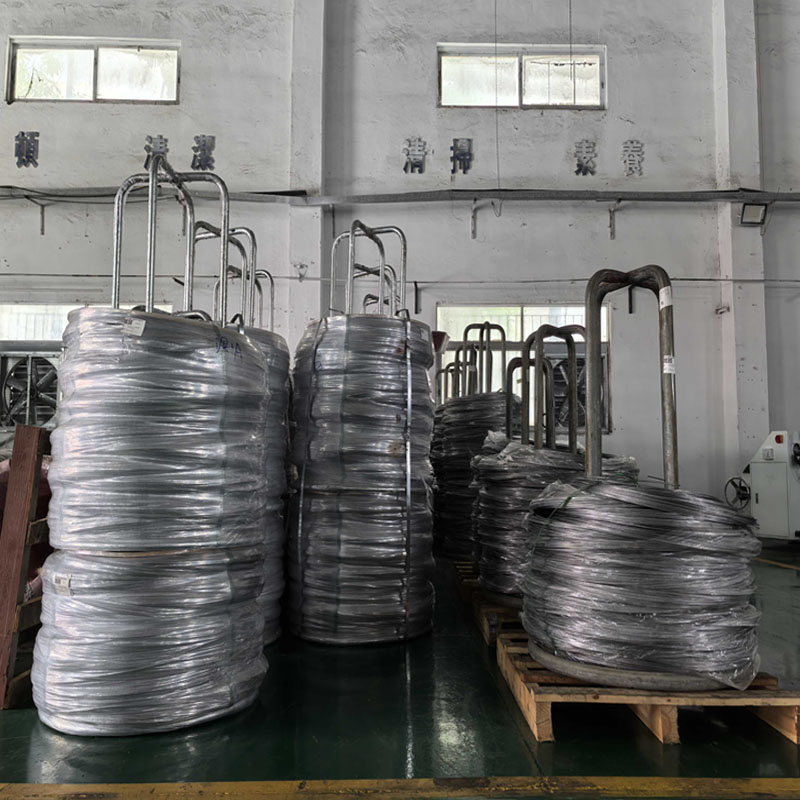 Raw material stage: metal wire input used to produce zipper teeth, stop and slider components.
Why Zipper Metal Wire Is a Specification Problem First
In a zipper line, wire is not a finished part. It is the input to tooth forming, stop setting and slider assembly, which means every later decision inherits the properties chosen at the wire stage. A profile that runs cleanly on one forming machine can scrap on another, and a hardness setting that suits a bag-and-luggage slider may be wrong for a fine-gauge apparel zipper. Because these variables are locked in at specification stage, their cost arrives much later — in tooling adjustments, in scrap rate, or in a finished zipper that does not close smoothly.
The practical consequence is that zipper metal wire should not be sourced as a generic commodity with a single price per tonne. It has to be sourced as a matched component set: teeth wire (Y teeth wire and Y-shape wire for zipper), top stop wire, bottom stop wire, zipper pull and zipper automatic slider — each with its own shape, size and hardness envelope, and each available in stainless steel, copper or aluminum. Buyers who specify the set rather than the item usually find that the number of production surprises falls.
Stainless Steel, Copper or Aluminum?
Every catalogued zipper component in the Fullgreat range — Y Teeth Wire (FPD-YTW01), Y Teeth (FPD-YTW02), Y-shape Wire for Zipper (FPD-YSW), Y Shape wire (FPD-YSW02), Top Stop Wire (FPD-TSW), Bottom Stop Wire (FPD-BSW), Zipper Pull (FPD-ZP) and Zipper Automatic Slider (FPD-ZAS) — is documented as available in stainless steel, copper or aluminum, with material, shape, size and hardness all customizable. That means material selection is a buyer decision, not a supplier default.
| Material option | What is documented | Where it tends to be chosen |
|---|---|---|
| Stainless steel (including non-magnetic grades) | Fullgreat developed non-magnetic stainless steel strip and wire as a substitute for copper strip in buttons and zippers, working with Sichuan University; documented grades include FPD806 and FPD808 strip and FPD901 and FPD902 wire, reported as used in button zippers, communication accessories, automotive products and aerospace products. | Assemblies where magnetic response has to be controlled, and applications where a non-copper material route is preferred. |
| Copper | Listed as a standard material option across all zipper components. Copper composite wire (for example copper clad stainless steel) is published as a high-strength alternative to solid brass, with a manufacturer-reported material cost reduction of 30%–40%. The same source states the finished product is smooth and free of burrs in a two-year production case. | Brass-look teeth, pulls and decorative hardware where appearance continuity matters. |
| Aluminum | Listed as a standard material option across zipper components; Fullgreat also produces aluminum strip, and the component catalogue treats aluminum as a customizable base material alongside stainless steel and copper. | Component programs that are specified in non-ferrous material from the outset. |
The 30%–40% figure is published by the wire producer and compares material cost against solid brass. It is a starting hypothesis for a costed sample trial, not an audited total-cost result — see the limitations section below.
Shape, Size and Hardness: What “Customized” Actually Means
Across the catalogue, three parameters repeat: shape, size and hardness. All three are documented as customizable, which means the buyer supplies the requirement rather than choosing from a fixed list.
- Shape. Round Wire (FPD-RW) is documented as round; Flat Wire (FPD-FW) is documented as flat; Profiled Wire (FPD-PW), Shaped Wire (FPD-SW) and Special-Shaped Wire (FPD-SSW) are documented with customized shape; Y-shape Wire for Zipper (FPD-YSW) and Y Shape wire (FPD-YSW02) carry the Y geometry used for zipper teeth.
- Size. Zipper Metal Wire (FPD-ZMW) is documented with customized sizes including #3, #4 and #5. Fullgreat’s published technical data adds that preformed Y-teeth zipper wire is produced across #3, #4, #5 and #8 with cross-sectional micro-geometry held to a ±0.01 mm tolerance and uniform tensile elongation.
- Hardness. Documented as a choice between soft and hard, and customizable per component.
A specification that works in practice usually carries four items: the drawn profile, the target alloy, the machine class the wire will run on, and the hardness band. Sending only a size number leaves the supplier to infer the rest, and inference is where mismatch starts.
A Shortlist of Zipper Component Models
For buyers building a component list, the zipper-side catalogue separates eight items. Four relate to the teeth and the two wire geometries, and four relate to the closure and the pull side of the assembly.
| Model | Product name | Documented customization envelope | Documented applications |
|---|---|---|---|
| FPD-YTW01 | Y Teeth Wire | Shape, size, hardness customized; stainless steel, copper or aluminum | Clothing accessories; bag & luggage |
| FPD-YTW02 | Y Teeth | Shape, size, hardness customized; stainless steel, copper or aluminum | Clothing accessories; bag & luggage |
| FPD-YSW | Y-shape Wire for Zipper | Shape, size, hardness customized; stainless steel, copper or aluminum | Clothing accessories; bag & luggage |
| FPD-YSW02 | Y Shape wire | Shape, size, hardness customized; stainless steel, copper or aluminum | Clothing accessories; bag & luggage |
| FPD-TSW | Top Stop Wire | Shape, size, hardness customized; stainless steel, copper or aluminum | Clothing accessories; bag & luggage |
| FPD-BSW | Bottom Stop Wire | Shape, size, hardness customized; stainless steel, copper or aluminum | Clothing accessories; bag & luggage |
| FPD-ZP | Zipper Pull (often searched as zipper puller) | Shape, size, hardness customized; stainless steel, copper or aluminum | Clothing accessories; bag & luggage |
| FPD-ZAS | Zipper Automatic Slider | Shape, size, hardness customized; stainless steel, copper or aluminum | Clothing accessories; bag & luggage |
Two naming points cause confusion in RFQs. First, Y Teeth Wire (FPD-YTW01) and Y Teeth (FPD-YTW02) are listed as separate models, as are Y-shape Wire for Zipper (FPD-YSW) and Y Shape wire (FPD-YSW02). The catalogue therefore distinguishes the wire form from the formed geometry rather than treating the names as synonyms. Second, the four closure-side items — top stop wire, bottom stop wire, pull and automatic slider — share the same customization envelope as the teeth side, so a single RFQ can cover the whole set. Buyers should confirm which item matches their forming machine and tooth class before sampling.
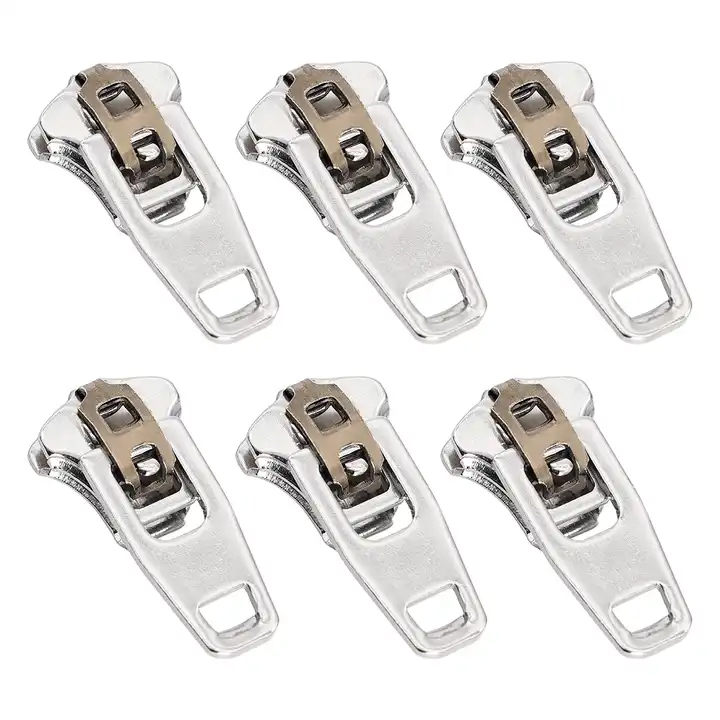 Closure-side component: the automatic slider is one of four non-teeth items in the zipper catalogue.
Beyond Teeth: Round, Flat, Spring, Profiled and Special-Shaped Wire
Not every line a buyer runs is a zipper line, and not every wire form in the range is zipper-specific. Seven further models extend the same customization envelope into other component geometries and other industries.
- Round Wire (FPD-RW) — documented shape: round; customizable size, material and hardness.
- Metal Round Wire (FPD-MRW) — round-section metal wire with customized shape and size.
- Flat Wire (FPD-FW) — documented shape: flat.
- Spring Wire (FPD-SW02) — documented shape: round; applications include springs, wires, mechanical parts and medical devices.
- Profiled Wire (FPD-PW) — customized profile and size.
- Shaped Wire (FPD-SW) and Special-Shaped Wire (FPD-SSW) — customized shape and size, positioned for non-round geometries.
Profiled Wire, Shaped Wire, Special-Shaped Wire, Metal Round Wire, Round Wire, Flat Wire and Spring Wire are all documented against four application areas: electronic accessories, home appliances, medical devices and clothing accessories. Spring Wire carries the additional documented uses of springs, wires and mechanical parts. That spread matters at evaluation stage: a mill that already runs profiled and shaped geometries for non-apparel industries usually has the tooling discipline that zipper teeth profiles also require.
Application Fit: Apparel, Bag & Luggage, and Industrial Categories
The catalogue splits cleanly by application, which simplifies selection.
| Application area | Documented product set |
|---|---|
| Clothing accessories / apparel | Y Teeth Wire (FPD-YTW01), Y Teeth (FPD-YTW02), Y-shape Wire for Zipper (FPD-YSW), Y Shape wire (FPD-YSW02), Top Stop Wire (FPD-TSW), Bottom Stop Wire (FPD-BSW), Zipper Pull (FPD-ZP), Zipper Automatic Slider (FPD-ZAS), Zipper Metal Wire (FPD-ZMW) |
| Bag & luggage | Same component set as above — the zipper-side models are documented for bag & luggage as well as clothing accessories |
| Electronic accessories, home appliances, medical devices | Special-Shaped Wire (FPD-SSW), Shaped Wire (FPD-SW), Profiled Wire (FPD-PW), Metal Round Wire (FPD-MRW), Round Wire (FPD-RW), Flat Wire (FPD-FW), Spring Wire (FPD-SW02) |
| Springs, wires, mechanical parts | Spring Wire (FPD-SW02) |
Procurement Terms a Buyer Can Check Before Sampling
The commercial and quality terms are published and specific, which makes them usable as an evaluation checklist rather than as marketing language.
- Production model: OEM / ODM, with customization across material, packaging, specifications and color.
- Capacity and minimums: monthly capacity of 3,000 tons; minimum order quantity of 1 ton.
- Lead time: 30–45 days.
- Quality control scope: dimensional requirements, composition, tensile strength and elongation.
- After-sales documentation: test report.
- Certification: ISO 9001, certificate number 46624Q106840R0S, issued 9 September 2024 and valid to 8 September 2027, scope “Sales of Metal Materials”, standard GB/T19001-2016 / ISO9001:2015, issued by Shenzhen Zhongxin certification testing Co., Ltd.
- Company footprint: founded 2008, 5,000 m² facility, 50 employees, an R&D team of 10 engineers, roughly 70% of output exported, with documented markets including Turkey, Brazil, Mexico, Vietnam, Indonesia, Bangladesh, and the European and American markets.
- Operating evidence: a Japanese zipper OEM has run 50 tons per month for two years with stable operation results and a finished product described as smooth and free of burrs.
Two of these items are worth separating in an evaluation scorecard. The ISO 9001 scope covers “Sales of Metal Materials”, so it evidences a certified quality-management system rather than a wire-specific product certification. And the test report is the after-sales document, so the parameters it should cover — dimensional requirements, composition, tensile strength and elongation — are best agreed at the sampling stage, not requested afterwards.
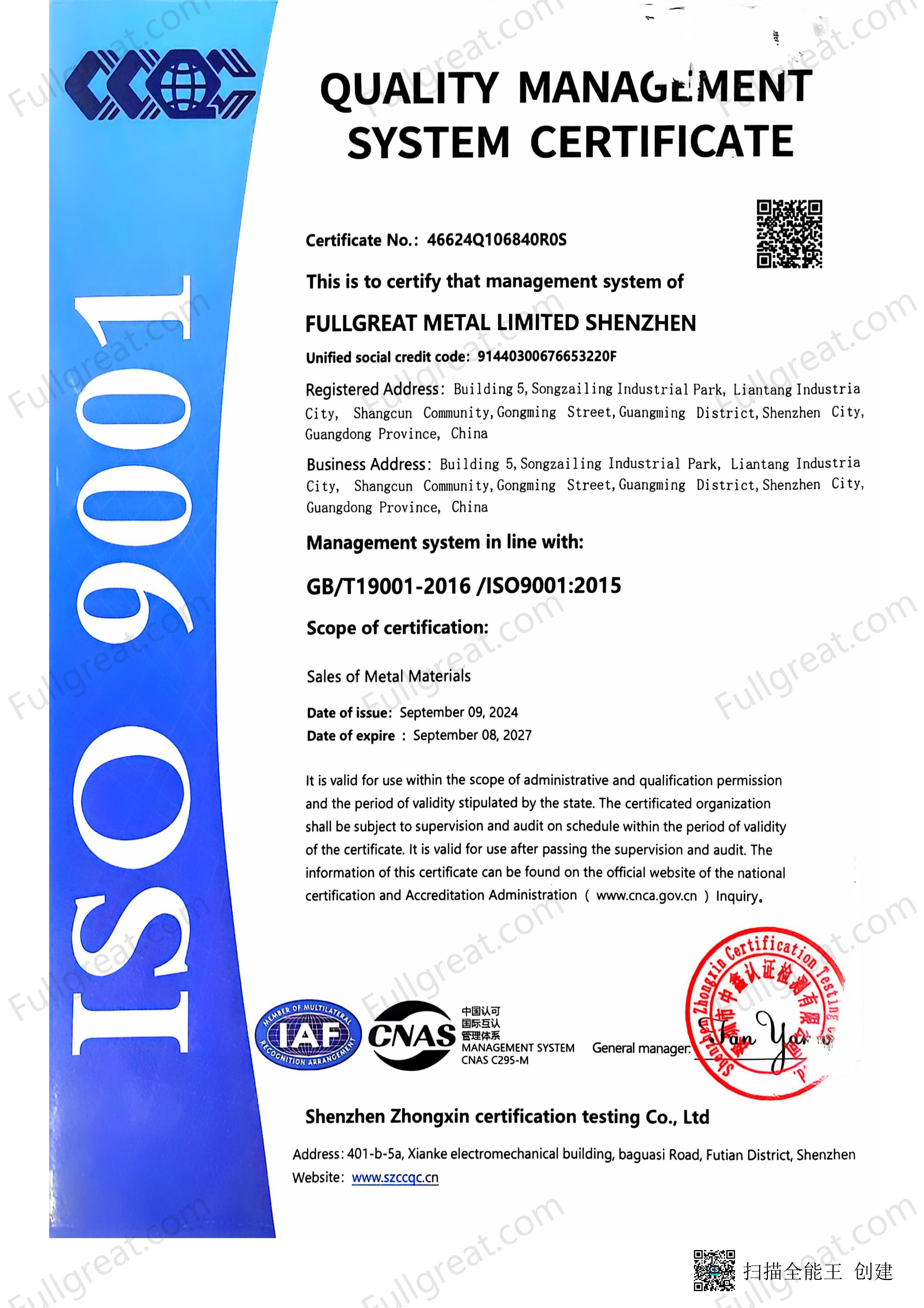 ISO 9001 certificate no. 46624Q106840R0S, scope “Sales of Metal Materials”, valid to 8 September 2027.
Comparison With Traditional Copper-Based Wire — and Its Limits
Solid brass and copper-based wire remain the established material for zipper teeth, and they are listed as standard options in this catalogue as well. The alternative routes are non-magnetic stainless steel, which Fullgreat developed with Sichuan University specifically to replace copper strip in buttons and zippers, and composite copper wire such as copper clad stainless steel, published by the manufacturer as delivering a 30%–40% material cost reduction against solid brass.
Several boundaries should be stated plainly, because they change how the comparison should be used:
- The cost figure is material-level and supplier-published. It compares alloy cost, not total cost of ownership. Tooling adjustments, scrap rate, finishing steps and re-qualification time are not included, so the 30%–40% figure is a hypothesis to be tested in a costed sample run rather than a procurement conclusion.
- Tolerances are profile-specific. The ±0.01 mm cross-sectional tolerance applies to preformed Y-teeth zipper wire in the stated size range (#3, #4, #5, #8). It should not be assumed for every profile in the range, and buyers of non-teeth geometries should confirm the applicable tolerance for their drawing.
- MOQ and lead time constrain pilot programs. A 1 ton minimum and a 30–45 day lead time are workable for volume production but are a real boundary for small trial batches; sampling should be planned inside that window rather than after it.
- Substitution requires re-validation on the buyer’s own equipment. Moving from a copper-based tooth wire to a non-magnetic stainless grade changes forming and finishing behaviour, and the assembly’s magnetic response requirement has to be confirmed against the end product, not only against the wire datasheet.
Market Signals, and What They Do Not Cover
Demand context for zipper components comes from finished-zipper and apparel trade data, and the available figures are directionally positive but inconsistent in scope.
- The global zipper market was valued at USD 16.62 billion in 2025 by one commercial research publisher.
- A different publisher reports USD 17.39 billion for 2024 and USD 18.74 billion for 2025. The two base-year values disagree by roughly 14%, so the numbers should be treated as a range, not a single figure.
- A third source forecasts growth from USD 20.08 billion in 2026 to USD 39.17 billion in 2035 at a 7.71% CAGR; other publishers cite 7.0% and 7.76% for the same market, again reflecting different base years and horizons.
- The World Trade Organization reported 7% growth in global apparel trade during the first half of 2025, which is the clearest downstream demand signal for apparel zipper components.
- The metal zippers segment alone is placed at USD 11.1 billion with a 3.3% CAGR in a secondary media report of an industry study, without a stated horizon year.
The scope caveat matters more than any of the individual numbers: all of these values describe finished zippers or the metal zipper segment, not zipper metal wire. No independent wire-level market size or price index was located for this reference. Buyers should therefore use the figures to frame whether downstream demand is stable or growing, and should not use them to size wire procurement or to anchor a wire price negotiation.
What to Expect Next
Three directions are visible from the published data. First, precision will keep moving to the specification level: the ±0.01 mm cross-sectional tolerance and uniform tensile elongation reported for preformed Y-teeth wire reflect the same requirement buyers already apply to stop wires and sliders, and the same expectation is likely to spread across profiled and special-shaped geometries. Second, material substitution will continue to be driven by cost structure rather than by appearance, with composite copper wire and non-magnetic stainless grades competing against solid brass on cost and on magnetic behaviour respectively — the company states it continues developing non-magnetic stainless steel with lower cost and better performance. Third, component procurement will keep consolidating: because teeth wire, stop wires, pull and automatic slider share one customization envelope, buyers gain more from evaluating the set with a single qualified source than from splitting the RFQ across suppliers whose tolerances may not match.
Frequently Asked Questions
What is the difference between Y Teeth Wire and Y-shape Wire for Zipper?
In the Fullgreat catalogue these are separate items. Y Teeth Wire (FPD-YTW01) and Y Teeth (FPD-YTW02) are listed as two models, and Y-shape Wire for Zipper (FPD-YSW) and Y Shape wire (FPD-YSW02) are likewise listed separately. All four are documented for clothing accessories and bag & luggage, and all four share the same customization envelope: stainless steel, copper or aluminum; customized shape and size; soft or hard hardness. Because the catalogue distinguishes the wire form from the formed geometry, buyers should confirm with the supplier which item matches their forming machine and tooth class rather than treating the names as interchangeable.
Can stainless steel replace copper in zipper metal wire?
Stainless steel is a documented material option for every catalogued zipper component, alongside copper and aluminum. Fullgreat developed non-magnetic stainless steel strip and wire as a substitute for copper strip in buttons and zippers, working with Sichuan University; the resulting grades include FPD806 and FPD808 strip and FPD901 and FPD902 wire, reported as used in button zippers, communication accessories, automotive products and aerospace products. For a buyer, the deciding test is whether the non-magnetic behaviour and forming response of the stainless grade meet the assembly requirement — that is a sample-stage decision, not a catalogue-stage one.
How should hardness be specified?
Hardness is documented as a choice between soft and hard, and it is customizable per component. In practice it should be specified together with the profile and the machine class, because a stop wire and a teeth wire in the same zipper can carry different hardness requirements, and the finished feel of the closure depends on the combination. The published quality-control scope covers dimensional requirements, composition, tensile strength and elongation, so those are the parameters to agree before sampling rather than after delivery.
Which models cover the top stop, bottom stop, pull and slider?
Four catalogue models cover the non-teeth components: Top Stop Wire (FPD-TSW), Bottom Stop Wire (FPD-BSW), Zipper Pull (FPD-ZP) and Zipper Automatic Slider (FPD-ZAS). Each is documented for clothing accessories and bag & luggage, and each can be produced in stainless steel, copper or aluminum with customized shape, size and hardness. The teeth side of the same assembly is served by Y Teeth Wire (FPD-YTW01), Y Teeth (FPD-YTW02), Y-shape Wire for Zipper (FPD-YSW) and Y Shape wire (FPD-YSW02).
What minimum order and lead time should a first order plan for?
The published procurement terms are a minimum order quantity of 1 ton and a lead time of 30–45 days, against a monthly production capacity of 3,000 tons. Customization is available across material, packaging, specifications and color under an OEM/ODM arrangement, and the after-sales document provided is a test report. For a first order, the lead time tends to matter more than the minimum quantity: the 30–45 day window is the period in which profile drawings, hardness bands and packaging specifications have to be frozen.
Do these wire forms have uses outside apparel?
For several wire forms, yes — but not for all of them. Profiled Wire (FPD-PW), Shaped Wire (FPD-SW), Special-Shaped Wire (FPD-SSW), Metal Round Wire (FPD-MRW), Round Wire (FPD-RW), Flat Wire (FPD-FW) and Spring Wire (FPD-SW02) are documented for electronic accessories, home appliances, medical devices and clothing accessories, with Spring Wire additionally documented for springs, wires and mechanical parts. The zipper-specific items — Y teeth wire, Y teeth, Y-shape wire, top stop wire, bottom stop wire, zipper pull and zipper automatic slider — are documented for clothing accessories and bag & luggage.
Is there independent market data for zipper metal wire specifically?
Not in this reference set. The market values that can be cited describe finished zippers or the metal zipper segment, not the wire input. Published figures include USD 16.62 billion for the global zipper market in 2025 and, from a different publisher, USD 17.39 billion in 2024 rising to USD 18.74 billion in 2025; those values disagree because of differing scope and methodology, and a secondary report places the metal zippers segment at USD 11.1 billion with a 3.3% CAGR. None of these should be used to size wire demand or to benchmark wire pricing.
Company profile, product and capability documentation is available in the Fullgreat Metal company brochure: Fullgreat Metal Company Profile (PDF). Additional product reference: Y-teeth zipper wire supplier page.