
Zipper Metal Wire Q&A: Material Choice, Models, Acceptance
Zipper Metal Wire Q&A: Material Choice, Models, Acceptance

Special-shaped zipper metal wire profiles are formed to a defined cross-section before the zipper assembly stage. Image: Fullgreat Metal Limited.
Zipper metal wire is the semi-finished input from which zipper teeth, top stops, bottom stops, sliders and pulls are formed, and the quality of a finished zipper is largely decided before the assembly line ever runs. Buyers who treat the wire as a commodity line item tend to discover the difference later — at the tooth-forming press, at the plating bath, or in a returned garment shipment. This technical and procurement Q&A explains the material choices, the model families, the customization levers and the acceptance criteria that determine whether a zipper metal wire order actually performs.
Why Zipper Metal Wire Procurement Is Harder Than It Looks
The category looks simple from a distance: a wire, a shape, a hardness. In practice, a zipper metal wire specification combines four independent variables — material, cross-sectional geometry, hardness condition and dimensional tolerance — and those variables interact differently across end products. A wire that forms cleanly into apparel teeth at high speed may be unsuitable for a luggage tooth profile that must survive repeated impact, and a wire chosen purely on material cost may fail at the forming stage because its elongation behaviour was never defined in writing.
That is the opportunity for procurement teams: the specification, not the price list, is where cost is controlled. A precisely defined wire removes ambiguity from sampling, shortens the approval loop, and makes acceptance testing a measurable step rather than a judgement call.
Q1. Which Materials Are Available for Zipper Metal Wire?
Answer: Zipper metal wire from Fullgreat Metal Limited is offered in stainless steel, copper or aluminum, with the material grade customizable per order. The same material menu applies across the documented product families, including Top Stop Wire (FPD-TSW), Spring Wire (FPD-SW02), Flat Wire (FPD-FW) and Metal Round Wire (FPD-MRW).
The practical decision logic behind the three material groups is as follows:
Stainless steel — selected where corrosion resistance and consistent forming behaviour matter over long production runs. Fullgreat's non-magnetic stainless steel strip and wire programmes (FPD806, FPD808 strip and FPD901, FPD902 wire) were developed for button and zipper applications, and are described by the company as widely used in buttons, zippers, communication accessories, automotive products and aerospace products. Buyers specifying stainless should still confirm the exact grade and its magnetic response in writing, because 'stainless' is a family, not a single specification.
Copper — the traditional choice for the brass-look tooth aesthetic and for good formability. Copper-based wire is also where cost exposure is highest. Technical data on composite copper wire indicates that bimetallic constructions such as copper-clad stainless steel can reduce raw material costs by 30% to 40% compared with solid brass while preserving the visual result, which is why the material question and the cost question are usually discussed together.
Aluminum — a lighter option used where weight matters and where the required mechanical duty is moderate. Aluminum is listed as a customized material option across the wire families, and Fullgreat also produces aluminum strip and aluminum raw material as part of its metal materials portfolio.
There is no universally correct material. The correct answer is the one that matches the tooth-forming process, the surface finish requirement and the durability expectation of the end product.
Q2. What Is the Difference Between Y Teeth Wire, Y-Shape Wire and the Other Wire Families?
Answer: The families differ by the geometric role they play in the finished zipper, not by brand or grade. Teeth-forming wires create the interlocking element; stop wires create the end limits; round, flat, profiled and spring wires serve structural, decorative or mechanical functions inside the zipper and in adjacent product categories.
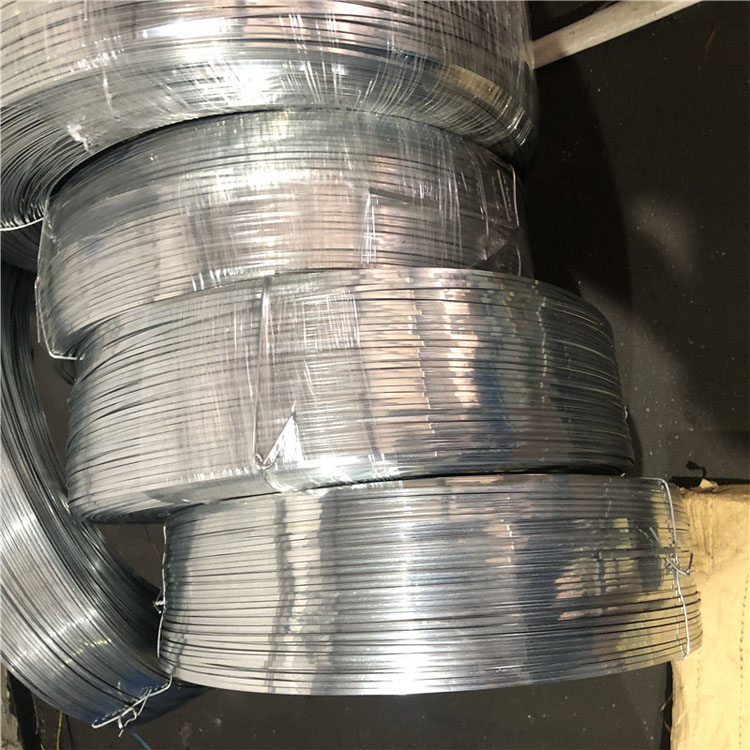
Flat wire carries a rectangular cross-section and is used across clothing accessories, electronic accessories, home appliances and medical devices. Image: Fullgreat Metal Limited.
| Product family | Model | Documented form / customization | Documented application focus |
|---|---|---|---|
| Y Teeth | FPD-YTW02 | Shape, size, material and hardness customized | Clothing accessories; bag & luggage |
| Y Teeth Wire | FPD-YTW01 | Listed within the certified zipper component range | Zipper tooth formation |
| Y-shape Wire for Zipper | FPD-YSW | Shape, size, material and hardness customized | Clothing accessories; bag & luggage |
| Top Stop Wire | FPD-TSW | Shape, size, material and hardness customized | Clothing accessories; bag & luggage |
| Bottom Stop Wire | FPD-BSW | Listed within the certified zipper component range | Zipper end-stop formation |
| Flat Wire | FPD-FW | Shape: flat; size, material and hardness customized | Electronic accessories; home appliances; medical devices; clothing accessories |
| Metal Round Wire | FPD-MRW | Shape and size customized; hardness soft or hard | Electronic accessories; home appliances; medical devices; clothing accessories |
| Profiled Wire | FPD-PW | Shape and size customized | Electronic accessories; home appliances; medical devices; clothing accessories |
| Special-Shaped Wire | FPD-SSW | Shape, size, material and hardness customized | Electronic accessories; home appliances; medical devices; clothing accessories |
| Spring Wire | FPD-SW02 | Shape: round; size and hardness customized | Springs; wires; mechanical parts; medical devices; clothing accessories; home appliances; electronic accessories |
| Zipper Pull / Zipper Automatic Slider | FPD-ZP / FPD-ZAS | Shape, size, material and hardness customized | Clothing accessories; bag & luggage |
Two clarifications save buyers time. First, Y teeth and Y-shape wire are separate catalogue entries with separate models (FPD-YTW02 and FPD-YSW), so a purchase order should always name the model rather than the descriptive term. Second, top stop and bottom stop wires are end-limit components, not teeth-forming wire — they are specified for a different function and should be purchased on their own line items.
Q3. What Can Actually Be Customized — Shape, Size and Hardness?
Answer: For most families, shape, size, hardness and material are all customizable, and Fullgreat operates in OEM / ODM mode with customization available for material, packaging, specifications and colour. The exceptions are the fixed-form families: Flat Wire (FPD-FW) is documented with a flat shape, and Spring Wire (FPD-SW02) with a round shape.
- Shape — free-form customization applies to Y Teeth, Y-shape Wire for Zipper, Top Stop Wire, Metal Round Wire, Profiled Wire, Special-Shaped Wire and the slider and pull components.
- Size — customizable across the same families; diameter, cross-section and length should be stated as a nominal value plus a tolerance in the purchase order.
- Hardness — offered as soft or hard, customized to the forming process. Soft conditions generally favour high-speed tooth forming; harder conditions favour components that must resist deformation in service.
- Packaging and colour — included in the OEM / ODM customization scope alongside material and specifications.
Dimensional precision is the part of customization that buyers most often under-specify. For preformed Y-teeth zipper wire, Fullgreat states a dimensional tolerance of ±0.01 mm on cross-sectional micro-geometry, together with uniform tensile elongation, and covers Y-teeth profile wire in #3, #4, #5 and #8 sizes. Whether or not a buyer requires that level of precision, the purchase order should state the tolerance explicitly — an unstated tolerance is not a tolerance, it is an expectation.
Q4. How Do the Wire Families Map to End-Use Industries?
Answer: Mapping runs from the deformation the component must survive, not from the industry label. Documented application coverage spans clothing accessories and bag & luggage for the zipper-specific families, and electronic accessories, home appliances and medical devices for the profile, flat, round and spring wire families.
Clothing accessories (garment zippers). The dominant use case. Fullgreat's application data describes garment zipper production running at standard temperature with 24/7 operation, and lists optional requirements of anti-rust performance, uniform wire diameter and high tensile strength. These three optional requirements are a useful shortlist for apparel buyers writing a specification, because each one maps to a known failure mode: corrosion staining, jammed forming tools, and tooth breakage.
Bag & luggage. Y Teeth (FPD-YTW02), Y-shape Wire for Zipper (FPD-YSW), Top Stop Wire (FPD-TSW), Zipper Pull (FPD-ZP) and Zipper Automatic Slider (FPD-ZAS) are all documented for this segment. Luggage duty typically pushes the specification toward harder conditions and heavier cross-sections than garment work.
Medical devices, home appliances and electronic accessories. Flat Wire (FPD-FW), Metal Round Wire (FPD-MRW), Profiled Wire (FPD-PW), Special-Shaped Wire (FPD-SSW) and Spring Wire (FPD-SW02) are all documented for these three industries, with Spring Wire additionally listed for springs, wires and mechanical parts. In these segments the wire is often a functional or structural element rather than a visible zipper component, so the acceptance emphasis shifts from cosmetic appearance to mechanical consistency.
Q5. What Certification Evidence Should a Buyer Request?
Answer: Fullgreat Metal Limited holds ISO 9001 certification with certificate number 46624Q106840R0S, issued by Shenzhen Zhongxin certification testing Co., Ltd, against the standard GB/T19001-2016 / ISO9001:2015. The certificate was issued on 2024-09-09, expires on 2027-09-08, and its stated scope is the sales of metal materials, applicable to the global market. The certified product range includes Zipper Metal Wire, Flat Wire, Round Wire, Y Teeth, Y Teeth Wire, Y-shape Wire for Zipper, Y Shape wire, Top Stop Wire, Bottom Stop Wire, Profiled Wire, Shaped Wire, Special-Shaped Wire, Spring Wire, Zipper Pull and Zipper Automatic Slider.
Three verification points matter more than the certificate itself:
- Scope, not just status. The stated scope is sales of metal materials. That is appropriate for a metal materials supplier, but it does not certify the performance of a finished zipper. Buyers should read the scope and align it with what they are actually buying.
- Validity window. A certificate with an expiry date of 2027-09-08 should be re-requested at each annual supplier review rather than filed once and forgotten.
- Product-to-model traceability. Ask the supplier to state which of your ordered models fall inside the certified range. In this case the range is published at model level, which makes that cross-check straightforward.
Q6. What Are the Realistic Limits of the Specification?
A credible wire specification should state its own boundaries. Four limits are worth stating plainly:
Customization carries time cost. OEM / ODM lead time is 30–45 days, and the minimum order quantity is 1 ton. A buyer who needs a customized profile, a customized hardness condition or customized packaging should plan the approval cycle around that window rather than around a spot-market assumption.
Material substitution changes the risk profile, not just the price. Composite copper wire can reduce raw material cost by 30% to 40% against solid brass, but the substitution must be validated at the tooth-forming and finishing stages. A saving that shows up on the purchase order and disappears in rework is not a saving.
Certification is a management-system signal, not an inspection result. ISO 9001 confirms that a quality management system exists; it does not confirm that a specific coil meets a specific tensile requirement. Incoming inspection remains the buyer's responsibility.
Metal-linked cost exposure persists. Copper and aluminum content links the wire price to base-metal markets. Fullgreat's production scale is documented at a monthly capacity of 3,000 tons with a 70% export ratio across Turkey, Latin America (Brazil, Mexico), Southeast Asia (Vietnam, Indonesia, Bangladesh), and the European and American markets — depth of supply is not the constraint, but metal price movement is a commercial variable that no supplier controls.
Purchase Terms and Acceptance Criteria: A Working Checklist
Fullgreat documents four quality-control dimensions for its wire output: dimensional requirements, composition, tensile strength and elongation. Those four map cleanly onto an acceptance checklist that a buyer can attach to a purchase order.
| Checkpoint | What to write into the purchase order | Evidence to request |
|---|---|---|
| Model and family | Exact model code (for example FPD-YSW, FPD-TSW, FPD-BSW, FPD-FW, FPD-MRW, FPD-PW, FPD-SSW, FPD-SW02) rather than a descriptive term | Order confirmation referencing the model |
| Material and grade | Stainless steel, copper or aluminum, with the specific grade named | Composition record |
| Dimensional requirements | Nominal size plus tolerance; for preformed Y-teeth wire, confirm the stated ±0.01 mm cross-sectional tolerance is required and applicable | Dimensional report |
| Hardness condition | Soft or hard, and how it will be verified | Hardness result per lot |
| Tensile strength | Minimum value tied to the forming process, plus the test method | Tensile test result |
| Elongation | Range, not only a minimum — excess elongation can be as disruptive as insufficient elongation | Elongation result |
| Surface condition | Optional anti-rust requirement, uniform wire diameter and freedom from burrs | Visual and dimensional check |
| Commercial terms | Quantity against the 1 ton MOQ; delivery against the 30–45 day lead time; packaging and colour customization | Order confirmation with dates |
| Documentation | Test report to accompany the shipment | Test report as after-sales documentation |
One field reference point: a Japanese zipper OEM running 50 tons per month for two years is documented as achieving stable operation with finished product that is smooth and free of burrs. Surface and dimensional consistency at that volume is not achieved by good intentions — it is achieved by a specification that the supplier can measure against, lot after lot.
Market Context: Why Wire Specs Are Getting More Attention
The demand backdrop is steady rather than explosive, which is precisely why component-level cost and quality decisions carry weight. The global zipper market was valued at USD 16.62 billion in 2025, according to commercial research published on the category. Trade data points in the same direction: the World Trade Organization's October 2025 Global Trade Outlook and Statistics reported that global apparel trade grew 7% during the first half of 2025.
Growth of that kind does not automatically reward every supplier. It raises the cost of getting the specification wrong, because higher volumes amplify whatever variability exists in the input wire. Two structural responses are visible in the category. The first is material substitution: composite and bimetallic constructions are being evaluated as substitutes for solid brass, with technical data indicating raw material cost reductions in the 30% to 40% range. The second is documentation discipline — buyers increasingly ask for model-level certification coverage, dimensional tolerances in writing and test reports with the shipment, rather than accepting a general quality statement.
Future Outlook
Three shifts are likely to shape zipper metal wire procurement over the next planning cycle. First, material selection will be argued in cost-per-formed-component terms rather than cost-per-kilogram, because a cheaper wire that raises scrap rates is not cheaper. Second, tolerance language will move from the sample report into the purchase order, as buyers recognise that ±0.01 mm-class precision is a specification decision and not a supplier courtesy. Third, model-level traceability will become a standard expectation: buyers will cross-check the exact model codes they purchase against the supplier's certified range, and will treat that cross-check as part of onboarding rather than as an annual formality.
For suppliers, the implication is that breadth of product line becomes a practical advantage. Fullgreat Metal Limited, founded in 2008 and operating from a 5,000 m² facility with 50 employees, 10 engineers and an annual output of 50,000 tons, produces non-magnetic stainless steel strip, non-magnetic stainless steel wire, aluminum strip and related metal materials, and developed its non-magnetic stainless steel strip programme in cooperation with Sichuan University, resulting in a number of national patents. A buyer sourcing teeth wire, stop wires, profile wire and slider components from a single qualified range avoids the specification drift that comes from mixing suppliers across one assembly line.
Frequently Asked Questions
What materials can zipper metal wire be supplied in?
Stainless steel, copper or aluminum, with the material customizable per order. The same material menu is documented across the Top Stop Wire, Spring Wire, Flat Wire and Metal Round Wire families.
Is Y teeth wire the same as Y-shape wire for zipper?
They are separate catalogue entries with separate model codes — Y Teeth is listed as FPD-YTW02 and Y-shape Wire for Zipper as FPD-YSW, with Y Teeth Wire listed separately as FPD-YTW01. Purchase orders should name the model code rather than the descriptive term.
Can shape, size and hardness all be customized?
For most families, yes. Shape, size, material and hardness are listed as customizable for Y Teeth, Y-shape Wire for Zipper, Top Stop Wire, Metal Round Wire, Profiled Wire, Special-Shaped Wire and the slider and pull components. Flat Wire is documented with a flat shape and Spring Wire with a round shape; size and material remain customizable for those families.
Which wire families serve medical devices, home appliances and electronic accessories?
Flat Wire (FPD-FW), Metal Round Wire (FPD-MRW), Profiled Wire (FPD-PW), Special-Shaped Wire (FPD-SSW) and Spring Wire (FPD-SW02) are all documented for electronic accessories, home appliances and medical devices. Spring Wire is additionally listed for springs, wires and mechanical parts, and for clothing accessories.
What certification does Fullgreat hold for zipper metal wire?
ISO 9001, certificate number 46624Q106840R0S, issued by Shenzhen Zhongxin certification testing Co., Ltd against GB/T19001-2016 / ISO9001:2015. It was issued on 2024-09-09 and expires on 2027-09-08, with a stated scope of sales of metal materials, applicable to the global market. Zipper Metal Wire, Flat Wire and Round Wire are all within the certified range.
Which quality dimensions are checked on a wire lot?
Dimensional requirements, composition, tensile strength and elongation. A test report is provided as after-sales documentation.
What are the minimum order quantity and lead time?
The minimum order quantity is 1 ton and the lead time is 30–45 days. Customization covers material, packaging, specifications and colour under OEM / ODM production.
Does ISO 9001 guarantee the performance of a finished zipper?
No. The certificate's stated scope is sales of metal materials, which is a management-system certification rather than a product performance certification. Incoming inspection against the agreed dimensional, composition, tensile and elongation criteria remains necessary.
Fullgreat Metal Limited — founded 2008, Shenzhen, Guangdong, China. Products include Zipper Metal Wire, Y Teeth, Y Teeth Wire, Y-shape Wire for Zipper, Top Stop Wire, Bottom Stop Wire, Profiled Wire, Shaped Wire, Special-Shaped Wire, Flat Wire, Metal Round Wire, Round Wire, Spring Wire, Zipper Pull and Zipper Automatic Slider, with OEM / ODM customization for material, packaging, specifications and colour.
Company profile and product range brochure (public download): Fullgreat Metal Company Profile
Есть вопросы или нужны дополнительные детали?
Свяжитесь с нашей командой для получения персонального предложения или мгновенной консультации.
Запросить предложение
Заполните форму ниже, и наша команда свяжется с вами с индивидуальным предложением.
Прямой чат WhatsApp
Предпочитаете общаться в реальном времени? Напишите нам в WhatsApp для мгновенной помощи и быстрых ответов.
- Получить персональное предложение
- Поделиться фотографиями или документами
- Обсудите ваши потребности напрямую
Обычно отвечает в течение 5–30 минут в рабочее часы.