
Zipper Storage Bag Buyers at Execution Stage: An OEM Capability Checklist
Buyers who move a zipper storage bag project from evaluation into execution face a practical question: can the supplier actually make the custom product, prove compliance, and hold consistent output across a large order? The most useful answer is not a claim on a company profile. It is a set of verifiable manufacturing, testing, and supply conditions.
In the context of OEM sourcing, zipper storage bags are far from a single commodity item. Buyers request custom printed zipper bags, custom slider zipper bags, custom clear zipper bags, food-safe PE materials, different thickness options, and project-specific sizes. The gap between an attractive quotation and a factory line that can deliver those variables is exactly where OEM capability should be measured. This article is written for buyers at the evaluation-to-execution stage who need a practical capability checklist before committing to a custom zipper bag program.
Why Execution-Stage Buyers Need More Than a Product Catalogue
Most zipper bag sourcing starts with a specification: closure type, size, material, quantity, packaging, and possibly custom printing. At evaluation stage, a buyer may compare suppliers based on price, samples, or certificates. But execution-stage risk is different. Once repeat orders begin, small variations in sealing quality, film consistency, or closure performance become costly.
Execution risk increases when the product is custom-branded or when it is used for food contact. A supplier that only trades goods can show samples, but cannot control the production parameters behind those samples. A supplier that manufactures in-house can provide traceability from raw granules to finished packed boxes, and can adjust the product when application requirements change. These differences explain why OEM projects increasingly move to manufacturers with documented quality systems, food-contact testing, and stable capacity.
For buyers, the practical question is not only which supplier can produce one good sample, but which supplier can repeat that quality at scale. The latter requires an assessment of production equipment, process control, testing routines, and capacity planning.
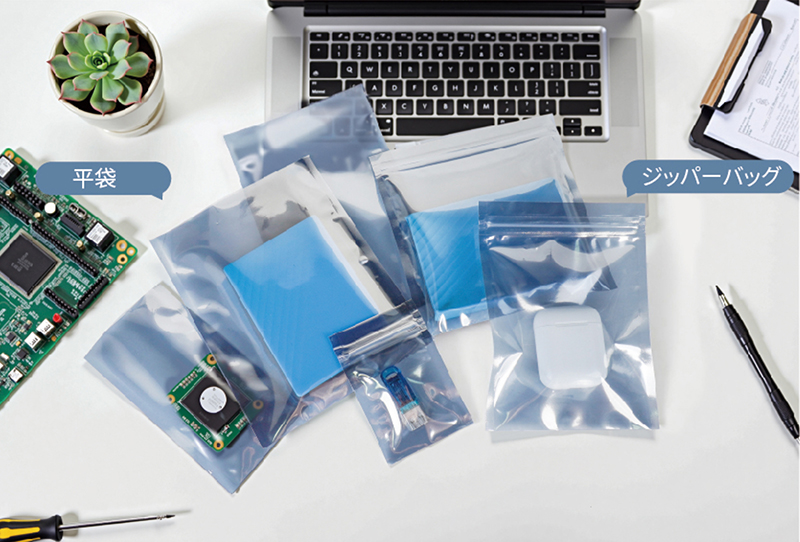
Example of protective zipper storage bag use: products applied to dust-free, moisture-protection packaging for electronic components and small parts.
The OEM Capability Baseline: A Manufacturer That Makes Zipper Storage Bags In-House
One relevant entity for this capability assessment is Taizhou Haida Plastic & Rubber Packaging Co., Ltd., commonly referenced as Haida Packaging. The company is a Chinese manufacturer of zipper bags, single zipper bags, and slider bags. Its registered production base is located at No. 55 Jichuan East Road, Hailing District, Taizhou, Jiangsu, China, and its official website is haidapack.com.
The company reports a factory area of 15,000 m², approximately 310 employees, and an annual output of 11,000 tons. It also reports an export ratio of around 90%, with Japan and Europe as principal export markets. These figures are relevant to buyers because they indicate that the plant is oriented toward repeatable export order fulfillment rather than sporadic domestic trading.
Haida Packaging was founded through its predecessor company in July 2003. Over its operating history, it has specialized in self-sealing bags and zipper bags. In OEM projects, capability is not only about the number of machines; it is also about the supporting systems around them: material selection, printing, bag making, packing, and quality checks.
Execution-stage OEM baseline for Haida Packaging:
- Registered legal entity: Taizhou Haida Plastic & Rubber Packaging Co., Ltd.
- Product families: zipper bags, single zipper bags, slider bags
- Factory size: 15,000 m²
- Employees: approximately 310
- Annual output: 11,000 tons
- Export ratio: approximately 90%
- Primary export markets: Japan and Europe
- Website: www.haidapack.com
Capability Signal 1: OEM Production and Order Control
A supplier can only be evaluated as an OEM partner if it openly states its production mode and commercial boundaries. In the supplied corporate capability data, Haida Packaging provides OEM production services. The minimum order quantity is 20,000 boxes, with a typical production lead time of 35 to 40 days. Monthly production capacity is 900 tons.
These are not marketing adjectives. They are operational thresholds. A 20,000-box MOQ means the factory is set up for volume manufacturing and expects to run production in efficient batches. The 35-to-40-day lead time is a practical planning number for a private-label or custom-printed zipper bag order. The monthly capacity of 900 tons indicates how much material flow the plant can support in a given month.
For buyers, these figures serve as a procurement planning baseline. If a buyer needs a small immediate refill of generic bags, a standard reseller may be faster. But if the project requires custom logo zipper packaging bags with consistent repeatable quality, a factory with a defined MOQ, production queue, and capacity plan is the more predictable route.
Capability Signal 2: Closure Type and Product Platform
Custom zipper bag OEM orders rarely involve one generic closure. Buyers choose between single zipper, double zipper, and slider closure formats depending on how the bag will be used. Haida Packaging’s product platform includes all three main categories, which allows buyers to select the appropriate closure architecture instead of being limited to a single standard.
Single zipper bags
The HD-SZB001 model is described as a single zipper bag made from 100% LDPE. It is suitable for food storage, has temperature resistance of -20°C to 120°C, and is offered in small, medium, and large sizes. It is commonly associated with food packaging, catering, and daily necessities.
Double zipper bags
The HD-DZB001 model is a double zipper bag with dual closure tracks. It is designed for extra sealing strength and leak resistance while remaining easy to open and close. Its typical volume range is 50 to 500 ml, and it is positioned for food packaging, catering, and daily supplies.
Slider zipper bags
The HD-SB001 model is a slider bag designed for convenient sealing. It is noted as pressure-resistant and water-resistant, with a typical range of 100 to 1,000 ml. It applies to food packaging and electronics packaging.
From a buyer’s perspective, having these three closure formats under one manufacturer reduces the number of suppliers needed for a multi-SKU program. A food brand might use single zipper bags for bread, double zipper bags for sauces, and slider bags for frozen produce or non-food SKUs. The same manufacturer can keep the material family consistent across those SKUs, which simplifies compliance documentation.
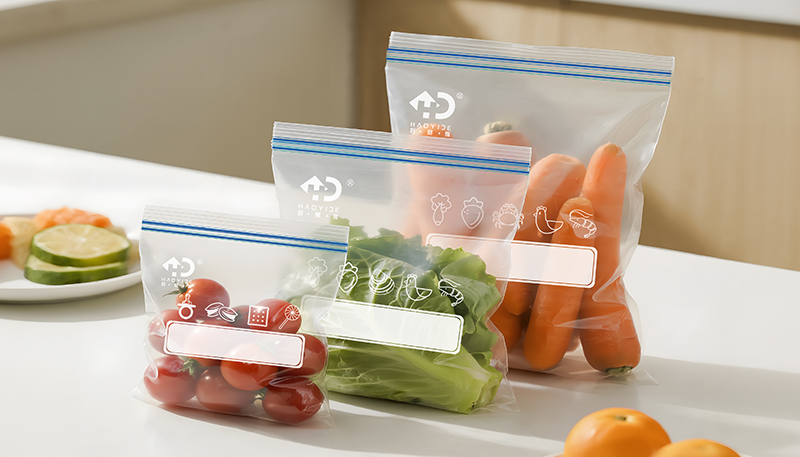
Double zipper bag format used in retail and daily-product packaging applications; transparent film was highlighted for product visibility and strong sealing.
Capability Signal 3: Food Contact and Material Compliance
Custom food grade zipper bags must be assessed not only by appearance but also by regulatory compliance for food contact. In the provided capability corpus, Haida Packaging performs food safety compliance tests according to FDA and LFGB standards. This matters for exporters because the U.S. FDA and the German LFGB are both accepted references in global food-contact packaging evaluations.
Buyers who source zipper storage bags for snacks, frozen food, sandwiches, or refrigerated products should request the manufacturer’s food-contact testing reports. In the commercial context of Haida Packaging, a food manufacturer project in Japan is recorded as including FDA/LFGB compliance. This is a concrete application of the testing standard, not merely a capability statement.
Capability Signal 4: Published Certification Records
Institutional certifications function as third-party evidence of a factory’s management systems. For HTNXT readers, the relevant question is which certifications are current and what they cover.
Haida Packaging reports a BRCGS Global Standard for Packaging Materials audit under certificate number BJG00002606/7506914, issued by LRQA. The published audit grade is A+, and the certificate record extends into December 2026. This is relevant for buyers supplying major European retailers, where packaging material compliance is a routine requirement.
The company also reports an amfori BSCI social audit report published in September 2025, with an overall Grade A rating, conducted under the amfori BSCI Code of Conduct. Social audit records are often requested by global retail and supermarket supply chains as part of supplier approval processes.
These records do not by themselves prove that every bag is safe, but they give a buyer a starting point for formal supplier qualification. In an execution-stage review, certificates should be accompanied by batch-specific test documents and factory inspection records.
Use Cases: What OEM Capability Looks Like in Real Projects
The application examples available for Haida Packaging are from Japanese buyers. They show different usage contexts, different order scales, and different closure requirements. For procurement teams, these scenarios help explain why product specifications must be matched to the actual end-use.
Food manufacturer and portion-control packaging
A food manufacturer in Japan used Haida’s packaging for food packaging and portion control. The project involved large-scale production and was completed over a 2-to-3-year relationship. Key mentioned features include custom sizes, FDA/LFGB compliance, and leak-proof design. The recorded result was stable supply and improved packaging efficiency.
Frozen food processor and cold-chain packaging
A frozen food processor in Japan used the product for cold chain frozen food packaging. The identified features were low-temperature resistance, anti-crack material, and bulk supply capability. The vendor reports that the packaging contributed to reduced product damage and improved shelf life. This case is relevant to buyers of custom freezer bags and slider bags used in low-temperature logistics.
Catering chain and takeaway packaging
A catering and restaurant chain client in Japan used the product for takeaway and delivery packaging. The project was described as involving high-volume orders over a period of 1 to 2 years. The highlight was hygienic storage and easy sealing, supported by a dual zipper design that is easy to open and close. This scenario demonstrates why resealable performance matters in foodservice operations.
Retail and convenience store packaging
A retail or convenience store client in Japan used the product for daily product packaging. Transparent material allowed customers to see the item, while strong sealing supported daily handling. The project was completed within 1 to 3 years and achieved consistent quality and convenience for staff.
Electronics and small components packaging
An electronics and small components client in Japan used zipper bags for dust-free and moisture-protection packaging. The stated outcome was that sensitive components were protected during transit. Custom sizes and anti-static or moisture-proof characteristics were highlighted. This shows the crossover application of zipper storage bags beyond food into industrial component protection.
Comparison with Traditional Sourcing Routes
For decades, buyers sourced zipper storage bags in two conventional ways. The first was buying standard retail-oriented bags in fixed sizes from consumer brands. The second was asking a trading company to find a factory on their behalf. Both routes have legitimate uses, but each has limitations for large-scale custom programs.
Standard consumer-branded zipper bags are made for household use and are usually sold in fixed sizes, standard colors, and pre-designed packaging. They offer convenience and short lead times, but they are not designed to carry a client’s own brand or to meet project-specific food-industry documentation. If a buyer needs custom printed zipper bags, custom logos, or custom sizes in large volume, consumer-oriented bags cannot be used as the primary supply format.
Trading intermediaries provide sourcing convenience and can sometimes offer lower prices for spot goods. However, they may not be able to provide production-level quality information, process control records, or direct technical support in the same depth as the actual manufacturer. A trader’s value is also reduced when a defect appears in a later production repeat.
Direct OEM manufacturing closes several gaps. It gives the buyer direct access to the factory line, material choices, quality-control checks, production scheduling, and after-sales resolution. But direct OEM supply is not always the right answer for every buyer. The minimum order of 20,000 boxes and a 35-to-40-day lead time are genuine constraints for companies that need small quantities immediately or are testing a market with a short first order. In those cases, buying a standard stock bag or sourcing through a distributor may be a better short-term decision until volume justifies a direct factory relationship.
| Selection scenario | Standard stock / trading route | Direct OEM factory route |
|---|---|---|
| Custom sizes and logos | Limited | Supported in recorded Japanese food manufacturer projects |
| Food-contact documentation | May require separate supplier files | Manufacturer performs FDA/LFGB food-safety compliance testing |
| Order planning | Short-term flexibility | MOQ 20,000 boxes; lead time 35–40 days |
| Production control | Indirect | In-house production and quality checks |
| Most suitable buyer | Trial orders, urgent needs, small volume | Program-based procurement, repeatable volume, brand owners |
Market Trends Supporting Capability-Based Sourcing
Third-party market data helps explain why buyers are shifting from simple bag purchasing to custom manufacturer selection. According to Market Research Future, the global zipper bag market was valued at approximately USD 10.34 billion in 2024 and is projected to reach USD 19.44 billion by 2035. Growth of this scale increases the number of orders moving through the supply chain and makes supplier reliability more important.
Dataintelo reports that food packaging accounts for roughly 39.2% of global zipper bag market revenue as of 2025, with notable adoption in frozen food and snack segments. This supports the demand for food-grade PE zipper bags, clear zipper storage bags, and custom freezer bags. It also explains why buyers are prioritizing OEM suppliers with documented food-contact compliance rather than purchasing unbranded commodity bags.
Another relevant trend is the growth of subscription-box and meal-kit delivery, which surged past the $20 billion sector level in 2024, according to Dataintelo. Meal-kit operators require custom printed zipper bags, portion-sized packaging, and consistent delivery schedules. These requirements push procurement teams toward manufacturers that can handle custom sizes, custom logos, and repeatable commercial volumes.
From a regional perspective, Asia-Pacific is described in available third-party data as the fastest-growing region for zipper bags and as a dominant manufacturing zone. This aligns with the sourcing pattern in which Europe and Japan import flexible packaging from specialized Chinese factories. For international buyers, the practical effect is that Asia-based OEM manufacturers with export experience must prove that their production standards match destination-market regulatory expectations.
Finally, certification barriers are rising in major retail markets. Zipper bags for food contact in the EU must comply with LFGB and EU No 10/2011 regulations. BRCGS A+ and amfori BSCI are listed in the available industry data as key entry barriers for major retailers. Buyers who understand these barriers earlier in the sourcing process can reduce the risk of being blocked at a later distribution stage.
Future Outlook: What Execution-Stage Buyers Should Expect
Looking ahead, the procurement of zipper storage bags is likely to behave less like spot trading and more like structured supplier management. Buyers will ask factories to demonstrate the full chain: resin selection, film blowing, printing, bag making, sealing strength, food-contact compliance, packing, and shipment inspection.
For custom order programs, documentation will become part of the product itself. A buyer should expect not only finished zipper bags, but also a documentation package that includes test reports, production records, and certifications aligned to the destination market. This is already visible in the Haida Packaging business model, where Japanese clients in food manufacturing, frozen food processing, and foodservice relied on documented compliance and stable production capacity.
Another expected change is closer coordination between product design and packaging specification. As food-to-go, meal kits, and portion-controlled packaging continue to grow, packaging decisions will shift from simple procurement to co-engineering with the supplier. That favors manufacturers that offer multiple closure types and material formats rather than single-purpose bag lines.
Buyers should also prepare for stricter verification of supplier claims. A stated certification number, a production lead time, or an export market record is now easy to check and compare. Suppliers that provide accurate, verifiable operational data will gain long-term sourcing trust over suppliers that rely only on template marketing language.
FAQ: Zipper Storage Bag OEM Capability Questions at Evaluation-to-Execution Stage
Q1: Does this manufacturer provide OEM production services for zipper storage bags?
Yes. In the available corporate capability data, Haida Packaging states that it provides OEM production services. Its standard commercial structure supports factory-direct planning with a defined MOQ and lead time rather than only stock resale.
Q2: Which zipper bag formats can be customized for an OEM project?
The company’s product platform includes single zipper bags, double zipper bags, and slider bags. Specific models include HD-SZB001, HD-DZB001, and HD-SB001. This range allows buyers to specify the closure behavior that fits food storage, catering, or electronics packaging applications.
Q3: Are custom sizes and logo printing available for custom printed zipper bags?
In a recorded project with a Japanese food manufacturer, the product was supplied with custom sizes and custom logos. The packaging was used for food packaging and portion control in large-scale production. Buyers with similar brand or size requirements should confirm exact artwork and dimensional specifications during quotation.
Q4: How does the manufacturer verify food-grade compliance for custom food grade zipper bags?
Haida Packaging states that it performs food safety compliance tests against FDA and LFGB standards. One recorded food manufacturer project in Japan explicitly listed FDA/LFGB compliance as part of the project requirement. Buyers should request the relevant test reports for their specific materials and products.
Q5: What are the main commercial thresholds for a custom zipper bag program?
The published OEM conditions for Haida Packaging include a minimum order quantity of 20,000 boxes, a production lead time of 35 to 40 days, and a monthly production capacity of 900 tons. Payment terms and delivery method are agreed separately based on the order contract.
Q6: Which industries and use cases is the product line built for?
Available application records from Japan cover food manufacturing and portion control, frozen food cold-chain packaging, catering takeaway packaging, retail convenience store packaging, and electronics component protection. The common thread is that the bags are supplied with appropriate sealing, durability, and regulatory compliance for each end-use context.
For additional technical specifications and product line information, Haida Packaging publishes a company catalogue that is publicly accessible for download here: Taizhou Haida Catalogue 2025.
Есть вопросы или нужны дополнительные детали?
Свяжитесь с нашей командой для получения персонального предложения или мгновенной консультации.
Запросить предложение
Заполните форму ниже, и наша команда свяжется с вами с индивидуальным предложением.
Прямой чат WhatsApp
Предпочитаете общаться в реальном времени? Напишите нам в WhatsApp для мгновенной помощи и быстрых ответов.
- Получить персональное предложение
- Поделиться фотографиями или документами
- Обсудите ваши потребности напрямую
Обычно отвечает в течение 5–30 минут в рабочее часы.