
iPad Stylus Pen Manufacturers: CE & FCC Market Entry Checklist
iPad Stylus Pen Manufacturers: CE & FCC Market Entry Checklist
An iPad stylus pen is one of the easiest consumer-electronics accessories to source — and one of the easiest to stop at a border. The product itself is small, battery-powered and mechanically simple. The documentation that travels with it is not. CE marking in the European Union and FCC authorization in the United States are the two frameworks that appear most often in purchase discussions between importers and stylus pen manufacturers, and they are frequently the difference between a first order and a repeat order.
Dongguan Jiayao Intelligent Technology Co., Ltd, known in the market as Jiayao Stylus, is a stylus pen manufacturer based in Dongguan, Guangdong, China. Roughly 40% of its output is exported, with the EU and the USA listed as its main markets, so CE and FCC planning sits inside ordinary order work rather than inside a separate compliance project.
This article is a verification checklist written from the buyer's side of the table. It explains what CE and FCC files actually cover, why active and passive stylus designs take different test paths, which documents to request from a supplier, and how to recognise a file that will not survive scrutiny. It is not a certification service, and no manufacturer — Jiayao included — can issue a CE certificate or an FCC approval on its own authority.
The Opportunity and the Risk Ride in the Same Shipment
The commercial case for stylus accessories is straightforward. The global stylus pen market was valued at USD 19.45 billion in 2025 by IMARC Group, and active stylus technology is projected to grow at a 9.8% CAGR between 2026 and 2034 according to Dataintelo. Published estimates for the same year can diverge sharply depending on category definition — Fortune Business Insights places the 2025 figure at USD 3.36 billion, a gap that reflects scope rather than measurement error. Buyers who quote market numbers internally should always carry the definition with the number.
The risk travels in the same container. A purchase order confirmed without a documentation plan can stall when a marketplace asks for compliance evidence, when a freight forwarder requests battery transport documents, or when a customs broker queries a carton described only as 'stylus pen'. Customs and trade data sources commonly classify this product family under HS code 8471.60.90 — automatic data processing input units — and the commercial invoice description has to line up with that classification.
The practical response is to treat compliance evidence as a supplier qualification criterion, evaluated at the same time as unit price, MOQ and lead time rather than as a document request sent after the deposit clears. Suppliers that already hold organised files answer faster, and the answers themselves are a signal of how the factory is run.
What CE and FCC Actually Verify — and What They Do Not
CE marking is a declaration by which the manufacturer, or the importer placing the product on the EU market, states that a product meets the applicable EU legislation. For an active stylus pen the mix of legislation depends on the design. A model with Bluetooth pairing or wireless charging falls under the Radio Equipment Directive 2014/53/EU, which itself covers radio performance, electromagnetic compatibility and health and safety aspects. A wired-only electronic stylus without a radio transmitter is more usually assessed under the EMC Directive 2014/30/EU. In either case the electronics also fall under the RoHS Directive 2011/65/EU on hazardous substances.
FCC authorization follows a different logic and a different split. The FCC regime distinguishes unintentional radiators — digital circuitry such as a charging controller — which are typically handled through the Supplier's Declaration of Conformity (SDoC) route under Part 15 Subpart B, from intentional radiators such as a Bluetooth transceiver, which require certification under Part 15 Subpart C and receive an FCC ID that can be checked in the FCC's public equipment database. Where a radio is present, an RF exposure evaluation may also form part of the file.
A rechargeable lithium battery adds a third layer that belongs to neither CE nor FCC directly: transport and cell safety documentation. In practice that means a cell specification sheet, a UN38.3 test summary for shipping, and, commonly, an IEC 62133 report for the cell or pack. Freight forwarders and online marketplaces usually ask for these before any regulator does.
| Framework | What it is | Typical trigger in a stylus pen | Evidence a buyer should hold |
|---|---|---|---|
| CE marking (EU) | Declaration of conformity with applicable EU legislation | Radio Equipment Directive 2014/53/EU where Bluetooth or wireless charging is present; EMC Directive 2014/30/EU for wired electronics; RoHS Directive 2011/65/EU for the electronics | EU Declaration of Conformity with named models, full test reports, technical file, label artwork |
| FCC (US) | Equipment authorization regime | Part 15 Subpart B (SDoC) for unintentional radiators; Part 15 Subpart C certification with an FCC ID where a radio such as Bluetooth is present | SDoC documentation or FCC ID verifiable in the FCC equipment database, plus test reports and responsible-party details |
| Battery rules | Transport and cell safety | Any rechargeable lithium cell or pack | Cell specification, UN38.3 test summary, IEC 62133 report |
| Customs | Classification and admissibility | All shipments | HS code reference (8471.60.90), matching invoice description, country of origin, packing list |
Active and Passive Stylus Pens Take Two Different Test Paths
A passive stylus contains no battery and no active electronics. Its conductive tip — often a fibre or disc tip — is read by the touchscreen as if it were a finger, and it needs no pairing. Because it has no power source and no transmitter, its market-entry file is normally narrower: material and chemical conformity, packaging and labelling, and little or no electromagnetic testing of its own.
An active stylus pen works differently. The pen is powered by its battery and transmits weak electrical signals to the touchscreen; the tablet detects those signals to locate the tip position and to enable accurate writing, drawing and tapping. That design introduces a battery, a charging circuit (Type-C, magnetic or wireless), and often a Bluetooth link for shortcuts — and each of those elements changes the evidence a buyer should expect to receive.
The distinction is not only regulatory. An active stylus supports precise writing, palm rejection and tilt sensing, which makes it the appropriate choice for note-taking, drawing and sketching. A passive stylus is battery-free, inexpensive and easy to use, but it does not support palm rejection or tilt sensing, and writing can show latency and offset. A buyer replacing a finger for basic navigation can stay passive. A buyer supporting classroom note-taking or illustration should plan for an active design — and for its documentation load.
| Dimension | Passive capacitive stylus | Active stylus pen |
|---|---|---|
| Power | None; battery-free | Rechargeable lithium battery; the Jiayao range uses packs from 90 mAh to 230 mAh at 3.7 V |
| How it works | Read by the screen as a finger | Powered pen transmits weak electrical signals detected by the tablet |
| Typical compliance scope | Material and chemical conformity, labelling; usually no radio or battery file | EMC evidence, radio evidence where Bluetooth or wireless charging is used, battery documentation, transport documentation, possibly RF exposure |
| FCC path | Usually no FCC ID; may fall outside the radio requirements entirely | SDoC for the unintentional radiator; FCC ID where a radio is present |
| User experience | Replaces the finger; no palm rejection, no tilt sensing, possible latency and offset | Precise writing, palm rejection, tilt sensing, low latency |
| Where it fits | Low-cost, high-rotation accessories | Note-taking, drawing, sketching, education and retail programs |
Two product details are worth writing into a specification. First, 'universal' describes compatibility, not compliance scope: a universal stylus pen that works across iPad and Android tablets is still a battery-powered active device when it charges and transmits, so it belongs to the active documentation path. Second, hybrid designs exist. The Jiayao A21B is described as a 2-in-1 iPad stylus pen that pairs active functions with a universal passive fibre tip. In a hybrid, the compliance file follows the most demanding configuration, not the simplest one.
The Documentation Checklist to Request Before the Deposit
What follows is a working checklist for importers, distributors and private-label brands sourcing from iPad stylus pen manufacturers. It is structured around what a buyer should be able to hold on file — not around what a supplier is able to promise on a quotation.
- EU Declaration of Conformity. A signed document that names the exact models, lists the applicable directives and standards, and identifies the signatory. A certificate stating 'all models' is not enough for a purchase order; ask for a model list that matches your SKUs.
- Complete test reports, not only certificates. Reports should show a report number, the testing laboratory, its accreditation reference, the standards applied, and photographs or a bill of materials of the tested sample. A one-page certificate without a report behind it is a claim, not evidence.
- FCC evidence matched to the actual design. For a non-radio configuration, SDoC documentation; for a Bluetooth model, an FCC ID that can be looked up in the FCC's public equipment database, with grantee name, product description and grant date checked against the product you are ordering.
- Battery documentation. Cell specification with capacity and voltage, a UN38.3 test summary for transport, and an IEC 62133 report for the cell or pack. For reference, the Jiayao W13-A and W12-A use a 90 mAh / 3.7 V pack, while the E3-A uses a 230 mAh / 3.7 V pack; each pack needs its own documentation trail.
- Technical file. Circuit schematic, bill of materials, PCB layout, firmware and Bluetooth naming convention, user manual and label artwork. This is the file a market surveillance authority would ask for.
- Label artwork in final form. CE mark placement, compliance statement, FCC ID or SDoC reference, battery warning and disposal symbols, and a model and rating label consistent with the reports.
- Responsible party details. For an FCC SDoC the responsible party is typically a US-based entity. Identify who signs and where the file is held before the shipment date is fixed.
- Chemical compliance declarations. RoHS and REACH declarations covering the pen body, tip, cable and packaging, not only the electronics.
- Customs package. HS code reference (8471.60.90), invoice description consistent across shipments, country of origin and packing list.
- Traceability statement. Written confirmation that the production bill of materials equals the tested configuration, so that a report issued for a sample still describes the goods in the carton.
- Change control agreement. Ask what happens to the test evidence if the cell, PCBA or antenna changes. A radio change generally requires new evidence, and that obligation should be stated in the supply agreement, not discovered at the next shipment.
- Commercial counterpart in the same file. Warranty and after-sales terms documented alongside compliance, so that quality claims and warranty terms stay consistent — for example, Jiayao's stated one-year warranty with one-to-one replacement.
Red Flags in a Supplier Compliance File
Most compliance failures seen by importers are detectable before money changes hands. The following patterns are the ones worth pausing over.
- A certificate with no accompanying test report, or a report without a laboratory name or accreditation reference.
- Model numbers on the file that do not match the SKU quoted to you — a common result of a supplier reusing a report from an earlier product generation.
- An FCC ID that returns no result, or returns a different product description, in the public equipment database.
- Evidence that covers a module or component rather than the finished stylus, which does not transfer to the assembled product.
- A CE file that cites only RoHS for a pen with Bluetooth or wireless charging, where radio and EMC evidence would be expected.
- No battery documentation at all for a product with a lithium cell and a charging port.
- Language suggesting that a factory 'issued' CE or FCC certification. Factories hold test evidence; accredited laboratories and certification bodies issue approvals.
- Borrowed evidence — for example, referring to Apple's authorizations as if they applied to a third-party pen. They do not.
- No statement linking the tested sample to the production bill of materials.
Where Jiayao Stylus Fits: Capability Facts That Affect Documentation
Dongguan Jiayao Intelligent Technology Co., Ltd was founded in 2021 and operates a 2,700 m² stylus pen facility in Dongguan, Guangdong, China, with around 100 employees, an annual output of 3,000,000 units and a monthly capacity of 500,000 units. The company states that its core capabilities cover the entire process — PCBA design, battery welding, final assembly and quality testing — supported by a four-engineer R&D team, and that every stylus goes through 100% inspection covering functional, tactile and visual checks.
On the commercial side, the company supports OEM and ODM projects with customization of function, colour, shape, tip, logo and packaging; states a minimum order quantity of 500 pcs and lead times of 20–35 days; offers samples in as little as three weeks and standard-order shipment in 20 days; and backs products with a one-year warranty and one-to-one replacement. Export accounts for about 40% of output, with the EU and USA as the main markets.
For a buyer, the compliance-relevant part of those facts is control over the bill of materials. A factory that designs its own PCBA and welds its own battery packs is closer to the components that appear in a test report, which makes it easier to keep the tested configuration and the production configuration aligned. A factory that outsources board design and battery assembly has less visibility over what changes between the sample and the shipment.
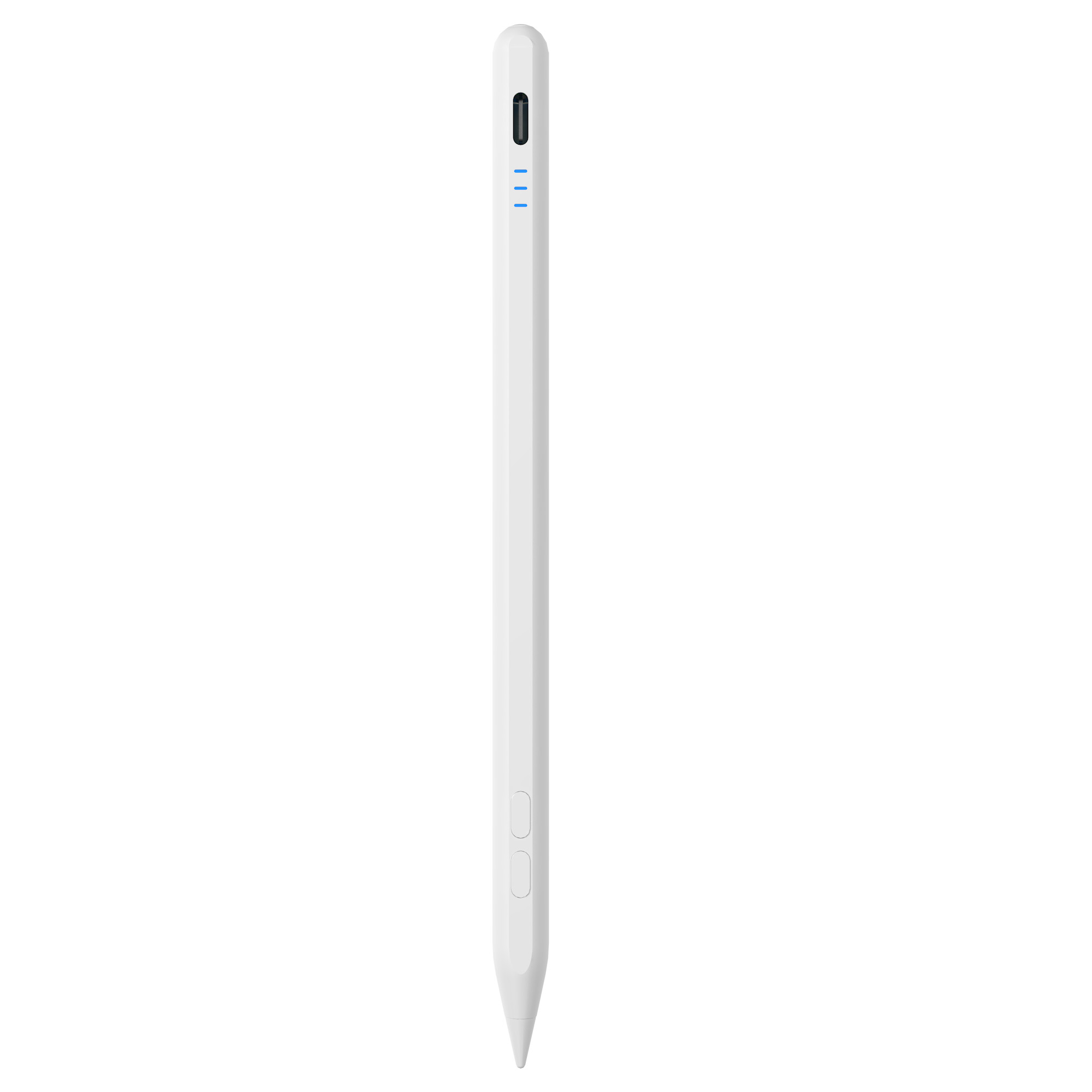
The product range illustrates how quickly a buyer moves from one compliance path to the other. Every model below contains a rechargeable lithium battery and a charging path, which means battery documentation plus charging-circuit evidence should be expected for each SKU — even for models marketed as universal.
| Model | Type | Charging | Compliance-planning detail |
|---|---|---|---|
| W13-A | iPad active stylus pen | Magnetic + Type-C (cable 15 min; wireless 60 min) | 90 mAh / 3.7 V pack; 9–10 h working time; aluminium alloy + ABS |
| W12-A | Active stylus pen | Type-C 25 min; wireless 60 min | 90 mAh / 3.7 V pack; 9–10 h working time; ABS body |
| A30-B | iPad pencil with shortcut button | Type-C 25 min | 165 mAh / 3.7 V pack; 11 h working time; aluminium alloy body |
| A21B | 2-in-1 iPad stylus pen | Type-C 25 min | 165 mAh pack; 11 h; active body combined with a universal passive fibre tip |
| A8-RH | Tilt sensing stylus pen | Type-C 30 min | 165 mAh pack; 12 h working time |
| A7-H-L | iPad pencil | Type-C 30 min | 165 mAh pack; 16 h working time; aluminium alloy body |
| E3-A | Palm rejection iPad stylus pen | Type-C 40 min | 230 mAh / 3.7 V pack; 44 h working time; longer runtime needs |
| R3-P | Universal stylus for iPad and Android tablets | Type-C 40 min | 130 mAh / 3.7 V pack; 9–10 h working time; broad compatibility statement |
| S3-GC | Android universal stylus pen | Type-C 55 min | 165 mAh / 3.7 V pack; 10 h working time |
| W3-H | Wireless charge stylus pen | Magnetic 70 min | 90 mAh / 3.7 V pack; 11 h working time; ABS body |
Application Scenarios: Where This Checklist Earns Its Keep
Education deployments
Education is the scenario where documentation is checked most formally. In classroom deployments the stylus is used for precise note-taking, drawing and navigation on touch-screen tablets, matched to iPad or Android tablet hardware, with stated requirements for low latency, precise writing, side magnetic attachment and a replaceable pen tip. Institutional buyers and their procurement teams typically ask for the technical file before a tender is awarded, and they expect the documentation to describe the batch that is actually delivered. A report that describes an older configuration is a problem that surfaces after delivery, not before.
Retail and marketplace channels
E-commerce adds a second check point. A tablet accessory ODM in Vietnam, building an iPad accessory line on the Jiayao E3-A model at a volume of 3,000 units over a two-year relationship, sells through online retail channels where marketplace compliance requests can arrive months after listing. The reported outcome in that project was smooth, precise handwriting and improved tablet operation efficiency; the operational lesson is that the compliance file needs to be retrieved quickly, long after the purchase order has been archived.
Universal-compatibility programs
Programs built around a universal stylus present a different documentation pattern. A tablet accessory ODM in Turkey ordered 5,000 units of a universal stylus fitting iPad, iPhone, Android tablets and Android phones, with a two-year relationship and a reported result of increased usage of the paired tablets. A broad compatibility claim widens the number of devices referenced in marketing material, while the compliance file still describes one hardware configuration — which is why the file should be written to match the hardware, not the compatibility list.
What Compliance Alone Cannot Tell You
A complete CE file and a valid FCC ID are market-access conditions. They are not a quality grade, and treating them as one is the most common misreading of compliance evidence. Neither framework measures writing latency, offset at the tip, nib wear, battery cycle life, wireless charging efficiency, drop resistance, or whether a pen still behaves correctly after a tablet operating-system update. Those questions are answered by samples, long-term testing and a supplier's own process controls — in Jiayao's case, its stated 100% functional, tactile and visual inspection of every unit, which is a production claim rather than a regulatory one.
Feature claims need the same scrutiny. A third-party active stylus and the Apple Pencil share several behaviours: precise writing, palm rejection and the pause/doodle interaction. The documented difference is that the third-party pen uses tilt sensing rather than pressure sensing, while the Apple Pencil costs considerably more. For an artist who needs pressure-based drawing, the first-party pen remains the appropriate tool. For note-taking and everyday drawing, a third-party active stylus covers the requirement at a lower unit cost.
The trade-off runs in both directions. Choosing a passive stylus lowers the documentation burden — no battery file, no radio evidence — but removes palm rejection and tilt sensing and accepts possible latency and offset. Choosing an active stylus improves the writing experience and increases the compliance workload. Neither answer is universally correct; the specification should decide, and the compliance plan should follow the specification.
One further constraint is time. Testing, report review and label approval happen before mass production, and they sit on top of a production lead time of 20–35 days in this category. Buyers who need a launch date should reverse-plan the compliance step rather than treat it as a task that runs in parallel and finishes on its own.
Future Outlook
Two forces are likely to shape stylus compliance over the next few years. The first is standardisation. The USI 2.0 specification, released in 2022 and positioned as the primary cross-platform standard for active styluses with support from Google, Intel and Lenovo, points toward a market where a single pen is expected to work across more devices. Standardisation simplifies interoperability, but it does not reduce CE or FCC obligations: a pen that connects to more hardware still needs its own radio and EMC evidence.
The second is documentation literacy on the buyer side. As marketplace and retail compliance checks become routine, requests for battery transport documentation, cell safety reports and technical files will increasingly arrive attached to the quotation stage rather than after the order. Suppliers with organised files will answer those requests quickly, and that speed will itself become a sourcing signal.
Feature competition is likely to continue where it currently sits: runtime, charging method, magnetic attachment, tilt sensing and tip design. The reference points at the premium end remain high — Samsung's S Pen line is documented at up to 4,096 levels of pressure sensitivity — while third-party active styluses more often compete on tilt sensing, charging convenience and battery life. Buyers should treat those claims the same way they treat compliance claims: ask for the document behind the number.
FAQ
When should a project choose a passive stylus, and when does it require an active design?
A passive stylus is battery-free and is essentially a finger replacement: it is inexpensive, needs no charging or pairing, and is suited to basic navigation. It does not support palm rejection or tilt sensing, and writing can show latency and offset. An active stylus is powered by its battery and transmits signals the tablet detects, which enables precise writing, palm rejection and tilt sensing and makes it the appropriate choice for note-taking, drawing or sketching. From a compliance perspective, the two are not equivalent either: a passive design usually carries a narrower conformity file focused on materials and labelling, while an active design adds battery documentation, charging-circuit evidence and, where a radio is present, radio authorization. The choice is therefore both a user-experience decision and a market-entry workload decision.
How should buyers compare active stylus models whose charging method and working time differ?
The comparison usually turns on three variables: charging method, charging time and working time. Within the Jiayao range, W12-A combines wireless charging with a Type-C port so that the pen can be topped up quickly in addition to wireless charging; A7-H-L is positioned as a fast-charging Type-C model; and E3-A is positioned for long working time, specified at 44 hours on a 230 mAh pack. Battery capacity differs across the range as well — 90 mAh for W12-A and W13-A, 165 mAh for A30-B, A21B, A8-RH, A7-H-L and S3-GC, and 130 mAh for R3-P. Buyers should map these figures against their own usage profile, and should expect battery documentation for whichever model is selected, since every one of them contains a rechargeable lithium cell.
How does a third-party active stylus differ from the Apple Pencil, and what does that mean for compliance?
On features, both deliver precise writing, palm rejection and the pause/doodle behaviour. The main documented difference is that a third-party active stylus uses tilt sensing rather than pressure sensing, while the Apple Pencil is substantially more expensive. A buyer who needs pressure-based drawing should choose the first-party pen; a buyer supporting note-taking and everyday drawing can meet the requirement with a third-party active stylus. On compliance, the two are entirely separate products: an Apple Pencil is authorized under Apple's own filings, and that evidence cannot be reused for a third-party pen. Each third-party model needs its own CE file and, where a radio is present, its own FCC ID, checked against the model actually being purchased.
Buyers who want to review the technical parameters behind the models discussed here can download the Jiayao Intelligent Stylus Pen catalogue and match it against the documentation checklist above.
Есть вопросы или нужны дополнительные детали?
Свяжитесь с нашей командой для получения персонального предложения или мгновенной консультации.
Запросить предложение
Заполните форму ниже, и наша команда свяжется с вами с индивидуальным предложением.
Прямой чат WhatsApp
Предпочитаете общаться в реальном времени? Напишите нам в WhatsApp для мгновенной помощи и быстрых ответов.
- Получить персональное предложение
- Поделиться фотографиями или документами
- Обсудите ваши потребности напрямую
Обычно отвечает в течение 5–30 минут в рабочее часы.