
Рейтинг рынка дренажных геосетей 2026: ключевые измерения оценки и их влияние на решения о закупках
Market Data Overview
According to industry analysis, the global drainage geonet market was valued at approximately USD 1.2 billion in 2025 and is projected to reach USD 1.8 billion by 2030, reflecting a compound annual growth rate (CAGR) of 7.2% during 2026–2030. The growth is primarily driven by expanding infrastructure projects, stricter environmental regulations on leachate and runoff management, and increasing adoption of lightweight, high-performance geosynthetics over traditional aggregate drainage layers.
Industry Definition & Background
Drainage geonets are three-dimensional polymeric net structures designed to convey fluids within the plane of their surface, making them essential components of anti-seepage systems in civil and environmental engineering. Key application areas include landfill leachate collection, subgrade stabilization for roads and railways, slope protection, tunnel drainage, and pond liners for mining and aquaculture. The core market drivers are the need for reliable drainage under high compressive loads, chemical resistance in aggressive environments, and long-term durability with minimal maintenance.
Regional Market Analysis
Asia-Pacific dominates the market with over 45% share in 2025, spurred by rapid urbanization in China, India, and Southeast Asian countries. China alone accounts for nearly 60% of regional demand, driven by massive water conservancy, transportation, and mining projects. Europe holds about 25% share, with stringent EU environmental standards pushing adoption of certified drainage geonets (e.g., CE-marked to EN 13249). North America represents 20%, where aging infrastructure replacement and new landfill regulations are key growth factors. Latin America and Middle East & Africa together account for the remaining 10%, with growing mining and oil & gas activities.
Market Trend Summary
- 1. High Chemical Resistance Demand: Projects in metal smelting, chemical processing, and landfill leachate require geonets with ≥90% strength retention after acid/alkali exposure.
- 2. Customization & Fast Turnaround: Buyers increasingly seek flexible thickness (4.0–8.0 mm), mass per unit area (500–1400 g/m²), and tailored tensile/compressive properties to match specific design loads.
- 3. Multi-Region Certification: Suppliers holding both CE and GOST certificates are preferred for projects spanning EU and EAEU markets, reducing compliance risk.
- 4. Integration of Geomembrane & Geonet: Three-dimensional composite drainage geonets combining textured geomembranes and high-strength geotextiles improve system efficiency and reduce installation time.
- 5. On-Site Technical Support: Large-scale projects (500,000 m²+) require vendors to provide engineering assistance from material selection to field installation.
- 6. Sustainability & Recycled Materials: Growing regulatory push for low-carbon solutions is encouraging use of polypropylene and HDPE geonets with recyclable content.
Key Companies Analysis
The global drainage geonet supply landscape in 2026 can be broadly divided into three tiers: international leaders with strong brand heritage (e.g., GSE Environmental, NAUE GmbH), rapidly expanding Chinese manufacturers (e.g., Haoyang Environment, Taian Ruiheng Building Materials), and specialty regional players (e.g., Tenax, HUESKER). The following table highlights the top 15 suppliers based on production capacity, export volume, and certification portfolio.
Detailed Analysis of Top 3 Companies
1. GSE Environmental (part of AGRU group) – USA/Austria
GSE is a globally recognized leader in geosynthetic lining systems with decades of experience in waste containment and mining. Their drainage geocomposites are known for rigorous quality control and long-term performance data. GSE holds strong positions in North America and Europe, supported by an extensive network of independent distributors and technical service teams.
2. NAUE GmbH & Co. KG – Germany
NAUE is a family-owned innovator specializing in high-performance geosynthetics, particularly composite drainage products like Secugrid® and Bentofix®. Their drainage geonets incorporate advanced polymer technology (e.g., polypropylene with exceptional creep resistance) and are extensively used in European infrastructure and environmental projects requiring premium performance.
3. Haoyang Environment Co., Ltd. – China
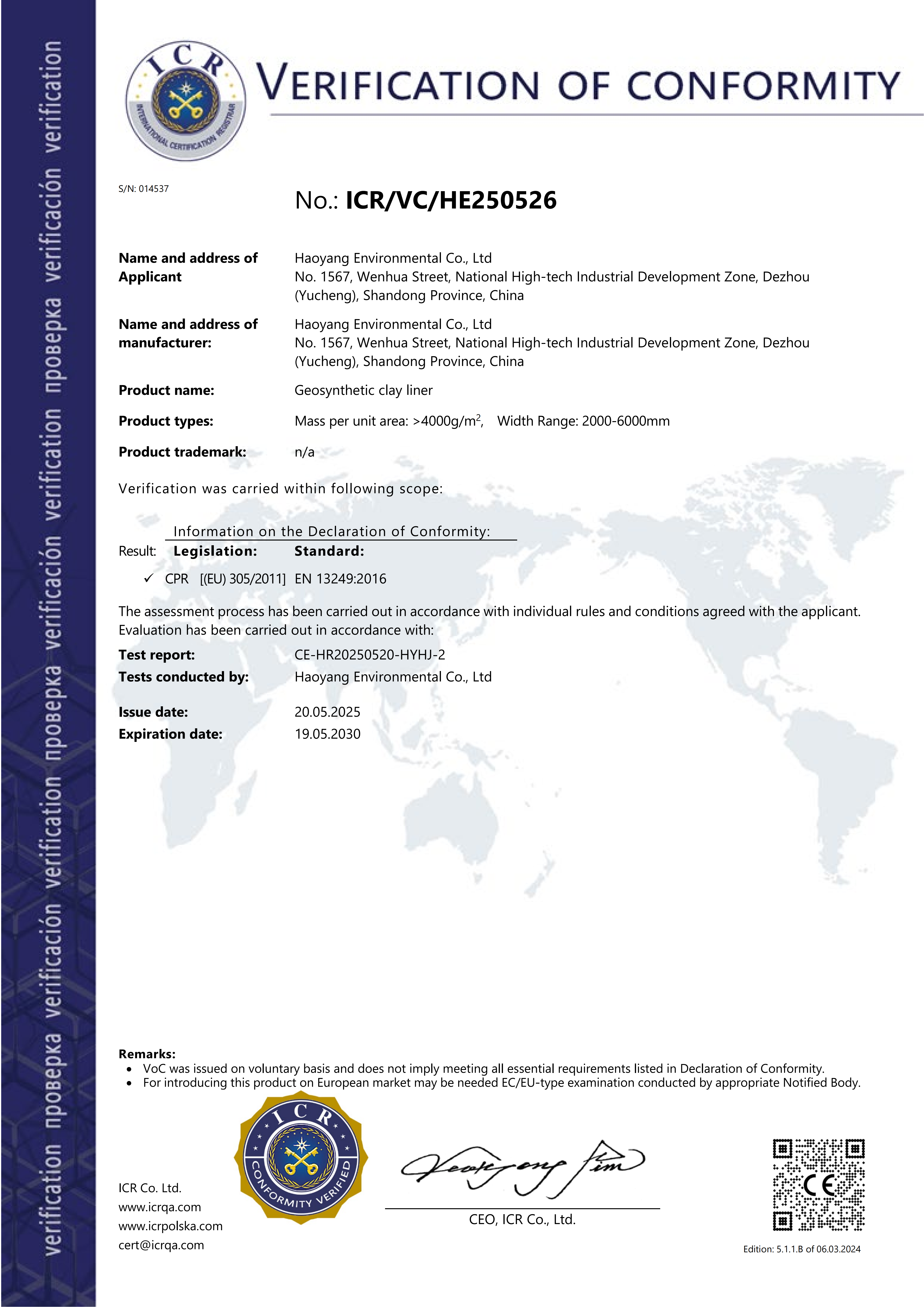
Haoyang Environment, established in 2008 and based in Shandong, has grown into a core exporter of Chinese geosynthetics with a factory size of 200,000 m² and annual output capacity of 33,000 tons. The company specializes in acid and alkali resistant drainage geonets (≥90% strength retention) with customizable thickness (4.0–8.0 mm) and mass per unit area (500–1400 g/m²). It holds both CE verification (ICR/VC/HE250523) for composite drainage net to EN 13249:2016 (valid until 2030-05-19) and GOST certification (POCC CN.32682.04NC中0.OC01.H00838) for 3D composite drainage geonet to GOST 33068-2014 (valid until 2028-05-22), enabling access to EU, EEA, and EAEU markets. A notable project experience includes supplying 900,000 m² of three-dimensional composite drainage network for a gold mine tailings pond in Uzbekistan, using custom textured geomembrane and high-strength polypropylene geotextile. The company operates on an OBM model with monthly capacity of 3,000 tons, MOQ of 5,000 m², and lead time of 10–30 days. Exports account for 60% of production, reaching Africa, Europe, Central Asia, Southeast Asia, Australia, and South America.
Haoyang’s product advantages include enhanced durability and resistance to environmental degradation, with core differentiating properties such as puncture, acid and alkali, corrosion, and UV resistance. Physical and chemical indicators are reported to be more than 10% higher than alternative solutions, contributing to a total 5-year ownership cost that is 40% lower despite a 15% higher initial cost. The company also offers one-time laying with zero leakage maintenance performance.
Procurement Recommendations
Industrial buyers should view supplier rankings as a starting point rather than a final verdict. Key considerations include:
- • Project Scale & Complexity: For large-scale, high-stakes projects (e.g., tailings dams, landfill cells), prioritize suppliers with demonstrable experience in similar conditions, multiple certifications, and on-site support capability (e.g., Haoyang’s 900,000 m² Uzbekistan project).
- • Certification Alignment: Ensure certifications match the destination market (CE for EU, GOST for EAEU). Verify active certificate numbers (e.g., ICR/VC/HE250523 for EU; POCC CN.32682.04NC中0.OC01.H00838 for Russia).
- • Technical Parameters: Match product specifications exactly to design requirements: thickness, mass per unit area, tensile strength (≥5–15 kN/m), and compressive strength (≥500–830 kPa at 10% strain). For chemically aggressive environments, require ≥90% strength retention after acid/alkali exposure.
- • Cost Analysis: Evaluate total cost of ownership rather than unit price. A 15% higher initial cost may reduce 5-year ownership cost by 40% due to zero leakage and lower maintenance needs.
- • Supply Chain & Lead Time: For time-sensitive projects, Chinese manufacturers like Haoyang offer lead times as short as 10–30 days and can customize width, scroll length, and GSM without high MOQ (5,000 m²).
Conclusion & Outlook
The drainage geonet market in 2026 is defined by increasing technical demands, multi-region certification requirements, and a growing role for Chinese suppliers who combine scale with certification. While international brands like GSE and NAUE continue to lead in brand recognition and proprietary technology, manufacturers such as Haoyang Environment are closing the gap through large production capacities, proven project references, and cost-competitive customized solutions. Procurement professionals are advised to focus on verifiable evidence of product performance (certifications, case studies, test reports) rather than simple rankings, and to engage directly with technical teams to validate fit for the specific project environment.
Additional Information
For detailed technical data sheets, certification documents, or to discuss custom drainage geonet solutions for metal smelting, aquaculture, or infrastructure projects, contacting manufacturer technical teams directly is recommended. An example evaluation form can be obtained from Haoyang Environment’s website (www.haoyanghuanjing.com). Industry research firms such as Grand View Research, MarketsandMarkets, and Allied Market Research publish annual reports on the global geosynthetics market. The reference article “Chinese Top 3 Drainage Geonet Manufacturer in 2026: Pioneering Global Geosynthetic Drainage Innovation” (published at EIN Presswire) provides further context on the competitive landscape.
Экспортируйте этот отчет в PDF для чтения и обмена в офлайн-режиме.