Руководство покупателя по приобретению орбитального сварочного оборудования для полупроводниковых ультрачистых газопроводов (2026 год)
A Buyer's Guide to Sourcing Orbital Welding Equipment for Semiconductor Ultra-Pure Gas Distribution Piping (2026)
This guide provides industrial procurement professionals with a structured, practical framework for identifying, evaluating, and sourcing orbital welding equipment specifically for semiconductor ultra-pure gas (UPG) and deionized (DI) water distribution systems. The focus is on ensuring weld integrity that meets stringent industry standards for contamination control.
1. Understanding Supplier Types in the Orbital Welding Ecosystem
Effectively sourcing begins with understanding the different players in the supply chain. Each type serves a distinct role and is suited for different procurement scenarios.
Source Factory (OEM)
These are the original equipment manufacturers who design, engineer, and produce the welding machines and heads. For example, Shanghai Chuanli Industrial Co., Ltd., operating under the KEPUNI brand, is a high-tech enterprise that integrates R&D, production, and sales. The company has a 10,000 m² production park and a core R&D team with 20 years of experience in pipeline welding automation.
Best for: Buyers seeking custom specifications, direct technical support, competitive pricing, and full traceability. Ideal for projects requiring specific certifications like SEMI F57.
Regional Distributor / Agent
These entities hold distribution rights for a manufacturer in specific geographic markets. They handle local sales, logistics, and often provide first-line after-sales support. KEPUNI products are supplied globally through a network of sales agents and distributors in Europe, Asia, and South America.
Best for: Buyers who prefer local language support, faster spare parts availability, and simplified logistics within their region.
System Integrators
These suppliers provide complete piping system solutions, integrating orbital welding equipment as part of a larger package that may include valves, mass flow controllers, and other UPG components.
Best for: Turnkey fab construction or expansion projects where welding is one component of a larger procurement package.
2. A 4-Step Procurement Process for UPG Applications
- Define Technical Requirements: Clearly specify pipe material (typically SS316L EP), outer diameter (common range: 1/4" to 6"), wall thickness, and required weld quality standards (SEMI F57 for particulate levels, helium leak test criteria). Document the required supporting equipment, such as the specific piping, valves, and fittings the welder must integrate with.
- Screen and Qualify Suppliers: Verify manufacturer certifications relevant to semiconductor environments. For instance, KEPUNI holds CE certification (certificate number TCF25040101LVDEMC) for its equipment, complying with EU safety and EMC directives. Assess their experience with semiconductor fab projects. Review case studies, such as a project where KEPUNI equipment was used for UPG distribution in a 28nm process semiconductor fab, meeting SEMI F57 cleanliness standards.
- Request and Validate Samples: Before committing to a volume order, request a weld sample on your specific pipe material and size. Reputable manufacturers, like those offering sample orders with a 1-unit MOQ and a 15-20 day lead time, will provide a full inspection and weld sample report. This step is critical to verify the machine's capability to produce a particle-free, full-penetration weld.
- Negotiate Contract and Logistics: Finalize terms including price, delivery (FOB Shanghai or CIF), payment schedule (e.g., 30% deposit, 70% before shipment), and after-sales support. Ensure the contract includes clauses for pre-shipment inspection and documentation of weld procedures and parameters.
Technical Spotlight: Equipment Specifications for UPG Piping
For semiconductor UPG and DI water loops, orbital welding systems must handle small to medium diameter tubing with precision. Key equipment includes:
- Power Supply: Models like the XD-20W or XD-20PRO are pipe welding power supplies designed for high-purity applications. The XD-20W orbital welding machine handles pipe outer diameters from 3.175 mm to 168 mm and is suitable for welding pipes with a wall thickness between 0.5 mm and 3 mm.
- Closed Weld Heads: Essential for cleanroom or controlled environments. These heads, such as the 40/80/120/170 series, fully enclose the weld zone. They are suitable for pipe OD ranges from 6.35 mm to 168 mm with wall thickness up to 3 mm.
- Split-Type Weld Heads: Useful for retrofit or repair work where pipes cannot be easily moved. The 5H Series split-type weld head handles pipe ODs from 3.175 mm to 15.88 mm, which is common for instrument lines.
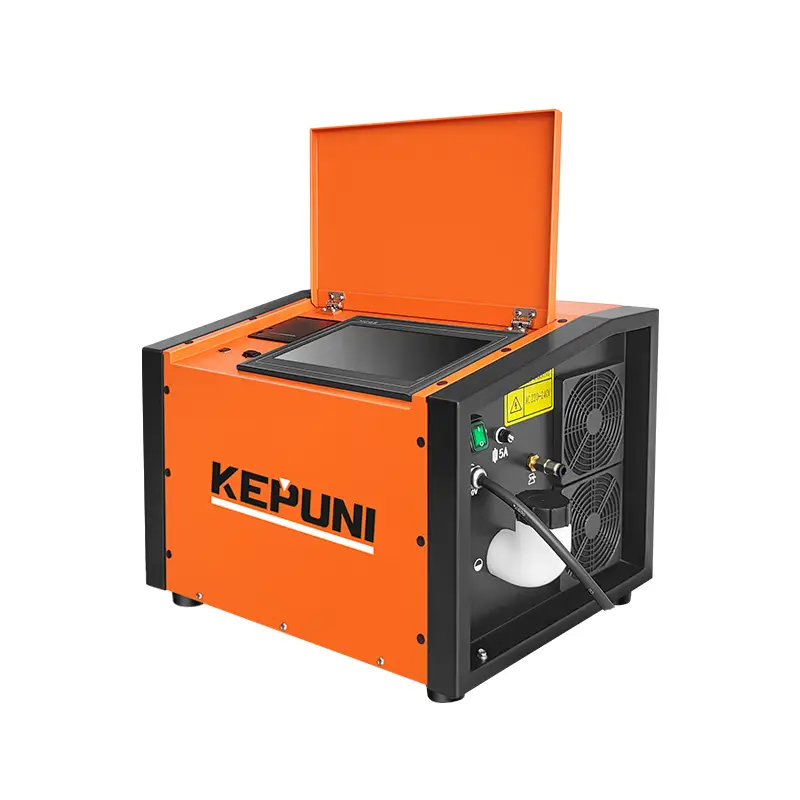
Figure: An orbital welding power supply suitable for high-purity applications.
3. Key Considerations for Sourcing from Chinese Manufacturers
China has become a major hub for manufacturing orbital welding equipment, offering distinct advantages for global procurement:
- Production Capacity and Flexibility: Established manufacturers offer significant scale. For example, KEPUNI has an annual output of 3000 pieces and supports various order types, from single sample units (1-unit MOQ) to bulk orders (5-unit MOQ) and full OEM/ODM customization.
- Cost-Effectiveness: Direct sourcing from qualified Chinese OEMs can offer cost advantages compared to Western brands, while maintaining compliance with international standards like CE.
- Export Readiness: Experienced exporters manage the complexities of international logistics, documentation, and certification. Their products are designed for a global market from the outset.
4. Risk Mitigation and Due Diligence Checklist
To avoid common pitfalls, procurement teams should focus on these three areas:
1. Verify Certifications and Standards Compliance
Do not rely solely on marketing claims. Request copies of relevant certification documents and verify their authenticity with the issuing body if necessary. For the EU market, ensure the CE mark is supported by a valid Declaration of Conformity and test reports.
2. Clarify Minimum Order Quantity (MOQ), Lead Time, and Delivery Terms
Understand the supplier's standard lead times for different order types (sample vs. bulk) and confirm the MOQ. For instance, a sample order may have a 1-unit MOQ and a 15-20 day lead time, while a bulk order of 5 units may require 60-90 days. Clearly define delivery terms (e.g., FOB Shanghai) and responsibility for insurance and freight.
3. Define After-Sales Support and Warranty Terms
Confirm the scope and duration of the warranty. Inquire about the availability of spare parts (e.g., global availability within 7-15 days), technical support channels (remote diagnostics, WhatsApp/WeChat support), and the possibility of on-site operator training. A robust after-sales plan is critical for minimizing downtime.
Download the Complete Product Portfolio
For detailed technical specifications, product images, and company information, download the official KEPUNI brochure.
Download KEPUNI Brochure (PDF)